

What if your city allows backyard chickens, but your HOA says no? Texas HOA chicken rules can’t be settled with a quick city-code search. Texas law limits some municipal bans, but private HOA restrictions may still apply. If you rent, you’ll also need your landlord’s written permission.
Rules may be spread across local ordinances, HOA documents, and lease terms. Before you invest in a coop or bring chickens home, identify which requirements apply to your address and who must approve your plans.
This guide explains how to check the rules, distinguish landlord approval from HOA approval, and make a clear, documented request that addresses coop placement, sanitation, and noise. Once you know what’s permitted, you can plan a durable coop that fits your property and your flock’s needs.
Key Takeaways
- Texas HOA chicken rules can vary by property, so review deed restrictions, recorded covenants, HOA declarations, and community rules as well as city ordinances.
- If you rent, review the lease and applicable community and local requirements before requesting written landlord approval. One approval doesn’t replace the others.
- Compare what your landlord, HOA, and local authority govern to spot conflicts and identify what to clarify before making plans.
- Prepare a respectful request that covers flock size, coop placement, cleaning and waste handling, noise, and predator protection.
- Once you have the required approvals, plan a coop and site that suit your flock and meet the property’s restrictions.
Texas HOA chicken rules: identify every rule that may apply
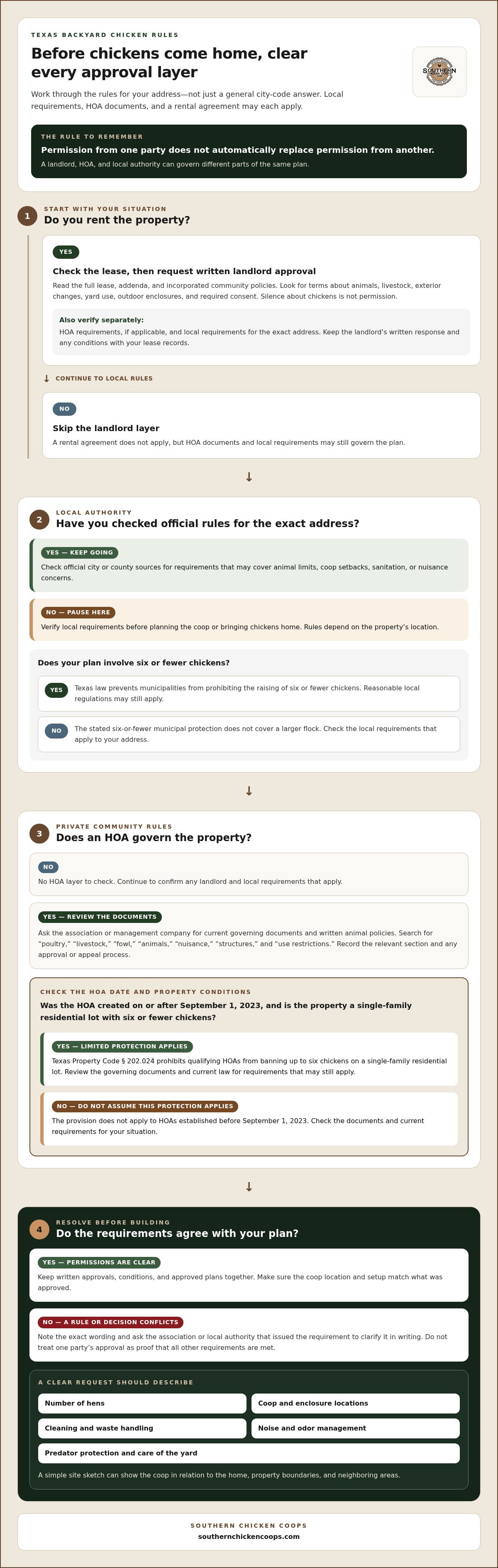
Start with the property, not a general answer about Texas. Rules for a particular address may come from deed restrictions, recorded covenants, an HOA declaration, and community rules, alongside local requirements. If you rent, your lease adds another layer. A rule that permits chickens in one setting doesn’t necessarily settle what’s allowed at your home.
State protections have limits. Texas law prevents municipalities from prohibiting the raising of six or fewer chickens, while allowing reasonable local regulations. A separate provision, Texas Property Code § 202.024, applies to HOAs created on or after September 1, 2023, and prohibits them from banning up to six chickens on a single-family residential lot. That protection does not apply to HOAs established before that date. Review the governing documents and current law that apply to your situation.
State law sets some boundaries, local rules govern matters such as placement and sanitation, HOA documents set private community restrictions, and a lease may impose separate terms between a landlord and renter. For a plain-language overview of association governance, see Understanding Homeowner Associations (HOAs).
Where to look for Texas HOA chicken rules
Ask the association or management company for the current governing documents and written animal policies. Search for terms such as “poultry,” “livestock,” “fowl,” “animals,” “nuisance,” “structures,” and “use restrictions.” Don’t rely only on a quick summary: a declaration may set a restriction, while a separate rule explains the approval process. Record each document’s title, relevant section, date, and any stated approval or appeal procedure.
Why local rules and HOA rules are not interchangeable
Use official city or county sources to check requirements that may cover animal limits, coop setbacks, sanitation, or nuisance concerns. Which local rules apply depends on the property’s location, so check using the exact address. Permission from one authority doesn’t automatically override a separate restriction: a city’s allowance may not satisfy HOA documents, and HOA approval may not satisfy local requirements.
Keep your findings together before making a request. If two documents seem inconsistent, note the exact wording and ask the association or local authority that issued the requirement to clarify it in writing. This can help you avoid planning a coop around an assumption that doesn’t fit your property.
How renters can get landlord approval for backyard chickens in Texas
As a renter, take the steps in order: review your lease, check community rules, verify local requirements for the address, and then request written approval from the property owner. Texas HOA chicken rules may apply separately from your rental agreement, so a landlord’s approval isn’t automatically permission from an HOA or local authority.
Verify each applicable permission separately. Approval from a landlord, an HOA, or a local authority doesn’t automatically replace approval from the others.
Review the lease before making a request
Read the full lease, including addenda and community policies incorporated into it. Look for clauses about animals, livestock, exterior changes, yard use, and additional approvals. Check whether written consent is required and whether the lease limits structures or outdoor enclosures. If the lease says nothing about chickens, don’t treat that silence as permission. Check for related restrictions elsewhere in the agreement and ask the landlord for a written answer.
Make a specific, considerate request
A clear request helps the property owner understand what you’re proposing and how you’ll care for the home. Include the number of hens, the proposed coop and enclosure locations, how you’ll keep the area clean, and how you’ll manage noise and waste. If your lease or community documents use terms such as “poultry,” the Texas Agriculture Code: Definition of Poultry may help explain the statutory terminology, though it doesn’t determine what your lease or HOA permits.
A simple site sketch can make the request easier to review. Mark the proposed coop location in relation to the home, property boundaries, and neighboring areas. Explain how the plan addresses cleanliness, odor, predator protection, and care of the yard. Be open to reasonable conditions, and make sure you understand exactly what has been approved before making changes or bringing chickens home.
Ask for the response in writing. Keep it with your lease records, along with any conditions, approved plans, and relevant messages. If approval depends on a particular location or enclosure, retain those details so your setup can match the agreement.
Once permissions are in place, plan a coop around the approved location and your flock’s needs. Southern Chicken Coops builds handcrafted, semi-custom chicken coops in McGregor, Texas, tailored to individual needs. Explore handcrafted chicken coop designs as you plan a suitable structure.
What to do when Texas HOA chicken rules conflict with your plans
A lease, HOA document, and local rule may each address a different part of your plan. Compare them side by side before deciding what to do next. Approval from one party isn’t proof that you’ve met every other requirement.
| Who sets the rule | What it may govern | What to verify |
|---|---|---|
| Landlord | Animals, yard use, and structures under the rental agreement | Lease terms, required written consent, and any conditions on approval |
| HOA | Private community restrictions, property use, and review procedures | Current governing documents, animal policies, and any written decision or appeal process |
| Local authority | Requirements such as animal limits, coop placement, sanitation, or nuisance rules | Current official rules for the property’s exact address |
If a lease appears to allow chickens but HOA documents restrict poultry, don’t rely on the lease alone. Ask the association to identify the provision it’s applying and clarify whether it covers your property and proposed setup. The reverse matters too: HOA approval doesn’t override a lease term or local requirement. Texas Property Code § 202.024 restricts certain HOA bans for associations created on or after September 1, 2023, but the provision doesn’t apply to older associations. Don’t assume it settles a specific dispute without reviewing the governing documents and applicable law.
If the HOA says chickens are not allowed
Request the exact governing-document language and ask for any written review or appeal procedure. Check whether the provision names chickens or poultry, or relies on broader terms such as “animals” or “nuisance.” These distinctions can clarify what the association is applying, but they don’t guarantee an exception. If the documents or decision process remain unclear, don’t treat a verbal response as the final word.
If the lease, HOA, or local guidance seems unclear
Keep a simple record of each conflicting statement, its source document and section, the date, and who provided the guidance. Then seek clarification from the party responsible for that rule, rather than asking one decision-maker to interpret another’s requirements. If the disagreement could affect your legal rights or obligations, consult a Texas attorney before acting.
Until the requirements are clear, hold off on buying or placing a coop. Resolving the questions first can help you avoid a preventable dispute and plan around the rules that apply to your property.
How to prepare a responsible chicken request for a Texas property
A thoughtful request shows that you’ve considered more than whether chickens are allowed. Explain what you’re proposing, where the setup would go, and how you’ll care for the birds and property. The Texas HOA chicken rules for your address may determine which details matter, so base your plan on the restrictions and approval process you’ve already identified.
What to include in a written approval request
Keep the request clear and specific. Include the property address, proposed number of hens, intended coop location, and the date you hope to begin. Attach a simple site layout showing the home, property boundaries, coop, enclosure, and nearby homes. This gives the reviewer a practical picture of the setup instead of asking them to approve an idea in the abstract.
Describe your routine for cleaning the coop, handling waste, keeping the enclosure secure, and limiting noise and odor. Explain how you’ll protect the flock from predators and keep the setup considerate of neighboring properties. If written approval is required, wait for it before buying hens or arranging coop delivery. Keep the response and any approved conditions with your property records.
For a useful preparation checklist, see our Texas backyard chicken coop preparation guide.
Plan the coop only after checking the site
Before settling on a design, measure the area you’re considering and compare it with applicable setbacks and community restrictions. A convenient location may not meet placement requirements or leave enough room for the enclosure and everyday care. Consider Texas weather, too: think through shade, ventilation, drainage, and predator protection when describing the proposed site.
Once you know the location and structure are permitted, plan around both your flock’s needs and the property’s limitations. A durable coop should fit its setting, not force you to revise an approved plan later. Our custom chicken coops in Texas guide offers broader housing considerations.
With permission in hand and the site prepared, explore custom chicken coop designs for a structure suited to your property and flock.
After approval: plan a Texas coop that fits your property
With the rules settled and required written approvals in hand, prepare the site and plan a coop that fits your flock and the approved conditions. Keep any approved drawings or placement details close by. The Texas HOA chicken rules for your property may shape where a coop can sit and how large it can be, so account for those details from the start.
Match coop plans to approved conditions
Compare the approved dimensions and location with the level area available on your property before finalizing plans. Check that the coop and enclosure fit within any stated boundaries or setbacks, while leaving space for routine care. The right footprint depends on the flock’s needs and the site’s restrictions; a design that suits one yard may not suit another.
In Central Texas, consider shade, ventilation, drainage, and durability as you plan for weather and everyday flock management. Southern Chicken Coops builds handcrafted coops in McGregor, Texas, including its 6-by-12-foot Polka model, along with semi-custom designs tailored to individual needs. Compare the proposed dimensions and placement with your written approval before choosing a design.
Make the move from permission to preparation
Keep approval letters, conditions, and drawings accessible while preparing the site. Completed coops are delivered to a prepared, level lot, so make sure the approved location is ready before arranging delivery. Careful preparation helps the structure fit its place and makes the transition from planning to welcoming a flock more straightforward.
Good planning protects your investment, supports the chickens’ well-being, and helps maintain a considerate relationship with neighbors. Once your site and approvals are ready, explore custom chicken coop options for a thoughtfully made home for your flock.
Take the next step toward a well-planned flock
Before bringing chickens home, confirm which rules apply to your address, get any required written approvals, and keep the decisions and conditions on hand. For renters, landlord consent is separate from checking HOA and local requirements. A clear plan for flock size, coop placement, cleanliness, and neighbor considerations helps everyone understand how the setup will work.
Once chickens and a suitable structure are permitted, plan the coop around your flock’s needs and the approved site. Southern Chicken Coops is family-owned and operated in McGregor, Texas, crafting coops by hand with semi-custom options. Completed coops are delivered to a prepared, level lot, so site preparation is part of bringing your plans together.
Ready to explore a coop that fits your property and flock? Explore handcrafted chicken coop options and take the next step toward preparing a home for your hens.
Frequently Asked Questions
Do Texas HOA rules allow backyard chickens?
Sometimes, but there isn’t one answer for every Texas property. City or county requirements, HOA documents, and lease terms may all affect whether chickens are allowed. Texas law limits municipalities from prohibiting six or fewer chickens, though local governments can impose reasonable regulations. A separate state-law protection applies to certain newer HOAs. Check the rules tied to your exact address before buying hens or planning a coop.
Can an HOA prohibit chickens in Texas?
Some can. Under Texas Property Code § 202.024, HOAs created on or after September 1, 2023, can’t prohibit up to six chickens on a single-family residential lot. That protection doesn’t apply to HOAs established before that date, which may still prohibit chickens. Other restrictions and local requirements may also apply. Review the association’s current governing documents and verify how the law applies to your property before relying on an exception.
Do I need my landlord’s permission to keep chickens in a Texas rental?
Get your landlord’s written permission before keeping chickens in a rental. Review the lease for terms about animals, livestock, yard use, exterior changes, and outdoor structures. Then check any HOA or community rules and local requirements for the address. A lease that doesn’t mention chickens isn’t automatic approval. Keep your request, the landlord’s written response, and any approved conditions with your rental records.
Does landlord approval override HOA rules about chickens?
No. A landlord’s approval addresses the rental relationship, but it doesn’t automatically satisfy separate HOA restrictions or local requirements. The reverse is true too: HOA approval doesn’t necessarily change your lease terms. Check each source independently, including any written conditions attached to the landlord’s consent. If the rules appear to conflict, ask the party responsible for each one to clarify the applicable provision before setting up a coop.
How do I find out whether my Texas city allows backyard chickens?
Use official city or county sources to check requirements for your exact address. Look for rules about animal limits, coop setbacks, sanitation, and nuisance concerns. Confirm whether the property falls within city limits or an unincorporated area, since that can affect which local authority’s rules apply. Don’t assume a city’s allowance means an HOA or lease also permits chickens; those requirements need separate review.
What should I include in a request for HOA approval to keep chickens?
Make the request specific: include your property address, proposed number of hens, intended coop location, and requested start date. Attach a simple site plan showing the coop, enclosure, property boundaries, and nearby homes. Explain your cleaning routine, waste handling, noise and odor management, and how you’ll keep the enclosure secure from predators. Ask for the decision and any conditions in writing, and wait for required approval before proceeding.
What happens if I keep chickens before getting required approval?
Keeping chickens before required approvals are in place could lead to disputes or enforcement under your lease, HOA documents, or local rules. Depending on the applicable requirements, you may receive a notice or be asked to correct the issue, which could mean changing the setup or removing the birds. The specific consequences depend on the governing documents and rules. Verify permissions first, and consult a Texas attorney if a dispute develops.


