

What if the biggest obstacle to your dream of fresh morning eggs isn't the birds themselves, but a single tape measure? For many of our neighbors, the desire to bring a bit of the homestead into the city is often met with a cloud of uncertainty regarding the Houston TX chicken ordinance. You want to provide for your family and care for your animals, but the fear of a city inspector or a frustrated neighbor can make the process feel like a legal hurdle. We believe that keeping hens should bring peace to your backyard, not stress to your life.
We've spent years crafting durable homes for Texas flocks, and we know that legal compliance is the foundation of a happy homestead. In this guide, we'll help you navigate the city's specific requirements with ease and clarity. You'll get a clear roadmap for the 30-foot rule, tips for keeping your coop neighbor-friendly, and professional advice on siting a structure that handles our local heat. Our goal is to give you the confidence to set up a legal, beautiful backyard space where your hens can thrive and your mind can rest easy.
Key Takeaways
- Understand that backyard hens are legal in Houston under Chapter 6, as long as your setup prioritizes animal welfare and neighborhood harmony.
- Learn how to accurately measure the 30-foot distance required by the Houston TX chicken ordinance to keep your coop legally compliant and your neighbors happy.
- Navigate flock limits and the practical realities of owning roosters in the city to avoid noise complaints and unnecessary fines.
- Identify the structural requirements for a secure, easy-to-clean coop that stands up to the Texas climate while keeping your birds safe.
- Gain peace of mind by discovering how a professionally delivered, handcrafted coop can simplify the siting process and ensure long-term durability.
Is it Legal to Keep Chickens in Houston? (2026 Ordinance Overview)
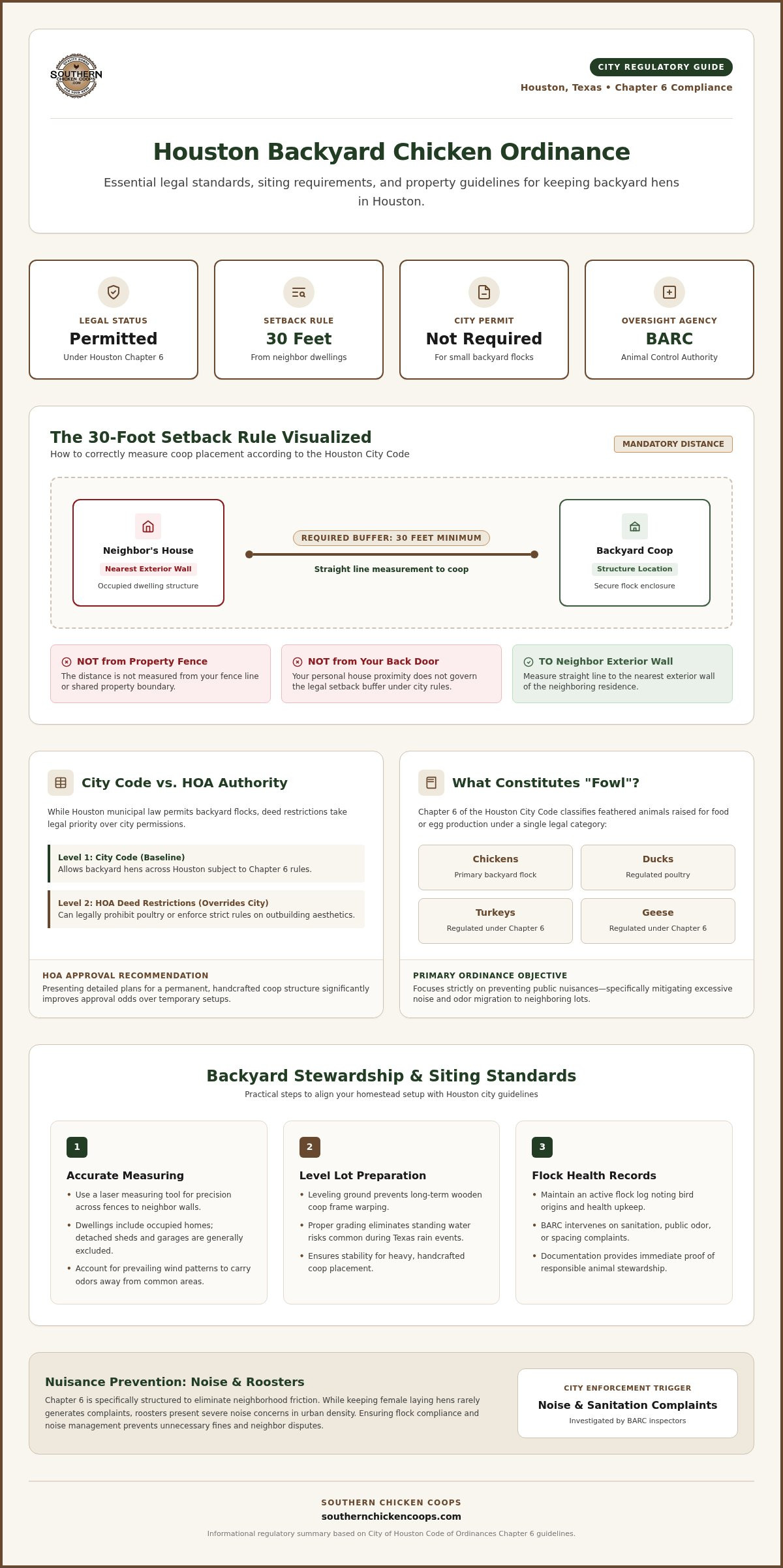
Yes, it's legal. We often get calls from folks across the city asking if they'll get in trouble for keeping a few hens in their backyard. The short answer is that Houston welcomes urban chicken keeping as long as you follow the rules laid out in Chapter 6 of the City Code. These guidelines aren't meant to be hurdles; they're designed to keep our neighborhoods clean and our animals safe. Under Houston city law, the term 'fowl' refers to chickens, turkeys, ducks, geese, and any other feathered animals typically raised for food or eggs. The Houston TX chicken ordinance is primarily focused on preventing public nuisances like odors or noise, ensuring that your hobby doesn't become a headache for the family next door.
Understanding City Code vs. HOA Rules
We always tell our neighbors to check their deed restrictions before they start picking out breeds. While the city says yes, your Homeowners Association (HOA) might have a different opinion. City code is the baseline, but an HOA can legally enforce stricter rules that override city permissions. Some neighborhoods might ban poultry entirely, while others simply want to ensure your coop matches the aesthetic of the neighborhood. If you're planning on ordering a handcrafted coop, take a moment to look at your neighborhood's bylaws regarding outbuildings. We've found that presenting your HOA with a plan for a professional, high-quality structure often goes a long way in gaining approval. It's much easier to get a "yes" when they see you're investing in a beautiful, permanent addition to your property rather than a temporary eyesore.
Permits and Registration Requirements
As we look at the requirements for 2026, the city still doesn't require a specific permit just to own a small flock of hens. However, you're still part of a community regulated by BARC, Houston’s animal control authority. They're the folks who step in if there's a complaint about sanitation or space. To stay fully aligned with the Houston TX chicken ordinance, we suggest keeping a simple log of your flock. Note where your birds came from and keep up with their general health. This level of care shows any visiting inspector that you take your role as a steward seriously. It isn't just about checking a legal box; it's about protecting the life you're building in your own backyard. By keeping records and maintaining a clean space, you build trust with both the city and your neighbors.
The 30-Foot Rule: Siting Your Coop for Legal Compliance
The most common point of confusion we see involves a simple tape measure. While many assume you can't have birds on a standard city lot, the Houston TX chicken ordinance actually focuses on the distance between your coop and your neighbor's home. Specifically, the structure must sit at least 30 feet away from any neighboring dwelling. This distance isn't measured from your own back door or the shared fence line; it's a straight line from the coop to the nearest wall of the house next door. This rule exists to ensure that noise and dust don't interfere with your neighbor's right to enjoy their property. Following this guideline isn't just about avoiding a fine. It's about being a good steward of your land and a kind neighbor.
There are rare instances where neighbor consent can help if you're slightly within that 30-foot window, but we always recommend sticking to the letter of the law for long-term peace of mind. When we handle your professional coop delivery, we work with you to verify that your chosen spot meets these city requirements. We've seen how a well-placed coop keeps the peace, and we take pride in helping you find that legal sweet spot in your backyard.
Measuring for Success in an Urban Backyard
Finding 30 feet in a tight Houston lot can feel like a puzzle. We suggest using a laser measure for the most accurate reading, as it's easier to point at a neighbor's wall than dragging a physical tape across a fence. Remember that dwellings include occupied homes, but usually don't include detached sheds or garages. By placing your coop strategically, you can also leverage natural wind patterns to move odors away from common areas. For more detailed advice on flock health and setup, the Texas A&M AgriLife Extension poultry guidance offers wonderful resources that align with our local climate challenges.
Preparing Your Level Lot for Delivery
Once you've found the legal spot, the ground needs to be ready. A level lot is essential because it prevents the frame of your handcrafted coop from warping over time and ensures proper drainage. Standing water is the enemy of a clean coop and can lead to sanitation issues that the Houston TX chicken ordinance specifically prohibits. You might choose a pad of crushed granite, simple pavers, or even well-compacted dirt. If you're unsure where to start, we've put together a guide on preparing your backyard for a chicken coop to help you get the foundation right. A solid base is a sign of respect for the craftsmanship of the building and the comfort of the birds inside.
Houston Flock Limits and the Rooster Question
While some cities limit you to just three or four birds, the Houston TX chicken ordinance is surprisingly generous, allowing residents to keep up to 30 birds. However, we always tell our neighbors that just because you can keep 30 hens doesn't mean you should. The city's limit is a ceiling, but the practical reality of your backyard space usually dictates a much smaller number. When you factor in the 30-foot rule we discussed earlier, most standard residential lots find their natural balance with a much more manageable flock. Keeping too many birds in a small space leads to sanitation issues and noise that can quickly draw the attention of city inspectors.
We've designed our signature 6x12 Polka model specifically with these urban constraints in mind. It provides the breathing room your birds need to stay healthy while fitting comfortably within the legal boundaries of a typical Houston yard. It's about finding that point of stewardship where your hens are thriving and your neighbors aren't even aware they're there. A well-managed, smaller flock is always better than a crowded one that struggles with the Texas heat.
Can You Have a Rooster in Houston?
The question of roosters is where things get a bit tricky. While the written ordinance doesn't explicitly ban roosters by name in every single residential zone, the city's noise and nuisance laws effectively do the job. If a neighbor complains about a "disturbing the peace" violation due to early morning crowing, you'll likely face a fine or a request to remove the bird. In the dense neighborhoods of Houston, roosters are almost always a recipe for conflict. If you happen to find a cockerel among your straight-run chicks, it's best to find him a new home in a more rural area before he starts finding his voice. Keeping the peace with those living next door is a vital part of the urban homesteading lifestyle.
Choosing the Right Number of Hens
For most families we work with, 10 to 12 hens is the "goldilocks" zone. This flock size provides plenty of eggs for a household and enough to share with neighbors, which is a great way to build goodwill. It also ensures that each bird has ample space to move, preventing the stress and pecking that comes with overcrowding. If you're looking for a structure that offers this perfect balance of size and durability, our chicken coop for 10 hens is handcrafted to provide a lifetime of service. We believe in building homes for your birds that reflect the same care and integrity you put into your own home, ensuring they stay safe and comfortable through every Houston summer.
Structural Standards: Building for Safety and Sanitation
The Houston TX chicken ordinance is clear that poultry must be kept in a "sanitary condition" and in a structure that prevents escape. While that sounds straightforward, anyone who has spent a summer in the Bayou City knows that "sanitary" is a moving target when the humidity hits 90 percent. A cheap, porous wood coop will soak up moisture and waste, creating the exact kind of odor that leads to neighbor complaints and city citations. We build our structures with the belief that a coop should be a permanent, clean addition to your home. By using non-porous materials and providing easy-access doors for cleaning, we make it simple for you to meet the city's standards without spending every Saturday morning scrubbing.
Predator Proofing in the Bayou City
Keeping your hens safe is a legal requirement under the ordinance, but it's also a moral one. Houston is home to a surprising amount of wildlife, from clever raccoons and opossums to wandering neighborhood dogs. We've seen many folks start with thin chicken wire, only to find it's no match for a determined predator. That's why we use heavy-duty hardware cloth on all our builds. It's a small detail that makes a massive difference in the safety of your flock. Our handcrafted coops are designed to be an impenetrable fortress, giving you peace of mind when the sun goes down over the ship channel. Investing in professional quality ensures your birds stay where they belong and out of harm's way.
Ventilation and Humidity Control
Stagnant air is the enemy of a healthy flock, especially in our local climate. The city's rules regarding animal welfare mean you must provide a space that doesn't cause suffering. In Houston, that means prioritizing airflow. Without proper ventilation, ammonia can build up quickly, leading to respiratory issues for your birds and smells that drift over the fence. We design our Polka model with specific venting that encourages natural air movement while keeping the interior dry. Whether you use the deep litter method or prefer frequent cleanings, a well-ventilated structure is the best way to stay in compliance with the Houston TX chicken ordinance and keep your hens happy.
If you are ready to invest in a structure that meets the highest standards of safety and craftsmanship, we invite you to view our custom chicken coops built right here in Texas.
Ordering Your Handcrafted Houston-Ready Coop
Choosing to raise chickens is a commitment to a different kind of lifestyle, one rooted in the steady rhythms of nature even in the heart of a bustling city. When you decide to bring hens home, the structure you choose becomes the centerpiece of that journey. We believe that a coop should be more than a temporary shelter; it should be a handcrafted home built with the same devotion you have for your flock. By choosing a professional build from Southern Chicken Coops, you ensure that your setup remains in perfect alignment with the Houston TX chicken ordinance for years to come. You aren't just buying a product. You're entering into a partnership with a family that cares as much about your success as you do.
From McGregor to Your Backyard
Every one of our coops begins its life in our workshop in McGregor, Texas, where we build them one at a time with careful attention to every joint and latch. We've chosen not to offer DIY kits because we know that the longevity of a building depends on the integrity of its assembly. When your coop is ready, we bring the finished product directly to your prepared, level lot. Our professional team handles the logistics of moving these heavy, durable structures, ensuring they're positioned exactly where you need them to stay compliant. For a closer look at how we get your new coop home, feel free to read our guide on handcrafted chicken coop delivery in Texas. We take the heavy lifting off your shoulders so you can focus on welcoming your new birds.
The Polka: Designed for the Texas Lifestyle
Our signature 6x12 Polka model has become a favorite for Houstonians because it strikes the perfect balance between spaciousness and a footprint that fits urban lots. While big-box stores often sell disposable coops made of thin wood that warps in our humidity, we build for resilience. The Polka is designed to handle the intense Texas sun and the heavy rains of the gulf coast, providing a safe haven that won't require replacement in a few years. This durability is key to maintaining the sanitary conditions required by the Houston TX chicken ordinance. If you're ready to start your journey with a structure built to last a lifetime, we invite you to view our custom chicken coops Texas options. We'd be honored to help you build a beautiful, compliant homestead right in your own backyard.
Starting Your Houston Homestead with Confidence
Building a sustainable lifestyle in the city is a rewarding journey that starts with a clear path to compliance. By respecting the 30-foot rule and choosing a manageable flock size, you create a space where your hens can thrive without disturbing your neighbors. We know that following the Houston TX chicken ordinance feels much simpler when you have a structure built specifically for the task. A high-quality coop isn't just about meeting city standards; it's about providing a safe, heat-ready sanctuary for your birds that stands the test of time.
We'd be honored to help you take this next step. Every one of our coops is handcrafted one at a time in McGregor, Texas, and designed to handle our unique climate and local wildlife. From our workshop to your backyard, we provide professional delivery to ensure your new home for your hens is positioned perfectly for long-term success. Our predator-proof and heat-ready designs take the guesswork out of urban poultry keeping, letting you focus on the joy of the homestead.
Find Your Perfect Houston-Compliant Coop
Your dream of fresh eggs and a quiet backyard retreat is well within reach, and we're here to guide you every step of the way. Happy farming, neighbor.
Frequently Asked Questions
How many chickens am I legally allowed to have in Houston?
Houston allows you to keep up to 30 birds on a residential lot. While that's a generous limit, the practical reality of your backyard space and the city's sanitation rules usually mean a smaller flock is better. A signature 6x12 Polka model is a great fit for about 10 to 12 hens. This size provides plenty of eggs for your family while ensuring the birds have enough room to stay healthy and quiet.
Is the 30-foot rule measured from my house or my neighbor's house?
The 30-foot rule is measured from your coop to the nearest wall of your neighbor's dwelling. It doesn't matter how close the birds are to your own back door. This specific part of the Houston TX chicken ordinance ensures that noise and potential odors don't interfere with the families living around you. When we handle your professional coop delivery, we'll help you find a spot that respects these boundaries and keeps your neighbors happy.
Do I need a permit to build a chicken coop in Houston?
You don't need a specific poultry permit to keep hens, but you might need a general building permit if your coop exceeds certain size or height limits. It's always a good idea to check with the city's planning department for the latest structural codes. Since we deliver fully assembled, handcrafted structures, your main job is ensuring your lot is level and ready. We focus on building coops that are permanent, beautiful additions to your property.
Are roosters allowed within Houston city limits?
Roosters aren't explicitly banned by name, but they are effectively restricted by noise and nuisance laws. If a rooster's crowing leads to a "disturbing the peace" complaint, you'll likely be asked to remove the bird. In the tight quarters of most Houston neighborhoods, we generally recommend keeping only hens. This ensures your morning stays quiet and your homestead remains a peaceful, welcome part of the community without drawing unwanted attention from city inspectors.
What are the penalties for violating the Houston chicken ordinance?
Violating the code can lead to citations and fines that often range from $100 to $2,000 for each day the violation continues. These penalties usually happen because of sanitation issues, noise, or improper coop placement. The city typically issues a warning first to give you a chance to fix the problem. Following the Houston TX chicken ordinance from the start with a well-built, correctly sited coop is the best way to protect your investment and your flock.
Does my coop need to be a certain distance from my own house?
The city doesn't set a minimum distance from your own home, but we suggest leaving some breathing room. Placing your coop at least 10 to 15 feet away helps with airflow and keeps dust from drifting into your windows. We design our coops to be attractive structures that you'll be proud to look at every day. Just keep in mind that the 30-foot neighbor rule is the one that city officials will check if they visit.
Can my HOA ban chickens even if the city allows them?
Yes, your Homeowners Association can enforce stricter rules than the city and may ban chickens entirely. City ordinances provide the baseline, but deed restrictions are private contracts that you're legally bound to follow. Before you order your handcrafted coop, we strongly encourage you to review your neighborhood bylaws. Many associations are more open to hens when they see you're investing in a professional, high-quality structure rather than a temporary eyesore.
How do I keep my coop from becoming a 'public nuisance'?
Keeping your coop clean and dry is the best way to prevent the odors and flies that cause nuisance complaints. Use absorbent bedding and ensure the structure has proper ventilation to handle the Texas humidity. Our coops are built with non-porous surfaces that make regular cleaning much easier. By staying proactive with maintenance and sharing a few fresh eggs with your neighbors, you'll find that your backyard homestead becomes a source of community goodwill.


