

A neighbor stops by your fence, not to admire your hens, but to ask if your coop meets the city's thirty-foot setback rule. It's a heart-sinking moment that many urban farmers dread, but it's one you can easily avoid. Getting familiar with Austin Texas backyard chicken laws is the first step toward true peace of mind. We've spent years crafting coops that honor both the birds and the land, and we know that legal compliance is the foundation of a happy flock.
You likely feel that same sense of stewardship we do, wanting to provide a safe home while remaining a respectful neighbor. It's frustrating when city codes feel like a barrier, especially when you're caught between HOA rules and municipal setbacks. We promise to clear up that confusion so you can focus on the joy of fresh eggs without the fear of a code violation notice.
We'll break down the 2026 bird limits, explain the distance requirements that keep you in the city's good graces, and share how to choose a location that satisfies the law. Let's ensure your homestead is built on solid ground and neighborly integrity.
Key Takeaways
- Discover how to navigate Austin’s chicken-friendly ordinances, including the 10-bird threshold that keeps your backyard flock legal and manageable.
- Gain clarity on the strict rooster ban and other essential Austin Texas backyard chicken laws to ensure your home remains a peaceful part of the neighborhood.
- Learn the specifics of the 30-foot setback rule so you can place your coop with confidence, protecting both your birds and your property rights.
- Explore practical sanitation tips for managing waste in the intense Texas heat to prevent odors and maintain a healthy environment for your community.
- Identify how high-quality craftsmanship and a thoughtful coop footprint can simplify compliance while providing lasting protection for your animals.
Austin Backyard Chicken Laws: What You Need to Know in 2026
Austin has always marched to the beat of its own drum. This includes a deep respect for local food and sustainable living. We've seen the city embrace the movement of urban backyard chicken keeping with open arms, provided we all play by the rules that keep our community clean and quiet. Understanding the Austin Texas backyard chicken laws isn't just about avoiding a fine. It's about being a good neighbor and a faithful steward of your birds.
Understanding Austin City Code Chapter 3-2
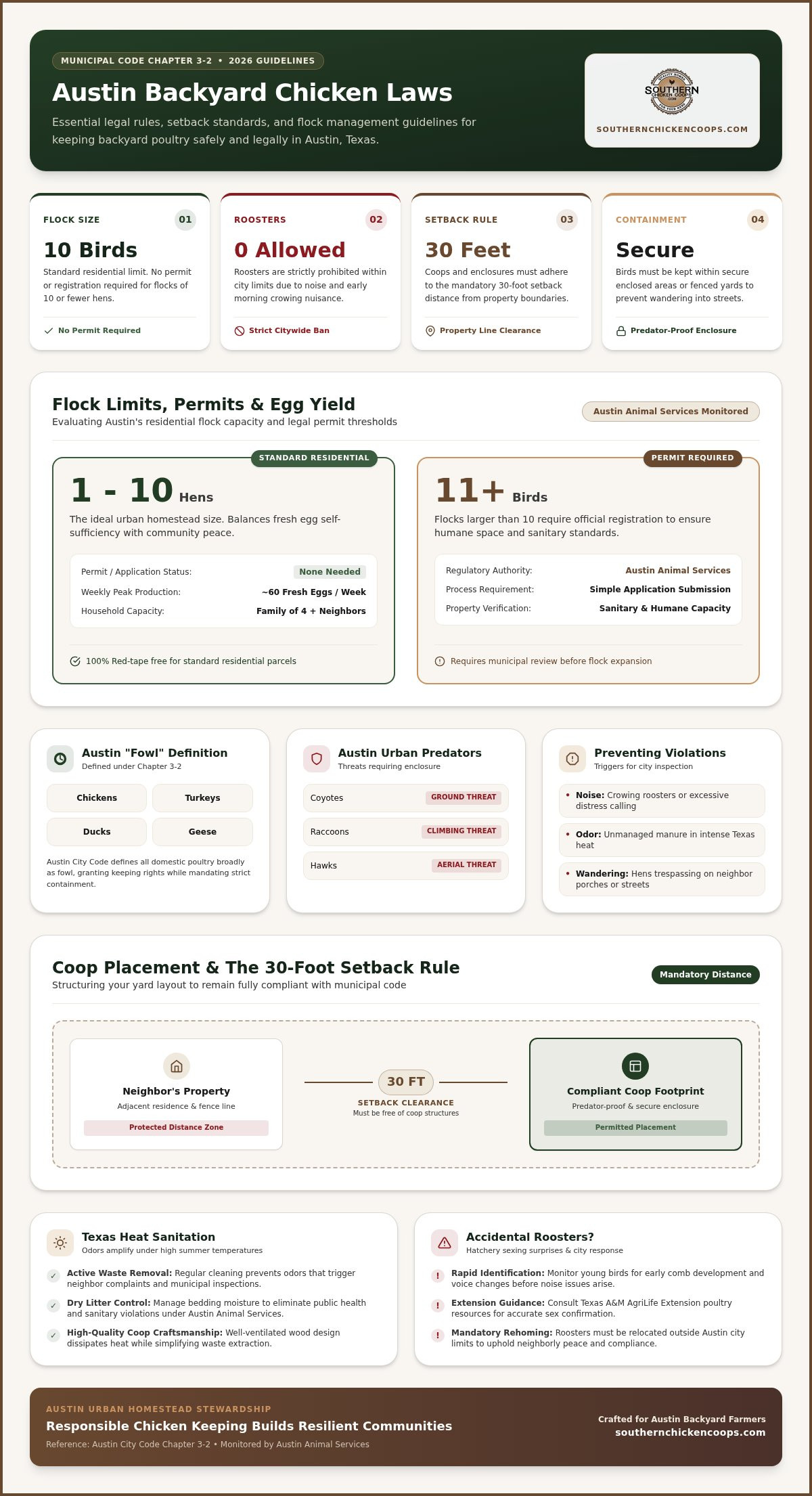
Austin City Code Chapter 3-2 is the rulebook for our backyard flocks. The city defines "fowl" broadly, including chickens, turkeys, geese, and ducks. While the code gives us the right to raise these animals, it places the responsibility of their care and containment squarely on our shoulders. Austin Animal Services monitors these residential flocks to ensure they aren't creating a public health issue. Recent 2026 updates have helped clarify these rights, making it easier for families to understand exactly what the city expects. A compliant flock is one that's kept in a secure, sanitary environment that doesn't disturb the peace of the surrounding homes.
Why Compliance Matters for Your Homestead
Staying within the law protects your investment in more ways than one. When you follow the city's guidelines, you avoid the dreaded "nuisance" tag. This label often comes from complaints about noise or smell, which can lead to inspections and potential fines. Beyond the legal side, these rules are designed for the safety of the birds themselves. Austin is home to clever predators like coyotes, raccoons, and hawks. A coop built to city standards is often a coop built to keep these visitors out. We always tell our neighbors that a compliant homestead is a resilient one. It maintains your property value and keeps those relationships with the folks next door healthy and positive.
One of the most important parts of the code involves "enclosed areas." While the idea of hens roaming free across a lush lawn is beautiful, Austin requires birds to be contained. Free-ranging is permitted only within a secure fence that prevents your chickens from wandering onto a neighbor's porch or into the street. Most residents find that a well-built, predator-proof enclosure is the best way to balance the birds' freedom with the city's requirements for safety and containment. This balance ensures your chickens stay safe while you stay in the city's good graces.
Bird Limits, Roosters, and Permit Requirements
We often get asked how many birds a family actually needs to feel self-sufficient. In Austin, the city has set a very reasonable threshold that balances your desire for fresh eggs with the comfort of your neighbors. Understanding these boundaries helps you plan your flock with a clear conscience and a steady hand. Stewardship begins with knowing the limits of your land and the laws that protect your community.
The 10-Bird Rule for Residential Lots
For most of our neighbors in the city, 10 chickens is the magic number. This limit is generous; a healthy flock of 10 hens can produce around 60 eggs a week during peak season. That is more than enough for a family of four to enjoy and even share with the folks next door. Under the current Austin Texas backyard chicken laws, keeping 10 or fewer birds requires no special permits or registration. It's a straightforward way for the city to encourage urban farming without adding a layer of red tape. This rule applies to standard residential lots, though we always recommend double-checking your specific zoning if you live in a multi-unit or historic district where local rules might be tighter.
The 'No Rooster' Policy
While hens are welcome, roosters are strictly prohibited within Austin city limits. The city defines their early morning calls as a noise nuisance, and code compliance is quick to respond to reports of crowing. We know that sometimes a "surprise" rooster shows up in a batch of sexed chicks from a hatchery. It happens to the best of us. If you suspect one of your young birds is developing a comb and a loud voice, you can consult Texas A&M AgriLife Extension poultry resources to help identify their sex early. Finding a new home for a rooster outside city limits is a necessary part of being a responsible urban steward and maintaining peace with your neighbors.
If your heart is set on a larger flock of 11 birds or more, you must register your chickens with Austin Animal Services. This process involves a simple application to ensure your property can humanely support the extra birds without creating a sanitary issue. Whether you're planning for a small group of three or the full residential limit of 10, choosing a well-sized custom coop ensures your birds have the space they need to thrive while staying fully compliant with local ordinances. We believe that providing the right amount of space is the first step in honoring the animals we've been called to care for.
Setbacks and Coop Placement: Navigating Austin Property Rules
Setting up your backyard homestead is an exciting journey, but the physical location of your coop is where the rubber meets the road. Most folks want to be good neighbors; they just aren't sure where the line is drawn. Austin Texas backyard chicken laws are quite specific about where your hens can sleep. The cornerstone of these rules is the 30-foot setback requirement. This isn't just about your property line. It's about the distance from your coop to any habitable structure on a neighbor's property.
Visualizing the 30-Foot Setback
When you're standing in your yard with a tape measure, remember to look past the fence. The law requires your coop to be at least 30 feet away from any neighbor's dwelling. While standard property line setbacks still apply for any structure in your yard, this specific distance from habitable homes is what the city focuses on for poultry. If your neighbor has a shed or a garage right on the property line, you don't necessarily have to measure from that. You measure to the house where they live. Even on a standard urban lot, a 6'x12' footprint can often find a perfect home tucked into a back corner. A common mistake we see is people placing the coop right against the back fence, only to realize the neighbor's bedroom is just ten feet away on the other side. Taking a moment to measure twice saves you from a difficult conversation or a city inspection later.
Preparing Your Site for Delivery
Once you've found that legal "sweet spot," the next step is ensuring the ground is ready. A handcrafted structure needs a stable foundation to remain resilient against the Central Texas elements. We always ask our clients to provide a level, prepared lot. This isn't just for the health of the coop; it's for the accuracy of your setbacks. If a coop shifts or leans because of soft soil, it could technically fall out of compliance or become difficult to secure against predators. You can find more details on preparing your backyard for a chicken coop to ensure everything is ready for the big day. Our professional delivery team takes great pride in helping you hit those marks. We'll work with you to place your coop exactly where you've planned, ensuring it sits square and true. This careful preparation is part of our commitment to your success as a backyard farmer.
Keeping the Peace: Sanitation and Neighborhood Relations
We've walked through the legal distances and bird limits, but the daily rhythm of your homestead is what truly keeps you in the city's good graces. Austin Texas backyard chicken laws are built around the idea of being a good neighbor. This means preventing "offensive odors" and keeping fly populations under control. In our Central Texas heat, sanitation isn't just a chore; it's a form of stewardship. We believe that a well-tended coop reflects the integrity of the person keeping it and ensures the health of the animals under our care.
Managing Manure and Odor in Texas
The secret to a fresh-smelling yard is simple: keep it dry. When moisture meets manure in 100-degree weather, odors become an issue quickly. This is why we emphasize the importance of ventilation in a well-built chicken coop. Our designs prioritize airflow to ensure your birds stay cool and their bedding stays dry. Austin allows you to compost your waste on-site; it's a wonderful way to give back to your garden. If composting isn't for you, the city requires waste to be disposed of in a way that doesn't create a health hazard. Many of our neighbors find success with the "Deep Litter Method," using high-quality pine shavings to manage moisture and keep the coop floor clean and healthy.
Dealing with Homeowners Associations (HOAs)
It's a common point of confusion, but in most cases, HOA deed restrictions will override city code. Even if the city says you can have ten hens, your neighborhood association might have a "no poultry" rule or specific coop height limits. We always encourage you to read your CC&Rs before making any big decisions. If your HOA is on the fence, we recommend presenting your plan as a commitment to craftsmanship. A handcrafted coop built with traditional methods looks like a beautiful garden structure rather than a makeshift shed. When a board sees that you're investing in an aesthetic asset for your property, they're often much more supportive. If you need a structure that meets these high standards, we can help you choose a custom chicken coop that honors your neighborhood's look.
Clear communication with your neighbors is the final piece of the puzzle. Most people aren't worried about the chickens themselves; they're worried about noise and smells. By showing that your homestead follows Austin Texas backyard chicken laws while maintaining a beautiful yard, you turn a potential conflict into a community connection. It's about more than just following the law; it's about building a homestead that everyone is proud to have on the block. Offering a half-dozen eggs to the folks next door goes a long way in keeping the peace.
Choosing a Compliant, Texas-Built Coop for Your Austin Backyard
Choosing a home for your birds is more than just a purchase. It is an act of stewardship that bridges the gap between legal requirements and the daily well-being of your flock. While we've discussed the nuances of the Austin Texas backyard chicken laws, the physical structure you choose is what makes those rules work in practice. A coop should do more than just house hens; it should stand as a testament to quality and a quiet promise of safety for the animals under your care. We build our structures to honor the tradition of handcrafted excellence while meeting the modern demands of urban farming.
The Polka: Designed for Austin Homesteads
Our signature Polka model, with its 6'x12' footprint, was specifically designed to harmonize with the needs of a Central Texas backyard. This size is ideal for the city's 10-hen limit, providing enough square footage to keep your birds healthy, active, and stress-free. When birds have ample space, they are quieter and happier, which helps you maintain that vital peace with your neighbors. The aesthetic of a handcrafted structure also serves a practical purpose; it looks like a deliberate part of your landscape. This visual harmony often eases the minds of HOA boards and neighbors who might be wary of a less substantial setup. If you are looking for a structure that balances beauty with function, you can explore our options for custom chicken coops Texas families have trusted for years.
Professional Delivery and Peace of Mind
The integrity of your homestead depends on how your coop is built and where it sits. Unlike mass-produced kits that struggle under the weight of a Texas storm, our coops are built one at a time in McGregor with resilience in mind. We understand the specific environmental challenges of our region, from the intense summer heat to the sudden shifts in weather. When we deliver a coop to your prepared lot, we aren't just dropping off a product. We are helping you ensure that your placement is legally sound and structurally stable. Bill and Tina Drivdahl take professional pride in every delivery, working with you to position the coop exactly where it belongs to satisfy those 30-foot setback rules.
Supporting a family-owned Texas business means you are getting a partner who understands the local landscape. We go beyond the basic safety requirements found in the Austin Texas backyard chicken laws by integrating superior predator-proofing into every build. Our goal is to provide you with a coop that satisfies the city inspector and keeps your hens safe from local wildlife. By choosing a locally built structure, you are investing in a piece of craftsmanship that will serve your family and your birds for many seasons to come. We believe that a well-built coop is the foundation of a successful, neighbor-friendly homestead.
Building Your Austin Homestead with Integrity
Stepping into the world of urban farming is a beautiful way to connect with your food and your land. By understanding the 10-bird residential limit and the specific 30-foot setback requirements, you've already done the hard work of preparing for success. Following the Austin Texas backyard chicken laws isn't just about checkboxes; it's about creating a safe, respectful environment where your birds can thrive and your neighbors feel valued. We've seen how a commitment to quality and sanitation turns a simple backyard project into a lasting legacy of stewardship.
When you're ready to take that next step, we're here to help you get it right. Every one of our coops is handcrafted in McGregor, TX, and specifically designed to keep hens cool and protected in our unique Central Texas climate. We take great pride in our professional delivery to your prepared lot, ensuring your new structure is positioned perfectly for both legal compliance and bird safety. Explore our handcrafted coops and start your Austin flock today. We look forward to helping you build a homestead you can be proud of for years to come.
Frequently Asked Questions
Do I need a permit to have chickens in Austin, Texas?
You don't need a permit if you keep 10 or fewer birds on your property. If you decide to grow your flock to 11 or more, the city requires you to register with Austin Animal Services. This process ensures your land can humanely support the birds without creating a public health or sanitation issue. Most families find that 10 hens provide plenty of eggs while keeping the homestead simple and paperwork-free.
Can I have a rooster in the Austin city limits?
No, roosters are strictly prohibited within Austin city limits. The city classifies their crowing as a noise nuisance that can lead to inspections and fines from code compliance. If you accidentally end up with a rooster in your chick order, it's best to find him a new home outside the city. Keeping only hens ensures you stay in the good graces of the families living nearby.
How many chickens can I legally own in Austin?
Most residents can legally own up to 10 chickens on a standard residential lot without any registration. This number is often perfect for a family looking to be self-sufficient and share eggs with neighbors. If your lot size or zoning allows for more, you can have a larger flock by registering with the city. We always recommend checking your specific deed restrictions before you start building your backyard homestead.
What are the setback requirements for a chicken coop in Austin?
The cornerstone of coop placement is the 30-foot setback rule. Your chickens' housing must be situated at least 30 feet away from any neighbor's habitable dwelling. While you must also follow standard property line setbacks, this specific distance from neighbor houses is what the city monitors most closely. Measuring carefully before delivery ensures your Austin Texas backyard chicken laws compliance and keeps your neighbors happy with the new addition.
Are there specific coop design requirements in Austin?
Austin doesn't mandate a specific architectural style, but the code requires a secure and sanitary enclosure. Your coop must prevent offensive odors and fly breeding while keeping the birds safe. We build our coops to exceed these standards, focusing on ventilation and durability. A well-crafted structure isn't just about following the law; it's about providing a healthy home that withstands the intense Central Texas heat.
Can my HOA ban chickens if the city allows them?
Yes, your Homeowners Association can legally ban chickens even if the city allows them. HOA deed restrictions are private contracts that often override municipal ordinances. It's vital to review your CC&Rs or speak with your board before bringing birds home. Presenting a plan for a high-quality, handcrafted coop can sometimes help you gain approval by showing you're committed to maintaining the neighborhood's beautiful aesthetic and integrity.
What happens if a neighbor complains about my chickens in Austin?
If a neighbor complains, Austin Code Compliance may visit your property to inspect for sanitation or noise issues. They typically check for offensive odors, fly problems, or prohibited roosters. As long as you follow the Austin Texas backyard chicken laws and keep your coop clean, you shouldn't have any trouble. Being proactive with neighborly communication and sharing a few fresh eggs often prevents these complaints from happening in the first place.
Does Austin require chickens to be kept in a coop at all times?
Austin requires chickens to be kept in an enclosed area, but they don't have to stay inside the coop 24/7. You can let them roam in your backyard as long as you have a secure fence that keeps them on your property. However, a predator-proof run is often the safest choice for the birds. Containment is key to preventing your hens from wandering onto a neighbor's porch or into the street.


