
Could your flock affect your taxes in one way even if it doesn’t qualify for another? When you’re claiming ag exemption for chickens in Texas, first identify which tax benefit you mean. A few hens raised for household eggs generally won’t meet the standard for a property-tax agricultural appraisal, while some poultry production may qualify if it meets the applicable requirements.
It’s easy to assume one “ag exemption” covers everything. In Texas, property-tax agricultural appraisal and the sales-tax exemption for agricultural purchases are separate programs with different rules. The relevant details may include your land use, flock’s purpose, production activity, and county standards.
This guide explains how to distinguish the two benefits, what information about your chicken-raising activity may matter, and which records to organize before applying. It also explains where to find current requirements from the Texas Comptroller and your county appraisal district, so you can focus your research on the rules that apply to your land or purchases.
Key Takeaways
- “Ag exemption” can mean a property-tax agricultural appraisal or a sales-tax exemption. Each has a different process.
- When claiming ag exemption for chickens in Texas, describe the flock’s purpose and your actual activity rather than relying on the label “farm.”
- Organize information about sales, land use, and operating records to help explain your operation.
- Check property-appraisal standards with your county appraisal district and sales-tax guidance with the Texas Comptroller.
- Plan chicken housing around your flock and property. Owning a coop does not establish tax eligibility.
Texas Chicken Ag Exemption: Which Tax Benefit?
In Texas, “ag exemption” is an informal phrase that can refer to different tax programs. If you keep chickens, start by deciding whether you’re asking about property taxes on your land or sales tax on qualifying agricultural purchases. These are separate benefits, handled through different processes. Keeping chickens alone doesn’t establish eligibility for either one.
What people mean by a Texas chicken ag exemption
A property-tax agricultural appraisal, often called an agricultural or open-space valuation, changes how qualifying land is valued for property-tax purposes. Instead of being appraised at market value, eligible land is appraised according to its agricultural productivity value. This is not a blanket exemption from property taxes. The land’s qualifying use, not simply the presence of chickens, is what matters.
A sales-tax exemption is different. It applies to certain qualifying purchases used in agricultural production, subject to state requirements. A valid Texas Ag/Timber Number is needed for many purchases, while some qualifying items may be exempt without one. This benefit concerns the tax treatment of specific purchases, not a reduced valuation of your land.
Quick distinction
- Property-tax agricultural appraisal: The county appraisal district decides whether land in its jurisdiction qualifies. The key question is whether the parcel and its agricultural use meet the applicable appraisal standards.
- Sales-tax exemption: The Texas Comptroller administers Ag/Timber requirements. The key question is whether a specific purchase and its use qualify for sales-tax treatment.
Why a backyard flock is not automatically eligible
Purpose and actual activity matter. A household flock kept for family eggs or meat is different from an organized operation producing eggs, poultry, or breeding stock for sale. But selling products, calling the property a farm, or intending to earn income doesn’t by itself guarantee a tax benefit. Each program has its own criteria, and the relevant authority evaluates the facts under those rules.
This distinction matters when claiming ag exemption for chickens in Texas. For a property-tax appraisal, the county’s standards for agricultural use and intensity apply to the land. For sales tax, the activity and the purchase must meet state requirements. Flock size, acreage, and coop ownership shouldn’t be treated as automatic proof of eligibility.
Before you apply or make a purchase you expect to be exempt, write down what your flock produces, whether anything is sold, how the land is used, and which purchases support the activity. Then review property-appraisal requirements with your county appraisal district and current sales-tax guidance with the Texas Comptroller. Keeping the two questions separate helps you focus on the right rules and records.
How Chicken-Raising Activity Can Affect Texas Agricultural Eligibility
The word “farm” doesn’t settle a tax question. What matters is what you actually do: why you raise chickens, how you manage the flock, whether you sell products, and how the land or purchases relate to that activity. The same flock may be relevant to one tax question but not another, so assess property appraisal and sales tax separately.
For property-tax agricultural appraisal, the land must be used primarily for agriculture, and the operation must meet the county appraisal district’s local standards. The district may consider the land’s agricultural history and whether the operation reaches the required degree of intensity for the area. Chicken-specific interpretations and standards can vary, so review the requirements for the county where your parcel is located.
Does selling eggs or poultry change the picture?
Sales activity can help explain whether a poultry operation is organized to produce agricultural products for sale, but selling eggs, meat, or breeding stock doesn’t guarantee eligibility. A family that keeps hens for household eggs has a different purpose from an operation that regularly sells eggs, but neither description decides the result on its own. Record what you produce, sell, and keep for household use, then compare those details with current official requirements.
For property appraisal, review how the county appraisal district evaluates poultry production, land-use history, and local intensity standards. For sales-tax questions, use the Texas Comptroller’s guidance on qualifying agricultural activity and purchases. The Texas Comptroller's Office: Agricultural and Timber Exemptions page explains the state’s Ag/Timber program, including requirements for qualifying purchases and the Ag/Timber Number. A production purpose doesn’t make every chicken-related purchase exempt.
What records may help explain a poultry operation?
Clear, dated records can help describe what happens on the property and how the operation works. They support your account but don’t replace eligibility requirements or guarantee approval. Keep records relevant to your activity, and review official guidance for any specific documentation or retention rules.
- Production and flock notes: Track flock numbers, egg or poultry production, breeding activity, and how products are used.
- Sales records: Keep dated invoices, receipts, or other documentation of products sold. Note which products are sold and which are kept for household use.
- Operating expenses: Save relevant feed, equipment, and other purchase records. Note how each expense relates to the operation.
- Land-use history: Keep information that helps describe how the property has been used for agriculture over time.
These records can make it easier to describe your operation accurately when claiming ag exemption for chickens in Texas. Separately, plan housing around your flock and property. Southern Chicken Coops builds handcrafted and semi-custom coops in McGregor, Texas. Thoughtful chicken housing can be part of your day-to-day poultry setup, but coop ownership does not establish tax eligibility.
Property-Tax Appraisal vs. Sales-Tax Exemption for Texas Chickens
Once you’ve identified your tax question, take it to the office responsible for that benefit. A property-tax agricultural appraisal concerns the land and is decided by the county appraisal district serving the parcel. Sales-tax exemptions concern specific purchases and agricultural use; the Texas Comptroller administers Ag/Timber registration and provides state sales-tax guidance. These are separate routes. Approval for one doesn’t automatically qualify you for the other.
| Route | Tax involved | Relevant authority | What is assessed or considered | Where to verify |
|---|---|---|---|---|
| Agricultural appraisal | Property tax | County appraisal district | Whether land meets agricultural-use and local appraisal standards | Appraisal district for the land’s location |
| Ag/Timber sales-tax exemption | Sales tax | Texas Comptroller | Whether the activity and specific purchase qualify | Comptroller’s current Ag/Timber guidance |
When the question is about land and property taxes
An agricultural appraisal, commonly called an “ag exemption,” generally values eligible land according to its agricultural productivity rather than its market value. The land remains taxable, and the appraisal doesn’t promise a particular value or amount of savings. The county appraisal district evaluates parcels in its jurisdiction, applying state requirements alongside local standards.
For a 2026 application, review the current instructions from the appraisal district serving the property. Confirm its poultry intensity standards, any acreage guidance, documentation expectations, and filing deadline. Texas law generally calls for agricultural use during at least five of the preceding seven years, and the usual application deadline is April 30 using Form 50-129. Verify current requirements and deadlines directly with the district before relying on them for your situation.
When the question is about feed, equipment, or other purchases
Sales-tax treatment depends on the qualifying agricultural activity, the item being purchased, and the applicable documentation. Don’t assume every chicken-related purchase is exempt. Under current state guidance, qualifying farm-animal feed may be exempt without an Ag/Timber Number, while certain equipment and machinery purchases require one. The item’s use and the rules for that purchase matter.
Review the Texas Comptroller’s current Ag/Timber exemption guidance for registration, renewal, and exemption-certificate instructions. Use the Comptroller’s information to determine whether a purchase qualifies and what documentation is required at the time of sale. A number alone doesn’t make every item tax-free.
Keep the two applications and sets of records distinct. If you’re claiming ag exemption for chickens in Texas, first identify whether you’re asking about land appraisal or a purchase, then follow the guidance for that route. This helps prevent a sales-tax registration from being mistaken for county approval of an agricultural appraisal, or vice versa.
How to Check Whether Your Texas Chicken Operation May Qualify
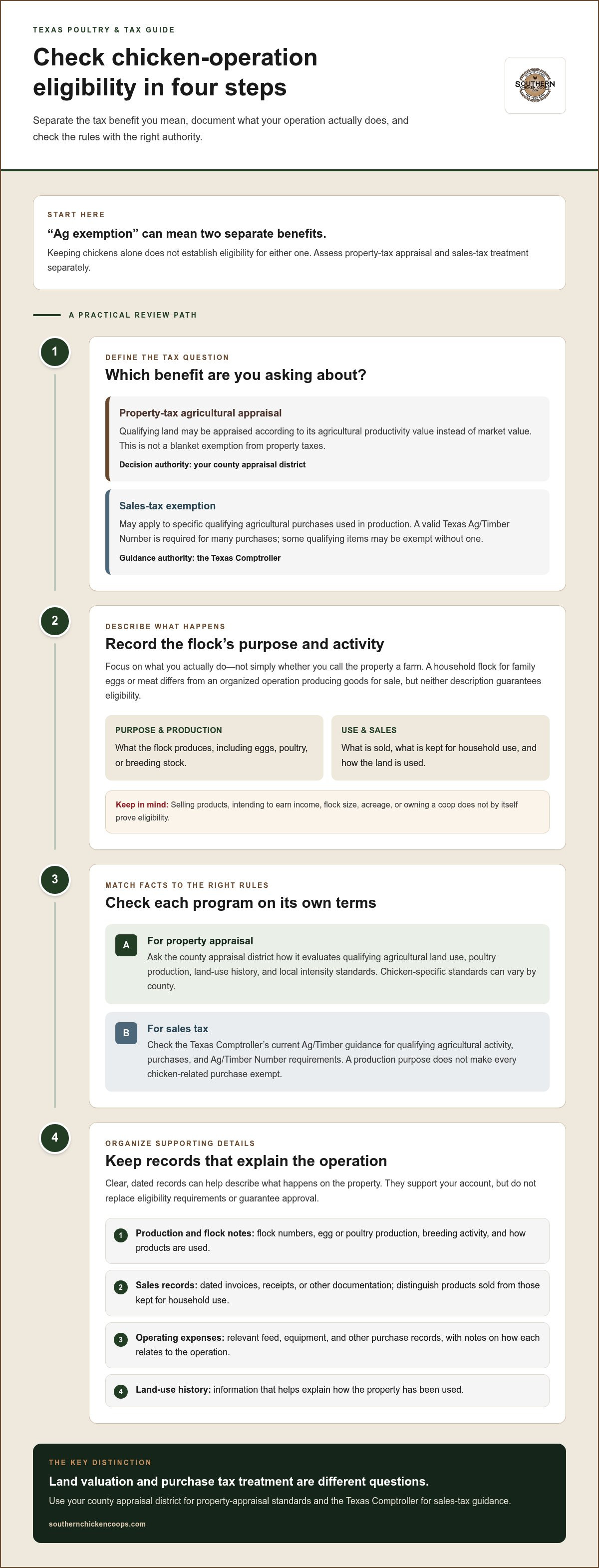
A little preparation can make a tax question easier to answer. Before filling out a form or presenting a purchase certificate, gather the facts about your flock and property. Then use the authority responsible for the benefit you’re asking about. This process can help you avoid following the wrong route, but it doesn’t guarantee approval.
- Identify the tax question. Are you asking about an agricultural appraisal for land and property taxes, or sales-tax treatment for a particular purchase? Treat these as separate questions because each has its own requirements and decision-maker.
- Describe your flock’s purpose. Note whether you raise chickens for household eggs or meat, sell eggs or poultry, breed birds, or combine these activities. Be specific about what you produce and what you sell or keep for personal use.
- Summarize the land use. For a property-tax question, gather the parcel’s location and acreage, how the land is used now, and any available history of agricultural use. Review the county appraisal district’s local standards for poultry operations.
- Organize operating records. Pull together dated production and sales records, flock notes, and relevant feed or equipment receipts. These documents can help explain your activity, but they don’t replace the eligibility rules.
- Verify requirements before acting. Direct property-appraisal questions to the county appraisal district. For Ag/Timber registration, certificates, and purchase questions, use current Texas Comptroller instructions. Confirm the applicable forms, deadlines, and requirements before filing or making a purchase you expect to be exempt.
A practical pre-application checklist
Before you contact an office, write down the parcel details, land-use history, flock purpose, sales activity, and records you have available. Then state your question in one sentence, such as whether the land may qualify for agricultural appraisal or whether a particular purchase may qualify for a sales-tax exemption. This makes it easier to direct your research to the right authority and current-year rules.
Common mistakes that can create confusion
A small flock, rural address, or coop doesn’t prove eligibility. A sales-tax certificate also doesn’t establish that land qualifies for agricultural appraisal. Avoid relying on acreage thresholds, deadlines, or examples from social posts without checking current requirements for your county and tax route. Procedures can differ, so verify the details before submitting an application or claiming an exemption.
Once you’ve researched the tax requirements, plan housing around your flock and prepared site. Southern Chicken Coops builds handcrafted and semi-custom chicken coops in McGregor, Texas, with delivery to a prepared, level lot. Explore custom chicken coop options as part of your poultry plans, separate from tax eligibility.
Plan Chicken Housing Separately from Your Texas Tax Eligibility
A tax decision and a housing decision serve different purposes. Buying or building a coop doesn’t create eligibility for an agricultural appraisal or sales-tax exemption. A coop’s size or style can’t substitute for the applicable tax requirements. Keep research with the county appraisal district or Texas Comptroller separate from planning shelter that suits your flock and property.
Keep the tax decision and housing decision distinct
Once you’ve reviewed the tax rules, turn to the everyday needs of your birds. Consider your flock’s purpose and size, where the coop will sit, how you’ll prepare the site, and the conditions around your property. These are practical housing considerations, not proof of agricultural use or a guarantee of tax approval. A prepared, level location is also important when arranging delivery of a completed coop.
For more site-planning context, our Texas backyard chicken coop preparation guide can help you think through the ground and placement before choosing housing. Consider how the coop will fit the site and your routine. A thoughtful layout supports day-to-day care, while tax eligibility must still be evaluated under the rules for the benefit you’re seeking.
It may help to keep two short planning lists:
- Tax questions: Which benefit are you asking about, and which official authority handles it?
- Flock needs: What kind of housing fits the birds and the way you care for them?
- Property preparation: Where can a coop sit on a prepared, level area, and how will it fit the property?
Separating these decisions is especially helpful if you’re claiming ag exemption for chickens in Texas. Don’t choose a coop to try to meet a tax threshold, and don’t assume an agricultural appraisal makes a particular housing purchase sales-tax exempt. Verify tax requirements on their own terms, then plan your flock’s housing around the birds and the site.
Explore a locally handcrafted coop when you are ready
Southern Chicken Coops is a family-owned maker in McGregor, Texas, crafting coops one at a time. Options include handcrafted and semi-custom designs, including the 6'x12' Polka model, designed for durability and functionality in the Texas climate. Each completed coop is professionally delivered to a prepared, level lot. Choose housing based on your flock and property, not on whether a tax benefit is approved.
After reviewing the current tax requirements and considering your site, explore handcrafted chicken coops for your flock.
Move Forward with a Clear Plan
Your next step can be straightforward. Write down the questions you still have, review the tax rules with the appropriate official source, and make housing decisions based on the flock you plan to care for. Taking these steps separately helps avoid confusing a coop purchase with tax qualification.
If you’re still researching claiming ag exemption for chickens in Texas, keep your notes and records organized as your plans develop. Tax rules and local standards should guide any application, while your birds’ needs and your property should guide their shelter. A well-planned home for your flock is worthwhile in its own right.
When you’re ready to plan housing, explore handcrafted chicken coops from Southern Chicken Coops. We build custom and semi-custom coops in McGregor, Texas, and deliver completed coops to prepared, level lots.
Frequently Asked Questions
Can I claim an ag exemption in Texas for a few backyard chickens?
A few backyard chickens don’t automatically qualify for a Texas tax benefit. If you’re claiming ag exemption for chickens in Texas, first decide whether your question concerns land appraisal or sales tax. Hens kept for household eggs present different facts from a flock producing goods for sale, but neither purpose alone determines eligibility. Write down how you use the birds and property, then review the relevant rules with the county appraisal district or Texas Comptroller.
Do I need to sell eggs to qualify for an agricultural appraisal in Texas?
Selling eggs may help describe the operation, but sales alone don’t guarantee an agricultural appraisal. The district evaluates the land’s use under the standards for that county. Occasional egg sales, for example, may not fully describe how a parcel is managed. Keep a clear account of production, sales, household use, and land activity, then review how the appraisal district evaluates those facts.
Is a Texas ag exemption the same as an Ag/Timber Number?
No. An agricultural appraisal concerns the property-tax valuation of qualifying land, while an Ag/Timber Number is associated with certain agricultural or timber purchases for sales-tax purposes. They aren’t interchangeable. Having a number for eligible purchases doesn’t establish that a parcel qualifies for agricultural appraisal. Identify whether your question is about a property-tax notice or a purchase receipt, then follow the instructions for that program.
How do I apply for an agricultural appraisal for chicken farming in Texas?
Start with the county appraisal district that serves the property and review its current application instructions. Gather the parcel identification, a description of your poultry activity, land-use information, and relevant production or sales records. Confirm which documents the district requires, how to submit them, and the deadline for your filing. County guidance provides the process for your parcel, which may differ from examples for other areas.
Can I use an Ag/Timber Number to avoid sales tax on chicken feed?
Not automatically. Texas rules distinguish among agricultural purchases, and having an Ag/Timber Number doesn’t make every feed or farm-related expense exempt. Before buying, review the Comptroller’s current instructions for the specific feed and how it will be used. Keep the receipt and any required exemption documentation with your operating records. If the item’s status is unclear, use the Comptroller’s guidance rather than assuming the number covers it.
What happens if my chickens are only for my family?
A flock kept for family use may be treated differently from poultry raised as part of agricultural production, but the answer depends on the tax program. Note whether eggs are shared, sold, or used only at home, and whether the land supports other agricultural activity. Describe the actual use plainly when reviewing the rules with the county appraisal district or Texas Comptroller. Don’t change how you characterize the flock just to fit a tax label.
Does owning a chicken coop help me qualify for an ag exemption?
No. A coop provides shelter, but owning one doesn’t prove that land or a purchase meets tax-program requirements. A coop’s size, cost, or placement shouldn’t be treated as approval evidence on its own. Choose housing for the birds and the site, and handle tax questions separately through the authority responsible for the relevant program. This keeps flock planning grounded in practical needs rather than assumptions about tax eligibility.


