

The lower quote may not be the lower-cost choice once delivery, size, and included features are considered. That’s why the cost of Amish coops vs Texas built coops is best compared by looking beyond the headline price. An Amish-built coop and a Texas-built one may differ in dimensions and what comes with them, so the first numbers you see may not describe equivalent homes for your flock.
It’s natural to look for a clear winner when investing in a safe, lasting home for your chickens. Start by matching the coop’s size and scope, then consider delivery and how the design fits your Texas property. This guide walks through the factors that shape the full purchase, from included features to site readiness. As a concrete reference point, Southern Chicken Coops’ handcrafted Polka model measures 6 by 12 feet, and completed coops are delivered to a prepared, level lot. With the details side by side, you can make a more informed choice for your flock and your land.
Key Takeaways
- A fair cost of Amish coops vs Texas built coops comparison starts with equivalent dimensions and a clear list of what each quote includes.
- Track the run, customization, delivery, and site readiness as included, optional, or outside the quoted scope.
- Consider your property’s placement needs and local heat and weather when weighing a coop’s fit.
- Use the same checklist for every quote, from flock requirements and dimensions to delivery logistics.
- A locally handcrafted or semi-custom coop can be a practical option when you want a defined design or a closer fit to your Texas property.
Cost of Amish Coops vs. Texas-Built Coops: Why the Sticker Price Can Mislead
A quote is useful only when you know what it covers. To compare the cost of Amish coops vs Texas built coops fairly, line up coops with similar dimensions, included structures, finish, delivery arrangements, and placement requirements. One quote may cover only the coop, while another includes an attached run or delivery. Until you compare the same scope, the price difference doesn’t tell you which option offers better value.
Compare individual builders rather than treating “Amish” or “Texas-built” as a complete product description. Those labels provide context, but they don’t specify dimensions or included features. The Amish culture and economy has a broader history and context, but a coop’s value depends on its design and written scope.
What does a coop quote actually cover?
Separate the main coop structure from anything attached to it. A run may be included in one quote, offered as an option in another, or not part of the design. Then compare practical details such as exterior dimensions, finish, stated flock capacity, delivery, placement, and site preparation. These details can make two coops very different purchases, even if they look similar in a photo.
- Structure: Note the coop’s dimensions and what the quoted scope includes.
- Run and additions: Record whether an attached run or other options are included, optional, or excluded.
- Delivery and readiness: Separate delivery and placement from site preparation. Southern Chicken Coops delivers completed coops to a prepared, level lot, so plan to have the site ready before delivery.
Compare stated flock capacity as well as dimensions. Two structures with similar footprints may be designed for different uses. Review the layout and capacity information before treating the quotes as equivalent.
Why the Amish label is not a specification
“Amish-made” identifies the maker or building tradition, but it doesn’t specify a coop’s materials, dimensions, finish, or included features. Those details vary by builder and design. The same is true of a Texas-built label: it doesn’t establish a uniform standard across Texas builders. Compare the particular coop and its written scope, not a regional shorthand.
For example, one quote might describe a compact coop without a run, while another covers a larger structure with an attached run. Calling one Amish-built and the other Texas-built doesn’t make their scopes equivalent. Write down what each quote covers, mark optional or unspecified items, and compare the details before judging the price.
This keeps the comparison focused on the home your flock will use. Look for clear dimensions, included structures, finish details, delivery terms, and the site conditions required for placement. Then assess the specific coop and builder rather than relying on assumptions about where it was made.
Which Cost Factors Change the Amish-versus-Texas Coop Comparison?
A useful comparison turns each quote into the same set of questions. The delivered cost is the total for the quoted scope through delivery and placement, including the coop, any included structures, and stated delivery terms. Site preparation is a separate planning item unless the quote specifically says otherwise.
Use the same status for every factor: included, optional, or outside the quote. If a detail is missing, mark it as unclear rather than assuming it comes with the coop. That makes differences visible before you compare the quoted amounts.
| Scope factor | What to compare | Record as |
|---|---|---|
| Size | Matching floor dimensions and stated flock capacity | Included, optional, or outside the quote |
| Run | Whether there is an attached run, plus its dimensions | Included, optional, or outside the quote |
| Customization | Requested changes compared with the base design | Included, optional, or outside the quote |
| Delivery | Delivery destination and whether placement is described | Included, optional, or outside the quote |
| Site readiness | Whether the lot must be prepared and level before delivery | Included, optional, or outside the quote |
Compare equivalent coop sizes and included structures
Begin with floor dimensions. A smaller coop and a larger one aren’t comparable just because each quote gives one total. If sizes differ, note that before judging the amounts. Treat the run as a separate structure: record whether it’s attached, whether it’s included, and how its dimensions compare. This keeps a coop-only quote from appearing equivalent to one that covers both a coop and a run.
Account for delivery, customization, and readiness
Write down the delivery destination and whether placement is part of the stated service. Separate requested customizations from the base design, too. Custom work changes the scope, but it doesn’t automatically make a coop a better value. Its value depends on whether those changes meet your needs. Finally, note any preparation required at the destination. Southern Chicken Coops delivers completed coops to a prepared, level lot, so include site readiness in your plans.
For a concrete size reference, the 6-by-12-foot Polka model gives you a defined footprint to compare with another quote. Set its dimensions and delivery scope beside the other coop, then account for differences rather than relying on regional labels. Explore Texas-built chicken coops as one example of a locally handcrafted option with a defined design.
Does a Texas-Built Coop Offer Better Value for a Texas Property?
A coop’s value partly depends on how well its design and placement suit your property. Texas-built doesn’t automatically mean more durable or better for every Texas site, just as Amish-built doesn’t mean a coop is a poor fit. Consider how each specific design, delivery plan, and placement requirement works for your flock and land.
Start by picturing where the coop will sit. Is the spot exposed to sun for much of the day, or does it have shade? How might seasonal weather affect the location? These are planning considerations, not guarantees about how a particular coop will perform. Compare the design details and stated specifications with your property’s conditions instead of treating the builder’s location as proof of climate suitability. Our Texas chicken coop buying guide offers broader regional context for that decision.
Consider regional conditions without relying on labels
Before comparing designs, make a short site note: intended placement, sun exposure, available space, and the local weather conditions you want to plan around. Then assess whether each coop’s described design suits that setting. A Texas origin provides context, but it can’t replace specifications. Assess an Amish-built coop on its individual design rather than ruling it out because of its origin.
This keeps the comparison grounded in your property. If two coops differ in design or stated features, record those differences instead of assuming one will handle Texas conditions better. Value comes from the fit between the coop, your flock’s needs, and the location you can prepare.
Include distance and placement in the value calculation
Delivery terms matter because the destination and placement plan affect the practical purchase. Compare the delivery destination, any distance-related terms, and whether placement is described. Don’t assume the arrangements are alike just because both builders sell completed coops. Record the terms in each quote and account for differences when you assess the full scope.
For Southern Chicken Coops delivery, the lot must be prepared and level. Site preparation and delivery are separate parts of the plan, so have the lot ready before the coop arrives. Our Texas coop delivery guide explains how to plan for that preparation.
These property and logistics details can change how you interpret the cost of Amish coops vs Texas built coops. A suitable design and workable delivery plan may make one coop a better fit for your situation, but origin alone can’t establish that. Compare each seller’s terms with your site, placement needs, and intended use, then weigh the overall fit alongside the quoted scope.
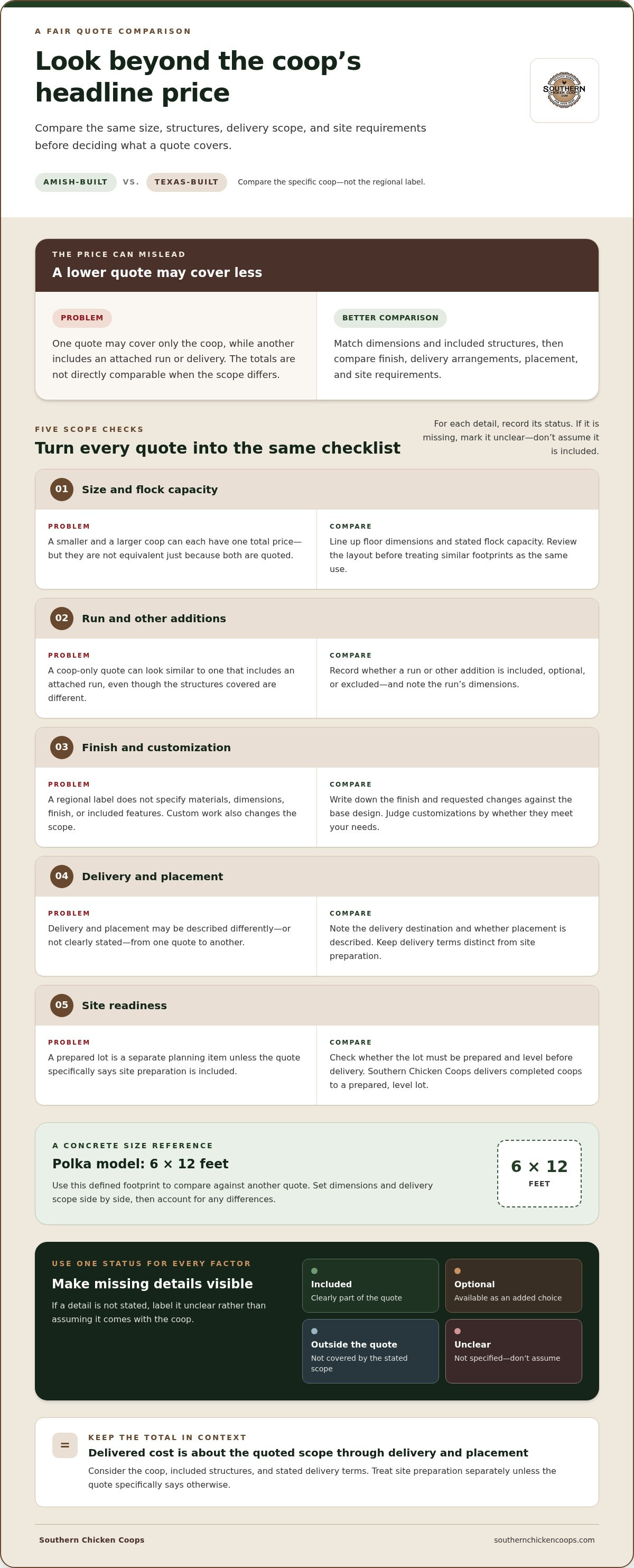
How to Compare Amish and Texas-Built Coop Quotes Fairly
A consistent checklist turns different-looking quotes into a practical comparison. Use the same steps for every builder, keeping your flock’s needs and property in view. That way, the cost of Amish coops vs Texas built coops reflects differences in actual scope rather than assumptions about the builder’s origin.
- Define your flock’s needs. Write down the flock size you’re planning for and how you intend to use the coop. Decide whether you need an attached run, and note features that matter to your daily routine. This gives every quote the same starting point.
- Standardize the dimensions. Set a target footprint before comparing amounts. Record the coop’s floor dimensions separately from any run, and note stated flock capacity. If a quote describes a different size, mark the difference rather than treating the options as interchangeable.
- List every inclusion. For each design feature or requested change, write “included,” “optional,” or “excluded.” If the quote doesn’t say, mark it “not specified.” Don’t count an unclear item as included or assign it a value. Keep customization separate from the base design so you can see how it changes the scope.
- Compare delivery logistics. Note the destination, stated delivery terms, whether placement is described, and what the site must be like beforehand. Keep lot preparation distinct from delivery. A prepared-site requirement affects your plans even when it isn’t part of the quoted work.
- Assess the fit. Review the written construction and customization details alongside your flock’s needs and intended placement. Ask whether the described scope suits your use, not whether its regional label sounds reassuring.
Keep the checklist beside each written quote rather than relying on memory or sales-page headlines. For example, Southern Chicken Coops’ 6-by-12-foot Polka model provides a defined footprint to compare with another coop. If the dimensions differ, you can spot the mismatch and decide whether you’re comparing equivalent options or weighing different sizes.
Once the scopes are clear, consider value in context. A custom feature may be worthwhile if it addresses a real need, but customization alone doesn’t establish better value. Consider what the change adds, whether it suits your flock, and how it affects delivery or placement planning. Documented details are more useful than general assumptions about Amish or Texas-built craftsmanship.
For a separate discussion of Texas pricing, the custom coop cost guide provides additional context. To consider how local design choices relate to a handcrafted coop, explore this handcrafted coop comparison. If you’re ready to apply the checklist to a locally crafted design, explore custom chicken coops as one option for your comparison.
When a Handcrafted Texas Coop Makes Sense for Your Flock
A locally handcrafted coop may suit you if you want a defined design to compare or prefer a semi-custom approach. The right fit depends on your flock, the space available on your property, and the scope that meets your needs. A Texas address alone doesn’t guarantee a coop suits every site, just as an Amish label doesn’t establish whether a particular design is right for your flock.
As you weigh the cost of Amish coops vs Texas built coops, focus on which specific coop gives you a clear, relevant scope. Southern Chicken Coops is a family-owned business in McGregor, Texas, building handcrafted coops one at a time. Its 6-by-12-foot Polka model offers a concrete footprint for comparison, while semi-custom designs offer another option for buyers with specific needs.
Compare your needs with the Polka and semi-custom options
Begin with the space you have and the coop dimensions you’re considering. The Polka is a 6-by-12-foot signature model, so you can compare its footprint with the measurements of another design. If you have particular requirements, a semi-custom design may be a better starting point. Keep the comparison grounded in the scope and details that matter to your property and flock.
For a closer look at this footprint, the 6-by-12-foot coop guide provides more context. Use it to consider whether that size works for your planned placement and how it compares with the dimensions in other quotes.
Make the next step simple
Before choosing, revisit your notes: flock needs, intended location, dimensions, included scope, and delivery terms. Southern Chicken Coops delivers completed coops to the customer’s prepared, level lot, so include site readiness in your delivery plan. Delivery and site preparation are distinct parts of the process. Have the lot prepared and level before the coop arrives.
A careful comparison doesn’t need to force a winner based on origin. It helps you see which design fits your needs and what the purchase involves, so you can make a considered choice for your flock and property. Let the written scope and the fit with your site guide your decision.
If a handcrafted or semi-custom Texas coop sounds like a good fit, explore our handcrafted coop options and compare the designs with your property and flock’s needs.
Choose the Coop That Feels Right for Your Flock
Turn your comparison into a choice that fits everyday life on your property. Think about how your flock will use the space, where the coop will sit, and which details matter most. Then weigh the cost of Amish coops vs Texas built coops against that picture, not against a label or a price in isolation.
A good decision doesn’t have to mean choosing the lowest quote or the most elaborate design. It means understanding what you’re bringing home and how its scope fits your plans. If a handcrafted coop is part of that picture, explore the available options and consider which design suits your chickens and property.
Explore Southern Chicken Coops’ handcrafted and semi-custom chicken coops to compare the Polka model and custom options for your Texas property.
Frequently Asked Questions
Is an Amish-built chicken coop automatically better quality than a Texas-built coop?
No. An Amish-built label alone doesn’t establish quality or specify what a coop includes. Review the particular builder’s documented design, dimensions, materials, attached structures, and delivery scope. Material descriptions and construction details are more useful than broad reputations when comparing two specific coops. Note any details the documentation leaves unanswered. The fairest comparison is between the actual coops under consideration, not between labels.
How much does an Amish chicken coop cost?
There isn’t one reliable price for all Amish-built coops. Size, design, an included run, customization, and delivery arrangements can all change what a quote covers, so one buyer’s purchase story shouldn’t stand in for typical pricing. Compare written quotes for a similar footprint and intended use, and separate included items from optional ones. For Texas buyers, a current regional coop pricing guide can provide context, while the complete scope remains the soundest basis for comparison.
Can I compare an Amish coop quote with a Texas-built coop quote if the sizes differ?
You can compare them, but different dimensions make headline prices difficult to interpret. Record each coop’s floor dimensions, any attached run’s size, included features, and delivery terms. Then compare the options against the same requirements. If the designs can’t be aligned, describe the differences clearly, such as one offering more floor space or a run. Don’t conclude that one is better value from its quoted amount alone.
Does “Amish-built” guarantee a particular coop design or set of features?
No. “Amish-built” identifies a maker or building tradition, not a universal specification sheet. The actual design and construction details depend on the individual coop and seller. To avoid assumptions, keep a written record of the dimensions, included structures, requested customizations, and materials described for the specific design. That lets you evaluate what’s being offered without assuming every Amish-built coop shares the same features.
Will an Amish coop seller deliver a coop to Texas?
Delivery terms vary by seller and coop; the Amish label alone doesn’t establish a Texas delivery area or indicate that delivery is included. In your comparison, record the destination, placement arrangements, and site-preparation requirements stated in the quote. This helps distinguish the coop’s quoted scope from the practical steps needed at your property.
How can I judge whether a chicken coop is worth its cost over time?
Judge value by how well the coop suits your flock, property, and intended use, then consider its documented construction details and delivery plan. For the cost of Amish coops vs Texas built coops, a broad origin label can’t establish long-term savings or lifespan. Instead, consider whether the design meets your needs and whether its stated scope fits your plans. Avoid assuming that a higher quote guarantees fewer upkeep needs later.


