

What if the best chicken coop for your Texas farmstead isn’t the biggest one, but the one that fits your flock, property, and daily routine? Choosing Texas farmstead chicken housing means balancing room to roam with protection from raccoons, foxes, bobcats, and birds of prey. It’s natural to wonder whether a standard layout will work, which construction details matter, and whether your site is ready for delivery.
Before you choose, compare coop and run layouts, estimate space needs from your flock size, and consider how you’ll access the housing for daily care. Details such as half-inch hardware cloth, door access, drainage, and a level delivery site can all affect how well the setup fits your farmstead. This guide walks through those decisions and explains when a standard layout or semi-custom design may suit your property.
Key Takeaways
- Choose Texas farmstead chicken housing around your flock size, property, and daily care routine, with Texas weather and predators in mind.
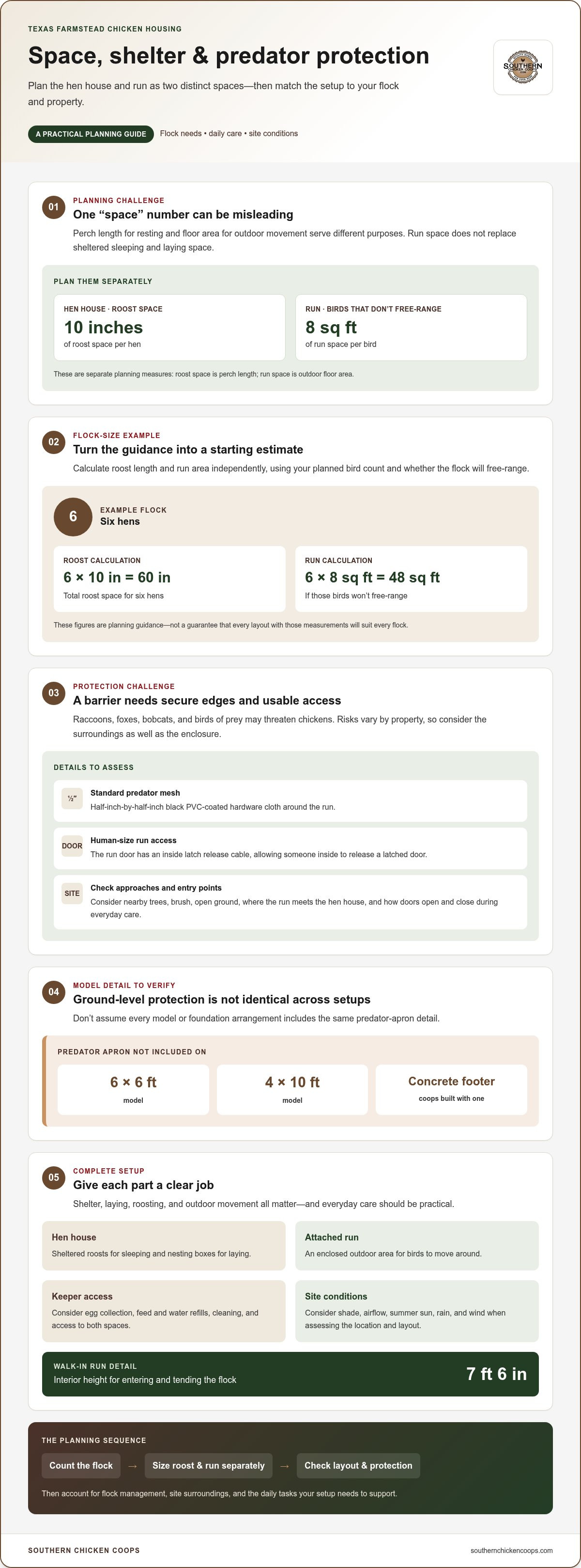
- Plan for 10 inches of roost space per hen and, for birds that don’t free-range, 8 square feet of run space per bird.
- Compare standard and semi-custom layouts by footprint, access, flock separation, and how the run will fit your farmstead.
- Prepare a level site before delivery, including a pad at least 8 feet by 8 feet larger than the coop dimensions.
- Learn what to expect from a completed coop handcrafted in McGregor, including turnkey model delivery within 50 miles of the shop.
What Does Texas Farmstead Chicken Housing Need to Do Well?
Texas farmstead chicken housing is a coop-and-run setup planned around the flock, the land, and the keeper’s daily routine. The right arrangement gives hens a sheltered place to sleep and lay, plus outdoor room for activity. It also accounts for site conditions, including summer sun, rain, wind, and the predators that visit the property.
Start with how your flock lives. Birds that free-range part of the day may use the run differently from birds that stay enclosed, but all need a secure place to return to. Consider how you’ll collect eggs, refill feed and water, and clean the housing. A layout that makes these regular tasks comfortable is more likely to work well over time.
Which farmstead needs should shape the housing choice?
Flock size is only the starting point. Laying hens need nesting boxes and roosts. If you keep separate groups, consider how the housing can keep those flocks apart. Also check whether the coop and run will fit the available space without making daily access awkward.
Protection priorities depend on your property. Raccoons, foxes, bobcats, and birds of prey can threaten chickens, but risks vary by location and surroundings. Consider nearby trees, brush, open ground, and other places predators might approach from. A thoughtful layout pairs secure shelter with predator-conscious barriers rather than relying on a single feature.
What belongs in a complete coop-and-run setup?
The hen house provides sheltered roosts for sleeping and nesting boxes for laying. A ramp can connect an elevated hen-house entrance to the ground or run. The attached run is an enclosed outdoor area where birds can move around. These spaces serve different purposes, so don’t treat run area as a substitute for sheltered sleeping and laying space.
Southern Chicken Coops builds completed housing with a hen house, roost bars, nesting boxes, and a walk-in run. The run’s interior height is 7 feet 6 inches, providing room for a keeper to enter and tend the flock. Standard predator mesh is half-inch-by-half-inch black PVC-coated hardware cloth. Standard construction uses robust SPF lumber, pressure-treated where it contacts soil.
Shade and airflow also deserve attention when you assess the location and layout. Shade can give birds relief from direct sun, while appropriate ventilation helps air move through the housing. Consider exposure to wind and rain, and keep access to the hen house and run practical for everyday care. A well-matched setup brings these details together rather than asking one part of the coop to meet every need.
How Much Space and Predator Protection Should Texas Chicken Housing Provide?
Plan space around the flock you intend to keep and how the birds will use their enclosure. Southern Chicken Coops recommends 10 inches of roost space per hen in the hen house. For chickens that won’t free-range, allow 8 square feet of run space per bird. These are separate measures: roost space is perch length for resting, while run space is floor area for outdoor movement.
How should keepers estimate space for their flock?
Start with your planned bird count, then calculate each space separately. For example, a flock of six hens needs 60 inches of total roost space. If those birds won’t free-range, the run-space guidance works out to 48 square feet. These figures are planning guidance, not a guarantee that every layout with those measurements will suit every flock.
Next, consider how you’ll manage the birds. Will they spend time outside the run, or will the enclosure be their main outdoor space? Do you expect to keep growing birds or separate groups? Those choices affect how usable the floor area is and whether the doors, paths, and interior arrangement make care straightforward. Allow for possible changes in flock size or management instead of choosing solely by a model name or advertised capacity.
Which construction details support predator-conscious housing?
Wire and entry points both matter. Southern Chicken Coops uses half-inch-by-half-inch black PVC-coated hardware cloth as standard predator mesh. Its small openings create a barrier around the run. Secure doors are important, too. The human-size run door has an inside latch release cable, so someone inside can release a latched door.
As you compare layouts, look at where the run meets the hen house and how doors open and close during everyday care. A barrier is only useful when its edges and access points are considered as part of the enclosure. Don’t assume every model or foundation arrangement includes the same ground-level protection. A predator apron isn’t included on 6-by-6-foot or 4-by-10-foot models, or on coops built with a concrete footer.
Use a practical selection process: estimate roost length from the number of hens, calculate run area based on whether they’ll free-range, then consider flock management and the protection details suited to your property. This gives you a more useful starting point than relying on a capacity label alone. Southern Chicken Coops handcrafts ready-to-use and custom chicken coops in McGregor, Texas, with layouts for different flock and site needs.
How Should You Compare Standard and Semi-Custom Farmstead Coop Layouts?
A coop layout should fit the shape of your property and the way you care for your flock. A standard design gives you a defined footprint to plan around. Semi-custom housing can suit a site, access need, or flock-management plan that calls for a more tailored arrangement. Compare practical priorities before deciding which approach fits your Texas farmstead chicken housing project.
| Farmstead priority | Standard layout may fit when… | Semi-custom layout may fit when… |
|---|---|---|
| Footprint | The prepared area can comfortably accommodate a set coop size. | The available site has unusual dimensions or specific placement limits. |
| Daily access | A straightforward route works for tending birds and collecting eggs. | Doors, paths, or the run need to work around existing features or routines. |
| Flock management | The flock will use one simple arrangement. | You’re planning distinct groups or need to think carefully about separation. |
| Run arrangement | A familiar attached-run configuration suits the property. | The run’s placement or relationship to the coop needs to respond to the site. |
When can a standard coop layout be a good fit?
A standard footprint can simplify planning if you have a prepared space and a straightforward flock routine. Southern Chicken Coops’ Polka is a 6-by-12-foot model, giving you a specific footprint to compare with your site. Other standard options include the 4-by-8-foot Value Coop, the 4-by-10-foot Chicken Dance, and the 6-by-6-foot Square Dance. For more information about the Polka, see the 6x12 chicken coop guide.
When might a semi-custom layout better match a farmstead?
A semi-custom design may suit a narrow or irregular area, a specific route to the coop, or plans to manage distinct groups of birds. These needs can guide the sizing and arrangement of a coop without assuming that one design suits every property. Explore how custom chicken coop options can be shaped around your project.
Before settling on a layout, sketch the usable area and mark access routes, nearby obstacles, and the intended run position. Then consider how your flock will use the space and whether the arrangement supports your daily routine. This keeps the decision grounded in the site and the birds, rather than a capacity label or appearance alone.
How Do You Prepare a Texas Farmstead Site for Chicken Housing?
Preparation makes delivery and placement more straightforward. Choose a spot that stays level and isn’t prone to flooding, then prepare a pad sized for the coop and its placement needs. The ground beneath a completed structure is not an afterthought; planning it carefully helps create a suitable foundation for your Texas farmstead chicken housing.
Plan a pad at least 8 feet larger than the coop in both length and width, add 2 to 4 inches of sand over soil for drainage, and make sure the finished ground is level and not flood-prone.
What should be ready before coop delivery?
Use this checklist to prepare the site. Measure the selected coop’s length and width first, then allow the stated extra space on each dimension. Add the sand layer over soil to support drainage.
- Measure the coop footprint. Record its length and width so the prepared pad can be sized correctly.
- Allow room around the footprint. Make the pad at least 8 feet larger than the coop dimensions in both length and width.
- Choose suitable ground. Select a level location that isn’t prone to flooding.
- Prepare for drainage. Spread 2 to 4 inches of sand over the soil.
- Check the finished surface. Make sure the prepared area is level before delivery and placement.
Measure the specific coop you’ve chosen rather than estimating from memory. If the planned area has a slope or tends to collect water, reconsider the placement before preparing the pad. These checks help ensure the site is ready for a completed coop to be delivered to prepared, level ground.
When might a concrete footer be needed?
Some installations may require a concrete footer, including the Texas Two Step. Plan the site around the chosen design and its intended position. Keep the footer in mind as you prepare the area rather than treating it as an adjustment after the pad is finished. A concrete footer does not include a predator apron.
Once the footprint, drainage, and ground conditions are settled, you’ll have a clearer picture of what needs to be ready before delivery. Explore ready-to-use chicken coops as you match a completed housing layout to your prepared farmstead site.
What Should You Expect from a Ready-to-Use Texas Farmstead Coop?
Southern Chicken Coops handcrafts completed coops one at a time in McGregor, Texas, then delivers them to prepared, level lots. You’re choosing a finished home for your flock, not a kit to assemble. That makes site preparation an important part of the process: the coop is built before delivery, and the placement area needs to be ready when it arrives.
What does ready-to-use mean for the buyer?
Your part begins with the property. Select the location, prepare a suitable level site, and make sure the planned spot and access route fit the coop you’ve chosen. Southern Chicken Coops delivers completed housing to prepared, level lots. Delivery for turnkey models within 50 miles of the McGregor shop is included. Beyond that distance, extra miles are charged at $4 per loaded mile. The Texas chicken coop delivery guide provides more detail on what to expect.
Materials and finish are part of the completed structure. Standard construction uses robust SPF lumber, pressure-treated where it contacts soil. Standard predator mesh is half-inch-by-half-inch black PVC-coated hardware cloth. The standard roof is silver/galvalume metal, and the standard paint finish is classic white. Other roof colors and paint colors are optional upgrades.
These details help you understand what you’re bringing onto your property, but they don’t replace choosing the right layout for your flock. Keep the coop dimensions and placement in mind as you prepare the site. A level, ready area helps make the handoff from workshop to farmstead clear and practical.
How can buyers take the next step with Southern Chicken Coops?
Compare the standard and semi-custom housing options against your flock’s needs, the space you have, and the way you’ll care for the birds each day. Southern Chicken Coops builds in McGregor, with included turnkey model delivery within 50 miles of the shop.
As you consider Texas farmstead chicken housing, bring together your decisions about flock size, layout, predator-conscious construction, and site readiness. The right choice is the one that makes sense for your birds and your property, not simply the one with the most features. Explore standard and semi-custom housing at Southern Chicken Coops.
Take the Next Step Toward a Coop That Fits
Choosing a home for your flock is also a chance to make daily care more manageable. Picture the ordinary tasks: tending the birds, collecting eggs, and making sure each part of the setup works with the way you use your land. That practical view can help turn your Texas farmstead chicken housing plans into a choice that fits your flock and property.
Southern Chicken Coops handcrafts completed coops one at a time in McGregor, Texas, using standard half-inch-by-half-inch black PVC-coated hardware cloth. Completed coops are delivered to prepared, level lots, so site planning is part of creating a smooth start for the birds.
Ready to explore housing for your farmstead? View ready-to-use and semi-custom chicken housing from Southern Chicken Coops.
Frequently Asked Questions
How much space does each chicken need in a coop and run?
Plan for 10 inches of roost space per hen inside the hen house. For birds that won’t free-range, allow 8 square feet of run space per chicken. For example, four hens would need 40 inches of total roost space and 32 square feet of run area using this guidance. Treat these as separate measurements, then consider how your flock uses the space and whether its size may change.
Is a walk-in chicken run useful on a farmstead?
A walk-in run lets you enter the enclosure to tend birds and check their surroundings. Southern Chicken Coops’ walk-in runs have a 7-foot-6-inch interior height and a human-size door with a 6-foot-3-inch opening. Consider how the entrance lines up with your usual path to the coop, especially if you’ll carry feed or supplies through it.
What should I put under a chicken coop for drainage?
A prepared pad can include 2 to 4 inches of sand over soil to support drainage. Choose a level location that isn’t prone to flooding, rather than a low spot where water tends to gather. If possible, look at the site after rain to spot drainage concerns before the coop is placed. Follow the placement needs of the coop and its foundation.
Can a chicken coop be delivered to a prepared farmstead site in Texas?
Southern Chicken Coops delivers completed coops to prepared, level lots. Delivery for turnkey models within 50 miles of the McGregor shop is included. Extra miles are charged at $4 per loaded mile. Plan the destination and access route ahead of time so the site is ready for placement. The coop arrives built, so your main preparation is having the intended spot level, suitable, and clear for delivery.
What is the difference between a standard and semi-custom chicken coop?
A standard coop follows a defined layout and footprint, which can work well when your site and flock routine fit that arrangement. A semi-custom coop offers a tailored approach for needs such as unusual property dimensions, access preferences, or plans to manage separate groups of birds. Compare the usable space and how you’ll care for the flock, rather than choosing by a model label alone.
How do I protect chickens from predators in Texas?
Use sturdy barriers and pay attention to how the run and doors close. Southern Chicken Coops uses standard half-inch-by-half-inch black PVC-coated hardware cloth as predator mesh, along with an inside latch release cable on the human-size run door. Consider the predators active around your property, such as raccoons, foxes, bobcats, or birds of prey, when planning where the housing will sit.
Does a concrete footer affect predator-apron inclusion?
Yes. A predator apron isn’t included on coops that use a concrete footer. It also isn’t included on the 6-by-6-foot or 4-by-10-foot models. Keep the foundation type and apron details in mind as you compare coop layouts, so you understand how the chosen setup addresses ground-level protection before preparing the site.


