

A pasture-raised flock can be ready before your egg-selling rules are. According to the Texas Department of Agriculture, producers need an Egg License to sell graded eggs from their personal flock; Texas law allows producers to sell eggs without a license if they don’t grade them. The distinction matters from the start when you’re planning to sell eggs in Texas.
It’s natural to focus first on the hens, pasture, and daily care. But starting a pasture-raised egg business in Texas also means understanding how grading, handling, refrigeration, and labeling affect how you can sell your eggs. This guide explains when a TDA Egg License is required, how the ungraded-egg exemption works, and what to consider when collecting, washing, cooling, and packing eggs. It also covers sourcing chicks or started pullets and planning suitable housing, so you can make informed decisions for your flock and business.
Key Takeaways
- Build a reliable egg routine around frequent collection, careful washing, prompt drying, and quick cooling.
- Understand how grading and your sales channel affect licensing, reporting, and the rules for selling eggs from your flock.
- Weigh the practical differences between raising chicks and buying started pullets, including the housing and care each requires.
- Plan for refrigeration and accurate carton details as part of safe handling and compliant sales.
- Match your coop and setup to your flock’s needs; custom coops and delivery can help with the housing part of your farm plan.
Hand-gathering, cleaning, and packing eggs
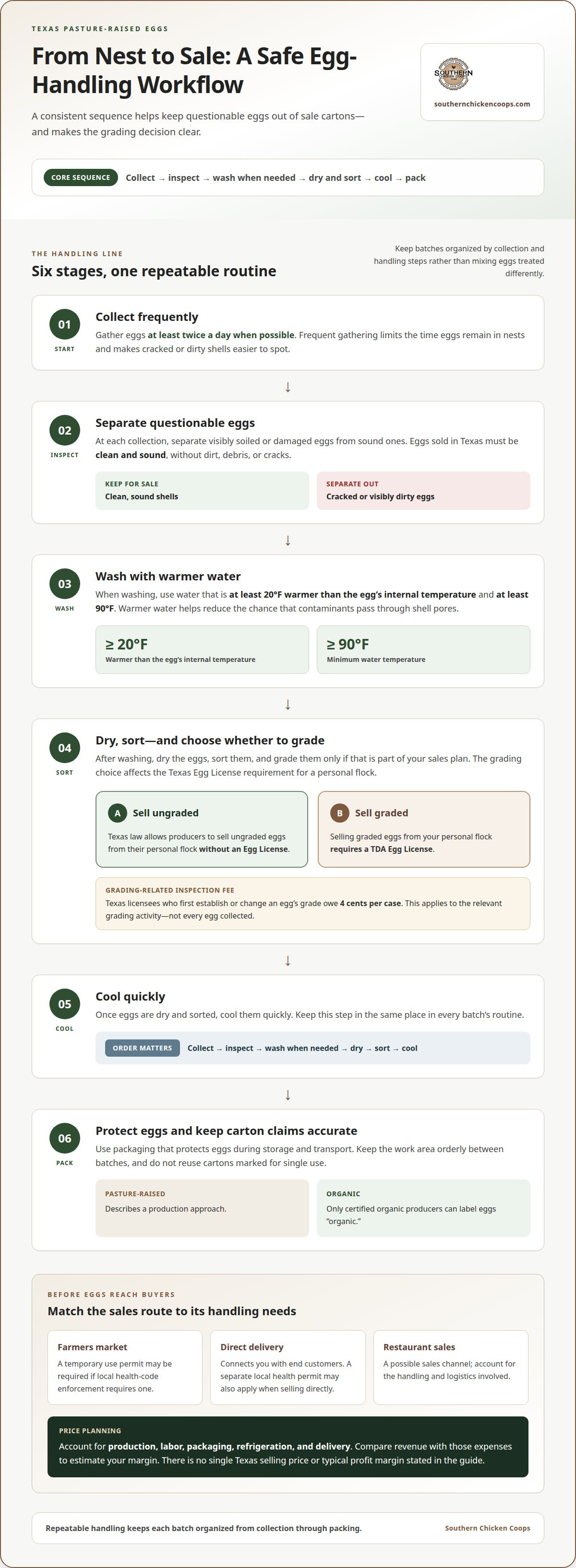
Set a collection routine before planning sales. Collect eggs at least twice a day when possible. Frequent gathering limits the time eggs remain in nests and makes it easier to spot cracked or dirty shells. At each collection, separate visibly soiled or damaged eggs from sound ones. Eggs sold in Texas must be clean and sound, without dirt, debris, or cracks.
For washing, use water at least 20 degrees Fahrenheit warmer than the egg’s internal temperature and at least 90 degrees Fahrenheit. The warmer water helps reduce the chance that contaminants pass through shell pores. After washing, dry the eggs, sort them, grade them if desired, and cool them quickly. Keep the handling sequence consistent: collect, inspect, wash when needed, dry, sort, then cool. This makes it easier to keep questionable eggs out of sale cartons.
Grading changes the licensing picture for a personal flock. According to the Texas Department of Agriculture, an Egg License is required to sell graded eggs from your own flock. If you choose to grade, keep that decision connected to your handling and packing routine. Texas licensees who first establish or change an egg’s grade owe an inspection fee of 4 cents per case. That fee applies to the relevant grading activity, not to every egg collected.
Sort eggs before packing so cracked or visibly dirty eggs don’t end up in customer cartons. Use packaging that protects eggs during storage and transport, and keep the work area orderly between batches. Cartons marked for single use cannot be reused. Organize batches by collection and handling steps instead of mixing eggs that have not received the same treatment.
Farmers markets, restaurant sales, and direct delivery are possible sales channels, each with different customer relationships and handling logistics. At a farmers market, obtain a temporary use permit if local health-code enforcement requires one. Direct delivery connects you with end customers.
There’s no single Texas selling price or typical profit margin for pasture-raised eggs. Set prices by accounting for production, labor, packaging, refrigeration, and delivery costs. Then compare revenue with those expenses to estimate your margin.
Some customers seek organic eggs, but that interest alone doesn’t qualify eggs for an organic label. Only certified organic producers can label eggs “organic.” Keep the distinction clear in conversations and on packaging: pasture-raised describes a production approach, while an organic claim requires certification.
Personal-flock egg sales and licensing exemptions
In Texas, whether eggs are graded affects the TDA Egg License requirement. Producers may sell ungraded eggs without that license; selling graded eggs from a personal flock requires an Egg License. A separate local health permit may also apply when producers sell their own eggs directly to end customers, through the Texas Department of State Health Services or the local health department. Starting a pasture-raised egg business in Texas means accounting for both your grading decision and how eggs reach buyers.
Choose a starting flock size that fits your time, housing, and likely customers. Penn State Extension recommends beginning small-scale layer production with 50 to 100 hens, giving new producers a chance to learn flock care and marketing before expanding. That range is a planning recommendation, not a requirement. A smaller flock may suit a household-scale operation, while a larger starting group means more daily care and housing capacity.
Flock size shapes everyday care, not just egg volume. Small-scale layer housing should provide at least 1.5 square feet of floor space per bird. Penn State Extension also advises that laying hens receive no more than 16 hours of light per day. Account for space, feed, water, and time before adding birds; a crowded or poorly managed flock can make routine care harder.
Pennsylvania’s small-flock rules offer a comparison, but they aren’t Texas rules. The described provisions cover producers with fewer than 3,000 laying hens who sell eggs within five days of lay, predominantly within 100 miles of the production or processing facility. Those eggs must be kept at 45°F or below from within 24 hours of lay until sale. Covered cartons must show net contents in letters at least 3/16 inch high. These Pennsylvania details shouldn’t be treated as Texas exemptions.
Business planning involves more than egg handling. Consider liability exposure, customer records, tax responsibilities, business registration, and whether local zoning allows poultry and sales at your property. These factors depend on the location and structure of your operation, so plan for them alongside flock capacity.
Texas heat, predators, and pasture conditions all affect outdoor flock management. Provide shade and water, secure birds at night, and rotate grazing areas so hens don’t exhaust the ground cover. Choose laying birds suited to local conditions, and source them from breeders who can explain their flock health practices. Allow used pasture time to recover between rotations.
Common startup risks include buying more birds than housing can support, underestimating daily labor, and expanding before sales are steady. Starting a pasture-raised egg business in Texas calls for matching housing and daily routines to the flock you can responsibly manage. A custom chicken coop can help align poultry housing with a carefully planned operation.
Chicks, started pullets, and breeder health
Your choice between chicks and started pullets determines how much early flock care happens on your farm. Chicks need a brooding area prepared before they arrive, plus close attention as they grow. Started pullets are typically 16 to 18 weeks old, so they arrive nearer laying age. That can shorten the wait for eggs, while requiring housing and daily routines ready for larger, older birds.
For chicks, prepare the brooding area before delivery and bring it to at least 95 degrees Fahrenheit at chick level. Arrange feed and water so each chick can reach them easily, then observe whether the group is eating, drinking, and settling. The 95-degree target applies before chicks arrive; their brooding needs change as they grow. A steady routine makes it easier to notice changes in activity or appetite.
Plan feed and water access around the number of birds. In small-scale layer production, one feed pan usually provides enough space for 20 birds, and the recommended watering capacity is one cup per 20 birds. Hen mash should contain at least 16 percent crude protein and 3.5 percent calcium. These figures help guide a practical feeding plan as pullets mature and begin laying.
Prepare nesting space before laying begins. A suggested minimum is two nests for the first four hens, then one additional nest for each additional four hens. Keep nests clean and accessible so hens use them consistently. Before pullets move into laying routines, have suitable nest access, feed, and water in place.
Start with careful sourcing and observation. Ask the breeder about the flock’s health history, how birds are raised, and what health records come with the sale. After arrival, observe each bird for alertness, movement, breathing, and interest in feed and water. Keep new birds separate from established poultry while assessing them, and record changes or concerns to discuss with an animal-health professional.
Keep simple records for each group, including source, arrival date, age, feed changes, and health observations. If you raise chicks, note when brooding conditions change. If you buy started pullets, record their age and how they adjust to the new setting. These details help connect later changes in laying or behavior with flock history. Choosing birds and housing together supports sound care from the start.
What Texas egg grading, labeling, refrigeration, and food safety rules apply to small producers?
Grading affects both sales paperwork and carton language. Texas Administrative Code, Title 4, Chapter 15, §15.2 addresses licensing for individuals selling graded eggs from personal flocks to end users. The carton rules are identified in Title 4, Chapter 15, Part 8. Keep the distinction clear: grading, labeling, and refrigeration are separate parts of preparing eggs for sale.
For ungraded eggs, cartons must identify the eggs as “ungraded” and include the producer’s name and address. Don’t describe ungraded eggs as “fresh,” “yard,” or “new-laid”; those terms are reserved for graded eggs of Grade A or better. You also may not reuse another producer’s carton unless all identification and labeling are removed. Cartons labeled for single use cannot be reused.
Eggs sold as a product in Texas must be stored at 45°F or below. Build refrigeration into the path from cooling through storage and transport, and keep cartons protected from temperature swings. Cartons must include Egg Safety Instructions, attributed to FDA and DSHS requirements. If safe-handling instructions appear inside the lid, “Keep Refrigerated” must appear on the principal display panel or information panel.
Reporting duties depend on the eggs a licensee handles. Texas producers must report monthly if they buy or sell both graded and ungraded eggs, or if they first assign a grade. In-state licensees who buy and sell only eggs already graded may report quarterly. Reports are due by the 10th day of the month following the reporting period, and licensees must keep reports at the licensed location for 2 years.
For quarterly reporting, the periods run from September 01 through August 31: September 01 to November 30, December 01 to the last day of February, March 01 to May 31, and June 01 to August 31. Reports are subject to yearly inspection. A grading fee of 6 cents per 30-dozen case must accompany the applicable monthly Texas egg report.
Food safety continues beyond the carton. Keep eggs refrigerated, follow the carton’s handling instructions, and cook eggs and egg dishes thoroughly. The USDA recommends cooking them to a minimum internal temperature of 160 degrees Fahrenheit. That recommendation applies to cooking, while 45°F is the Texas storage figure; don’t confuse the two temperatures when setting daily procedures.
Before packing a batch, sort the eggs, confirm the correct carton wording, and return saleable eggs to refrigeration. This final check helps keep labeling, storage, and handling practices consistent for each batch.
What are the costs to start a pasture-raised egg farm in Texas, including land, fencing, housing, and equipment?
There’s no single startup total for a Texas pasture-raised egg farm. Land, fencing, housing, and equipment costs depend on the site, flock plan, and existing infrastructure. Start with an inventory of usable pasture, buildings, water access, and fencing that needs repair. These details help determine the scale of your setup before you buy.
Land costs depend on whether you buy or lease, the acreage needed, and the property’s condition. Pasture access alone isn’t enough: consider how birds will reach shelter, water, and protected areas. Map the intended grazing space and account for fencing gates, corners, and perimeter. The layout and materials shape fencing needs, while your rotation plan helps determine how much usable space the flock requires.
Housing is another major planning decision. Sample small-scale egg budgets assume a 400-square-foot building, a useful example for understanding how a budget can assign space to poultry housing. It isn’t a required size for every farm. The right building depends on flock size, layout, and how the space supports daily care. Existing structures may reduce construction needs, while a new build calls for planning around the site and intended operation.
Equipment costs depend on the farm’s tasks, including feeding, watering, egg storage, and handling. These are categories to consider, not a universal equipment budget. Make a list based on your workflow, then separate essential purchases from those that can wait. Include storage capacity and the route eggs will take from collection to cooling.
Labor belongs in the startup plan, even when it doesn’t appear on an equipment receipt. Initial setup may involve preparing the site, arranging housing, installing fencing, and organizing daily routines. The work depends on the property’s condition and what must be done before birds arrive. Write down the sequence to identify dependencies, such as completing secure housing before flock placement.
For a clearer estimate, group planned spending under land, fencing, housing, equipment, and setup work. Record what you already have, what needs repair, and what must be acquired before starting production. If coop housing is a key part of your plan, explore coop options as you organize the farm’s infrastructure.
Southern Chicken Coops
Southern Chicken Coops helps with the housing side of planning a pasture-raised flock through handcrafted custom coops and delivery. Consider this step when sizing housing around your flock, daily care routine, and farm layout. A well-planned coop provides a practical foundation for the broader setup, while the design should reflect your birds’ and property’s needs.
As you move from licensing and flock planning to preparing your site, consider how the coop will fit daily access and pasture use. Southern Chicken Coops builds custom coops and delivers completed coops to a prepared, level lot. Contact Southern Chicken Coops to discuss a coop for your flock and site.
Shape Your Next Step Around the Flock
Starting a pasture-raised egg business in Texas means turning a clear purpose into workable daily routines. As you move from planning to setting up the property, consider how the coop will fit your flock, land, and bird-care routine. A thoughtful housing decision can bring these pieces together while supporting the work your farm is meant to do.
Southern Chicken Coops can help with the coop-planning part of your next step. Consider how the shelter will fit into your farm layout and daily routine, then bring those priorities to a conversation about a custom coop. It’s a practical place to start creating a home for your flock and a foundation for the work ahead.
Contact Southern Chicken Coops today to discuss your coop needs. Keep moving forward with care and purpose; a well-considered plan gives your farm a steady start.
Frequently Asked Questions
Who needs an Egg License from TDA?
Producers selling graded eggs from their personal flock need an Egg License, according to the Texas Department of Agriculture. The key distinction is whether eggs are graded, not whether the flock is pasture-raised. Sales involving eggs from other producers can also affect licensing requirements. Keep your flock’s eggs separate from purchased eggs in your records so you can identify which production and sales activities apply to your operation.
What Texas licenses and permits are required to sell pasture-raised eggs?
Requirements depend on how eggs are prepared and sold. A TDA Egg License applies to selling graded eggs from a personal flock; selling to restaurants or retailers, or reselling eggs from other producers, also requires a license. Producers selling their own eggs directly to end customers need a permit from DSHS or their local health department. At a farmers market, local health-code enforcement may require a temporary use permit.
How many laying hens can a Texas egg business keep before additional regulations apply?
The Texas egg-license criteria described here focus on grading and sales activity, not a stated hen-count trigger. Flock size still affects housing, feed, labor, and the volume of eggs you can handle. Keep separate records of flock numbers, egg batches, and sales channels to see how the operation changes as you add hens. Don’t treat flock count alone as a licensing rule.
How many eggs does a pasture-raised hen produce per year, and how many hens are needed for a target income?
There’s no single annual egg total for every pasture-raised hen, so don’t build an income plan around guaranteed yield. Estimate saleable eggs using your flock’s observed production, then account for eggs that aren’t sold and the costs of feed, packaging, refrigeration, and labor. Divide your desired income by the net contribution from each hen to estimate flock size. Update the estimate as your records grow.
What are the best sales channels for pasture-raised eggs in Texas, including farmers markets, restaurants, and direct delivery?
Farmers markets, restaurant sales, and direct delivery are possible channels. At farmers markets, obtain a temporary use permit when local health-code enforcement requires one. Direct sales to end customers may involve additional permitting requirements. Selling graded eggs to restaurants requires a TDA Egg License.
How much do pasture-raised eggs sell for in Texas, and what are typical profit margins?
There’s no single Texas selling price or typical profit margin. Account for production, labor, packaging, refrigeration, and delivery costs, then compare revenue with those expenses to estimate your margin.
What insurance, taxes, business registration, and zoning rules should a Texas egg producer consider?
Consider liability exposure and keep customer records, since customers may make health-related claims against a seller’s home insurance. Also account for tax responsibilities, business registration, and whether local zoning allows poultry and sales at your property.
What chicken breeds and pasture rotation systems work well for Texas egg farms?
Choose laying birds suited to local conditions, and source them from breeders who can explain their flock health practices. Rotate grazing areas to give used pasture time to recover.


