

A chicken with limited mobility needs a home that puts essentials within easy reach. Thoughtful special needs chicken housing includes accessible food and water, safe ways to move and explore, low resting places, and a protected area away from flock pressure. The goal is to shape the setup around the bird’s abilities and comfort.
It’s natural to focus first on keeping a vulnerable chicken safe. Comfort also depends on everyday details: whether food is easy to reach, the floor offers steady footing, and resting doesn’t require a difficult climb. Needs vary with a chicken’s mobility, health, and temperament, so watch how it moves and responds to its surroundings.
This guide covers ways to make feeding and hydration more accessible, adapt enrichment, create easy-to-reach resting places, and provide a sheltered living area. It also explores practical coop layouts for chickens with mobility challenges, so you can make considered adjustments that support their wellbeing and comfort.
Key Takeaways
- Place food and water where a chicken with limited mobility can reach them comfortably, and observe whether the setup works throughout the day.
- Choose enrichment around the bird’s abilities and interests, with opportunities to explore or forage without making movement a strain.
- Make resting spots easy to access by considering low perches, shallow ramps, or a roost-free layout.
- Plan a sheltered area that helps a vulnerable chicken rest safely and gives it space away from flock pressure.
- Shape coop access and layout around the bird’s mobility, then consider a custom coop when your needs call for a tailored design.
1. Accessible feeders and hydration support
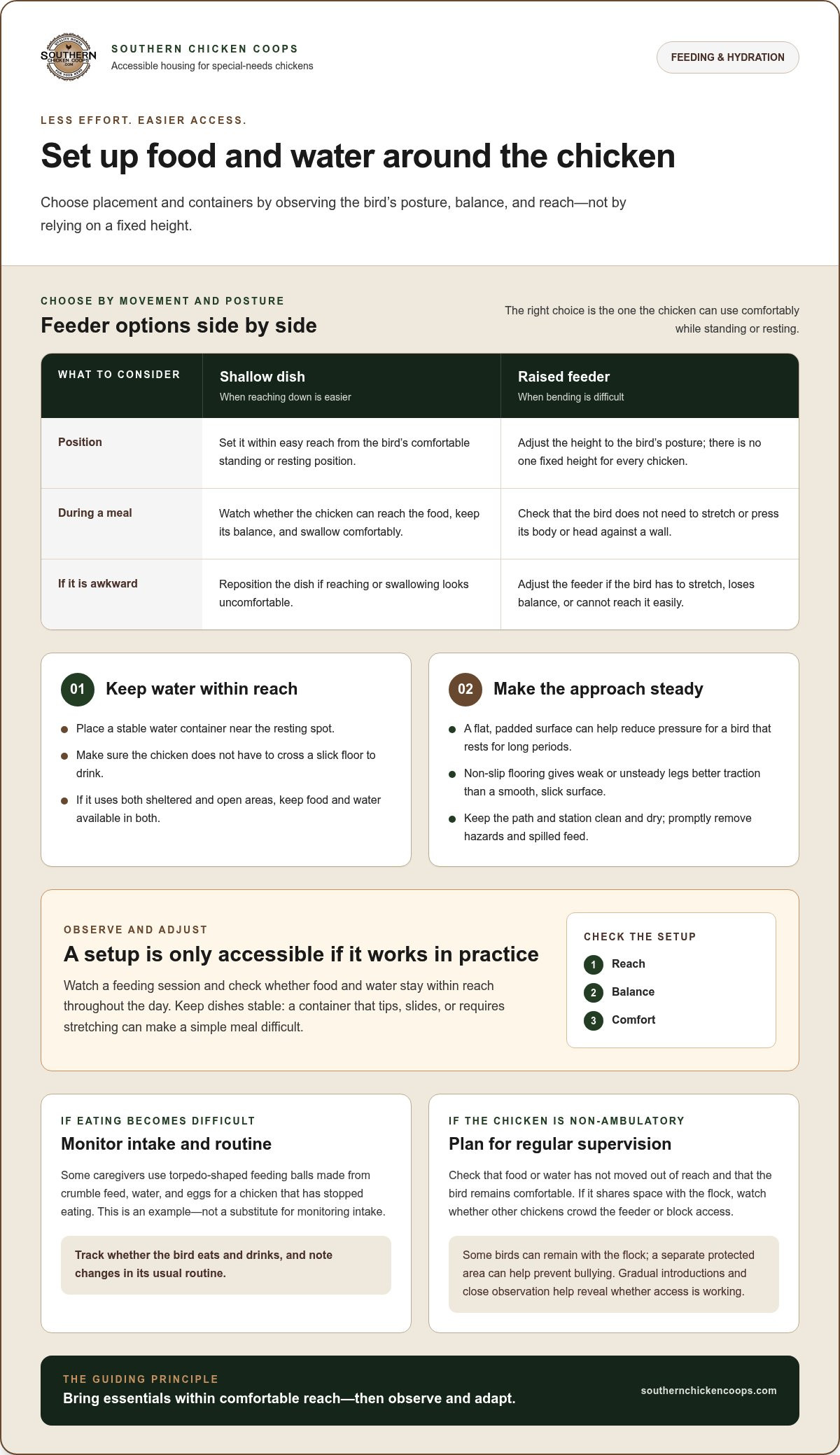
Make each meal reachable without a climb or a long walk. Set a shallow dish or raised feeder at a height the chicken can reach while standing or resting. Watch a feeding session: can the bird reach the food, keep its balance, and swallow comfortably? Adjust the dish if its body or head presses against a wall.
Water needs the same attention. Place a stable container near the resting spot, and make sure the bird can reach it without crossing a slick floor. If the chicken spends time in sheltered and open areas, provide feed and water in both. This reduces unnecessary travel and keeps essentials close when the bird changes locations.
Choose a shallow dish if reaching down is easier, or a raised feeder if bending is difficult. The right position depends on the chicken’s movement and posture, so observe rather than relying on a fixed height. Keep dishes stable and within easy reach. A container that tips, slides, or requires stretching can make a simple meal difficult.
Flooring matters at every feeding station. A flat, padded surface can help reduce pressure on a bird that rests for long periods. Non-slip flooring gives weak or unsteady legs better traction than a smooth, slick surface. Check for wrinkles, damp patches, loose edges, and spilled feed. Remove hazards promptly and keep the surface clean and dry. A secure approach helps the chicken reach its dish without skidding.
Some caregivers use torpedo-shaped feeding balls made from crumble feed, water, and eggs for a chicken that has stopped eating. Treat this as an example, not a substitute for monitoring intake. Track whether the bird eats and drinks, and note changes in its usual routine. Non-ambulatory chickens need regular supervision so caregivers can respond if food or water moves out of reach or the bird becomes uncomfortable.
Can special needs chickens live with healthy chickens, or should they be housed separately? Some can remain with the flock, but a separate protected area can help prevent bullying. Introduce the bird to the flock gradually, and watch whether other chickens crowd the feeder or block access.
What coop size and run space does a special needs chicken need? One described coop measured 3.5' x 4', while a suggested run was 3-4 feet wide and 10-12 feet long. Treat these as examples, not universal standards; mobility, flock interactions, and the bird’s access to food and water shape the useful layout.
2. Enrichment adapted to mobility
Enrichment can give a chicken with limited mobility meaningful ways to explore. Outdoor time, toys, and foraging can all be adapted. Start with an activity the bird already enjoys, then observe how it moves and responds. A familiar treat scattered nearby can encourage gentle foraging without requiring a long walk.
Offer one new activity at a time. Place it within comfortable reach, then observe whether the chicken approaches, investigates, or turns away. If it shows interest, let it continue at its own pace. If it strains, loses balance, or seems stressed, move the activity closer or choose an easier option.
Outdoor time can offer new sights, sounds, and scents. Choose an accessible area where the chicken won’t have to cross difficult ground. Stay nearby and watch how it responds. If it prefers shelter or becomes unsettled, let it rest there rather than encouraging more movement.
Adapt foraging to the bird’s reach and mobility. Place a small amount of suitable feed or a familiar treat near its resting place. A chicken able to move farther can explore a wider area, while a bird with restricted movement can investigate items close by. Keep the activity simple and engaging, without creating a barrier.
Toys can also invite attention without requiring travel. Set a familiar object where the bird can see and investigate it from a comfortable position. Observe whether it pecks, nudges, or ignores the toy. Those reactions help you choose activities that suit this chicken, rather than assuming every bird enjoys the same objects.
A hammock or sling can support a disabled chicken while standing and may reduce pressure sores. Introduce this support carefully, watching the bird’s posture and response. The aim is to support the bird, not force it to stay in place. If it appears uncomfortable or stressed, adjust the setup and let it rest naturally.
Personality and stress responses matter as much as physical reach. A curious chicken may welcome outdoor exploration, while a cautious bird may prefer a familiar toy beside its resting place. Note which activities interest the bird and which cause it to withdraw. Repeating suitable choices gives you a practical guide for adapting future enrichment.
Consider sensory or physical impairments when choosing activities. A blind chicken may rely more on familiar surroundings, while a crossed beak may affect how it investigates objects. Watch how the bird approaches each activity, keep preferred options accessible, and adapt the setup to its observed abilities and comfort.
3. Low perches, shallow ramps, and roost-free housing
A chicken that struggles to stand may not manage a standard roost. Design the resting area around how the bird moves now, not how other flock members perch. A low, accessible perch may suit a chicken that can step up safely. A roost-free layout may be kinder for a bird that cannot climb or balance.
Wide roost bars let a chicken rest with its feet flat instead of curling its toes around a narrow bar. Check its position while it rests: it should be able to settle without slipping or stretching to keep its balance. If its feet still grip awkwardly, consider a level resting surface instead.
If a bird can manage a gradual incline, a shallow ramp can connect the floor to a raised area. Keep the route stable and clear, and watch the chicken make a complete trip up and down. If it pauses, slips, or avoids the ramp, move the destination to ground level. Access matters more than keeping a perch.
A ground-level resting spot can be a simple, sheltered place where the chicken can settle without climbing. Keep the approach unobstructed. A low doorway, loose object, or uneven transition can become a barrier for a bird with weak legs. Follow the route at the chicken’s pace and remove anything that interrupts its movement.
Some chickens need no roost at all. A roost-free coop lets them rest on the floor, especially when standing or perching is difficult. One described setup used a guinea pig cave instead of roosts. The principle is to offer an easy-to-enter resting place, then observe whether the bird chooses it comfortably.
Match each feature to the chicken’s current abilities. A bird able to take short steps may use a low perch, while one unable to support its weight may need a level resting area. Mobility can change after injury or illness, so revisit the layout when the chicken’s movement changes. Keep routes between resting places clear.
What local zoning or animal welfare rules apply to backyard chicken housing in the United States? Requirements vary by locality and property, rather than following one nationwide backyard-coop rule. When planning coop placement and construction in Texas, review the local zoning and animal-care requirements that apply to your property.
Test the arrangement through everyday movement, not appearance alone. Observe whether the chicken can enter, turn, settle, and leave its resting place without help. A ramp that looks shallow may still be difficult for a particular bird. Change the route or remove the ramp if the chicken avoids it. For a bird recovering from injury or surgery, follow its veterinarian’s accommodation recommendations.
4. Protected or temperature-controlled living areas
A chicken with compromised health may need indoor or temperature-controlled housing. Choose a sheltered space based on the bird’s condition, comfort, and ability to cope with outdoor weather. Protect its resting area from direct exposure while maintaining access to the care and observation it needs.
To protect a disabled chicken from flock bullying and predators, provide a separate protected area. Solid walls at one end and hardware cloth on the remaining sides can form a sheltered pen. Observe flock interactions and keep the vulnerable bird apart when other chickens crowd or harass it.
Plan the sheltered end of a run around the bird’s daily routine. One suggested layout gives this sheltered end 3-4 feet of length. Orient it to block the prevailing direction of rain and wind, so the protected space remains useful when weather shifts. Keep the entrance accessible for the chicken and caregiver.
A covered run can provide protection beyond the sheltered end. One described setup included a 30 sq ft covered run. Another recommendation used a roof over the entire structure, with bedding throughout the run. These are examples, not universal dimensions; the bird’s mobility and the available protected space guide a workable arrangement.
Solid walls at one end can reduce exposure and create a calmer retreat. Hardware cloth on the remaining sides maintains separation while enclosing the area. Inspect the enclosure regularly for openings, loose sections, or places where flockmates can reach through. Keep the disabled chicken’s resting area inside the protected boundary.
Bedding throughout the run gives the bird a consistent surface across sheltered and open sections. Choose a layout that stays comfortable for resting and doesn’t force the chicken to cross exposed ground to reach essentials. Keep pathways clear, especially between its resting place and the protected portion of the run.
Weather protection should work as part of the whole housing plan. Position the sheltered section against prevailing rain and wind, then observe how the bird uses it during changing conditions. If it spends time away from shelter, check whether the route is accessible or whether flockmates are blocking the entrance.
For a bird recovering from injury or coping with illness, consider whether indoor or temperature-controlled housing better suits its condition. Keep the space calm and accessible, and observe the chicken’s comfort there. A protected area should provide room to rest without separating the bird from necessary care.
Review the arrangement as the chicken’s needs change. A separate pen may help during bullying, while a covered run can offer protection during outdoor time. Check that the shelter, roof, walls, bedding, and accessible routes work together, rather than treating each feature as a stand-alone fix.
5. How to build an accessible chicken coop for chickens with mobility issues?
Start with the chicken’s actual movement, not a standard coop plan. Observe how it enters, turns, rests, and reaches different areas. For limited mobility, ground-level access without a ramp is one possible setup. A level entrance removes a climb and makes everyday movement easier to assess.
Map the route between the entrance, resting place, and run. Keep each path clear, without raised thresholds or loose obstacles. Watch the bird move at its own pace. If it stops at a doorway or avoids one section, adjust that part before adding more features.
Choose a resting arrangement that suits the chicken’s balance. A bird that cannot perch may need a roost-free interior. One described coop used a guinea pig cave instead of roosts. A bird that can stand securely may manage a low resting surface, but observe how it settles and leaves.
Plan the run around comfortable movement, not simply its outer dimensions. One suggested layout for a chicken with limited mobility is 3-4 feet wide and 10-12 feet long. Use that example as a starting point for arranging clear routes, shelter, and room to turn. The bird’s abilities should guide the final layout.
Keep the coop and run connected without requiring a difficult transition. A level opening can help a chicken move between spaces independently. Check the threshold, ground surface, and turning area together. If a wheelchair assists a bird with leg paralysis, make sure the route accommodates both the device and the chicken’s movement.
Build access around daily care, too. Caregivers need to reach the chicken for observation and routine support. Position resting areas so you can see the bird without disturbing it unnecessarily. Avoid corners and narrow passages that could trap the chicken or make turning difficult.
For a bird recovering from surgery or injury, follow its veterinarian’s accommodation recommendations. Let those directions guide access, resting arrangements, and movement through the coop. Avoid adding a ramp, perch, or exercise route simply because it fits a typical design. The chicken’s recovery needs come first.
After arranging the space, observe the chicken using each route. Note where it hesitates, slips, or changes direction, then adjust the layout. Recheck after changes in mobility, since an entrance that was manageable may become difficult. A practical plan may combine a level entrance, open pathways, and a resting place suited to the bird.
If you’re planning a purpose-built layout, plan an accessible coop around mobility needs.
Southern Chicken Coops: Custom Chicken Coops
Southern Chicken Coops offers custom chicken coops for keepers planning around a bird’s mobility needs. If ground-level access, resting areas, or a protected layout matter to your flock, a semi-custom design can help shape the housing around those priorities. The signature Polka model is a 6'x12' coop designed for durability and functionality in the Texas climate.
Consider a custom coop when a standard layout doesn’t suit your chicken’s movement or care routine. During planning, describe practical needs such as accessible pathways or protected space. Southern Chicken Coops builds custom coops in Texas and delivers completed coops to a prepared, level lot.
If a thoughtfully planned coop would support your flock, contact Southern Chicken Coops to discuss your needs.
Make the next change with care
Your chicken’s needs can shift as its movement, confidence, or health changes. Let everyday observations guide your next housing decision: notice which parts of the space it uses, where it pauses, and what makes routine movement easier. Thoughtful special needs chicken housing responds to the bird in front of you, rather than relying on a fixed setup.
Choose one practical improvement to consider first. Sketch the coop’s routes, mark the areas the bird uses most, or note adjustments that could make its daily routine more accessible. Clear priorities help turn concern into a plan that fits your flock and your space.
If you’re ready to discuss a coop suited to your plans, contact Southern Chicken Coops. Take the process at a comfortable pace, keeping your chicken’s wellbeing at the heart of each decision. A carefully considered home can make everyday care feel more manageable for both of you.
Frequently Asked Questions
What housing adaptations do chickens with disabilities or special needs require?
Plan special needs chicken housing around the bird’s movement, senses, and care needs. A blind chicken may do better with familiar, uncluttered routes, while one with weak legs may need ground-level access. Consider whether it can turn comfortably and avoid flockmates blocking its path. Change one feature at a time, then observe how the chicken uses the space.
What ramp angle and roost height are safe for disabled chickens?
There isn’t one safe ramp angle or roost height for every disabled chicken. In special needs chicken housing, the bird’s balance, leg strength, and ability to step should guide the setup. If you add a ramp, observe whether the chicken can use it steadily in both directions. If it struggles, make access ground-level. A bird unable to perch can use a roost-free resting area instead.
How should coop nesting boxes, feeders, and waterers be designed for special needs chickens?
Position essential fixtures so the chicken can approach and use them without squeezing through narrow gaps. A nesting box with an easy entry and room to turn can help a bird that still lays eggs. Keep feeder and waterer locations consistent so a chicken with sensory impairment can find them. Choose stable containers that don’t slide as the bird eats or drinks.
What bedding and flooring are safest for chickens with weak legs or limited mobility?
Choose a level surface with secure footing, and keep it dry and free of loose obstacles. Low-dust bedding or a litter-free floor may suit birds needing respiratory comfort. Soft, fine pine shavings are another bedding option caregivers use. During routine cleaning, check for dampness, compacted litter, and uneven edges, which can make resting or moving harder.
How to keep a special needs chicken warm, dry, and well ventilated?
Use a sheltered living area that blocks direct rain and wind while allowing air to circulate. Keep bedding dry, remove wet patches, and watch for condensation or stale, damp air inside the coop. Ventilation should exchange air without directing a cold draft onto the chicken’s resting place. If the bird’s health is compromised, indoor or temperature-controlled housing may better support its comfort.


