

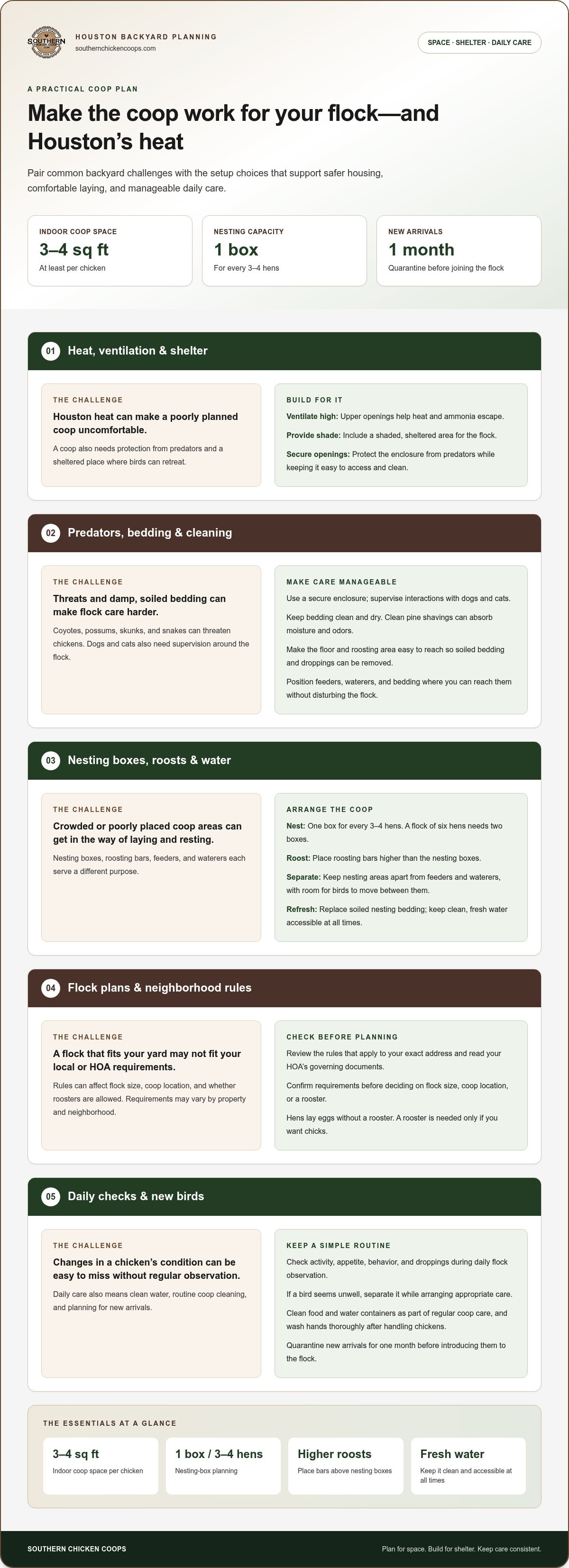
A well-planned Houston backyard chicken setup begins with space, shelter, and dependable water. Allow at least 3-4 square feet of indoor coop space per chicken, provide one nesting box for every 3-4 hens, and keep clean, fresh water available at all times.
It’s natural to start with the flock you’d like to keep, but Houston’s heat, your available space, and neighborhood rules all shape what will work at home. Choose breeds suited to warm weather and plan a coop that is secure and well ventilated.
This guide covers coop and flock planning, heat-tolerant breed options, and why to review local and HOA rules before getting started. You’ll also find practical advice on nesting areas and keeping fresh water accessible, so you can make informed choices for your hens and backyard.
Key Takeaways
- Plan a secure, easy-to-clean coop with ventilation near the top to help heat and ammonia escape.
- Review Houston rules and your HOA’s requirements before settling on a flock size or deciding whether to keep a rooster.
- Compare breeds for warm-weather suitability, and consider how feathering may affect comfort in Texas heat.
- Place roosting bars higher than nesting boxes, and keep fresh water clean and accessible throughout the day.
Backyard coop and flock setup
For a Houston backyard chicken setup, begin with the space your flock can use safely. Plan for at least 3-4 square feet of indoor coop space per chicken, then consider how much protected outdoor area fits your yard. A small flock needs less room than a large one, but every bird still needs shelter, room to move, and access to food and water. Check local ordinances and neighborhood requirements before choosing a flock size.
Common concerns include illness, predators, odor, and noise. Coyotes, possums, skunks, snakes, dogs, and cats can threaten chickens. Damp bedding and droppings can cause odors, while roosters may raise noise concerns.
Plan for Houston’s heat and the coop’s everyday use. Choose a sturdy, secure structure that is easy to clean, with upper ventilation to let heat and ammonia escape. Protect openings against predators, and provide a shaded, sheltered area where birds can retreat. Position feeders, waterers, and bedding so you can reach them without disturbing the flock.
Flock size affects more than floor space. Hens lay eggs without a rooster, so a hens-only flock may suit households that want eggs without a male bird. Before bringing chickens home, decide who will provide food and fresh water each day, clean the coop regularly, and care for any sick or injured birds. If you already keep chickens, quarantine new arrivals for one month before introducing them to the flock.
- Secure the enclosure: Protect chickens from coyotes, possums, skunks, and snakes, and supervise interactions with dogs and cats.
- Keep bedding manageable: Clean pine shavings can absorb moisture and odors on the coop floor.
- Make cleaning practical: Easy access to the floor and roosting area helps you remove soiled bedding and droppings.
- Watch for changes: Notice shifts in appetite, behavior, or droppings during your daily flock check.
Daily observation helps you notice problems early. Check each chicken’s activity and appetite, and watch for changes in droppings. If a bird seems unwell, separate it from the flock while arranging appropriate care. Wash your hands thoroughly after handling chickens, and include cleaning food and water containers in regular coop care.
In Houston, ventilation and reliable shade are essential parts of a chicken setup, not finishing touches. A secure, easy-to-clean coop provides steady shelter and makes daily care more manageable. Pair it with fresh water, regular observation, and a flock size suited to your space.
Nesting boxes and roosts
Plan nesting space around the number of hens, not the number of eggs you hope to collect. Provide one nesting box for every 3-4 hens. For a flock of six hens, that means two boxes, giving birds more than one place to lay. Keep the boxes easy to reach for egg collection and routine cleaning.
Choose a quiet, sheltered part of the coop for nesting boxes. A calm location helps make the laying area distinct from the busy spaces where chickens eat and move around. Keep bedding clean and dry, then replace it when it becomes soiled. A clean box gives hens a comfortable place to lay and helps keep collected eggs cleaner.
Roosting bars serve a different purpose from nesting boxes: chickens perch on them to rest. Place the bars higher than the boxes to encourage hens to roost instead of sleeping in the nesting area. If a bird settles in a box overnight, check that the roost is accessible and the box has not become its preferred resting spot.
Give each part of the coop a clear purpose. Keep nesting boxes separate from feeders and waterers, with enough room for birds to move between them. Choose feeder and waterer capacity and placement to suit your flock, so birds can reach food and water without crowding. The right arrangement depends on flock size and coop layout.
- Count the hens: Match nesting capacity to the flock, using one box for every 3-4 hens.
- Separate the spaces: Keep the laying area apart from feeding and drinking stations.
- Set roosts higher: Place roosting bars above nesting boxes to encourage nighttime perching.
- Keep boxes usable: Replace soiled bedding and make each box accessible for cleaning and egg collection.
Hens do not need a rooster to lay eggs. A rooster is needed only if you want chicks. This distinction helps you plan a flock around your household’s goals instead of assuming every group of laying hens needs a male bird.
As the flock settles in, observe where the hens perch and lay. If they crowd into one box, review the location and access to the others. If they sleep in nesting boxes, make the roosting bars more inviting and keep the boxes for laying. Small adjustments can help each area serve its intended purpose.
Provide one nesting box for every 3-4 hens, so a flock of six needs two boxes. Choose feeder and waterer capacity and placement so all birds can reach food and water without crowding; the arrangement depends on flock size and coop layout.
Checking Houston and HOA rules
Start with your exact address, because Houston city rules and neighborhood restrictions can affect flock plans differently. Before choosing a coop location or deciding how many chickens to keep, identify which local rules apply to your property. Also read your HOA’s governing documents. Houston-area communities may limit flock size or prohibit roosters, so a plan that suits one neighborhood may not suit another.
Houston’s poultry ordinance includes separate provisions worth understanding. One section says no more than 30 fowl are permitted. Another says a permit may be obtained for up to seven hens. Residents may own male and female chickens, but the birds must be confined and may not roam at large. Treat the permit provision and the separate fowl limit as distinct requirements when assessing your plan.
Texas law adds another part to the picture. A 2023 state law limits local governments’ authority to regulate agricultural operations in Texas. Before House Bill 1750 was enacted, Houston’s city ordinance restricted where residents could keep chickens and how many fowl and other livestock they could possess. The state law’s limits concern agricultural operations, so the relevant question is how the rules apply to your property and planned use.
- Identify your jurisdiction: Confirm whether your property falls under Houston rules or another local government’s requirements.
- Read the ordinance provisions: Note the 100-foot distance requirement and the separate provisions for 30 fowl and permits for up to seven hens.
- Review HOA documents: Look for limits on flock size, roosters, coop placement, or poultry keeping.
- Plan confinement: Keep chickens enclosed rather than allowing them to roam at large.
Houston’s ordinance restricts poultry, including chickens, to at least 100 feet from any human habitation, church, school, or hospital. That distance can be difficult to meet on a residential lot. Measure from the proposed coop location to nearby buildings before settling on its placement, and consider how the rule affects your available yard space.
Houston residents can source chicks from hatcheries or poultry suppliers, and feed and equipment from farm-supply or poultry-supply retailers. For a ready-to-use coop built in Texas, Southern Chicken Coops offers handcrafted standard and semi-custom designs, with delivery to a prepared lot. Match your purchases to the rules at your address, especially if you plan to keep a rooster or a larger flock.
Keep a short record of the requirements you find, including location restrictions, permit provisions, confinement rules, and HOA limits. These details shape the flock size and coop placement you can plan for. Reviewing them before bringing birds home helps you avoid designing a setup that conflicts with a stated restriction.
Choosing heat-tolerant chicken breeds
Houston’s hot summers make breed choice an important part of flock planning, but no breed eliminates the need for suitable housing and care. Rhode Island Reds are recommended as brown-egg layers that do well in heat; Dominiques are another option suggested for hot conditions. Compare those breeds with your preferences for temperament and egg laying, then consider how each will fit your backyard routine.
Start with the traits that matter to your household. If you prefer brown eggs, Rhode Island Reds and Dominiques are options to consider. Plymouth Rocks and Orpingtons are also recommended as beginner breeds for Houston flocks, though advice about Orpingtons in the heat differs. One recommendation cautions against heavily feathered breeds such as Orpingtons and Cochins in Texas summers. Weigh both beginner-friendly guidance and summer shelter when choosing.
Naked Neck chickens, also called Turkens, are suggested for hot weather because they have less feathering. This gives you a distinct comparison point when reviewing breed choices. Rather than choosing from a breed name alone, consider the bird’s feathering, your goals for eggs, and the shade and airflow available in its housing. A breed suited to warm conditions still needs a setup that supports comfort through Houston’s summer.
- For brown eggs and heat suitability: Compare Rhode Island Reds and Dominiques.
- For beginner breed suggestions: Consider Plymouth Rocks and Orpingtons, while weighing the separate heat caution about Orpingtons.
- For less feathering: Look at Naked Neck or Turken chickens.
Egg laying can vary by season. Some chicken keepers report that many breeds lay less in fall and winter, then resume in spring. A seasonal slowdown does not necessarily mean a breed is unsuitable. Account for changing daylight and seasons, and choose a flock for its overall fit rather than expecting the same egg output year-round.
One Louisiana chicken keeper reports that hens laid throughout summer in weather considered similar to Houston’s. This is a regional example, not a promise for every flock. Conditions still matter, including available shade, ventilation, and water. A Rhode Island Red in a sheltered, well-ventilated coop, for instance, has a different environment from one without protection from direct sun.
Shortlist breeds before bringing birds home. Compare Rhode Island Reds, Dominiques, Plymouth Rocks, Orpingtons, and Naked Neck chickens based on egg preferences, feathering, and the summer shelter you can provide. If choosing chicks, consider how each breed fits your longer-term plans: keeping a flock is a commitment beyond its first summer. A considered choice better matches the birds to the care your Houston backyard can provide.
Fresh water systems
Keep clean, fresh water available to chickens at all times. In Houston, make water checks part of the daily routine rather than relying on an occasional refill. Put the container somewhere visible and easy to reach, so you can spot low water, spills, or bedding and feed in the drinking area.
An open dish and a poultry waterer are two ways to provide drinking water. Whichever you use, place it on a stable surface where chickens can reach it without tipping it over. Keep it away from loose bedding and droppings where possible. If it sits beside a busy feeding spot, check whether feed is being scattered into the water.
Check water during morning and evening care. Inspect the water itself: remove visible debris, refill as needed, and clean the container when it gets dirty. Notice during the day whether the water remains accessible. A full container is no help if it has tipped over or collected debris.
Houston’s summer heat makes a shaded place for water a sensible part of coop planning. Keep the container easy to inspect and out of direct sun for long periods. Consider how easily you can reach it from the coop door. A convenient location makes routine checks simpler, especially when carrying feed or collecting eggs.
- Check access: Confirm that every chicken can reach the drinking area.
- Inspect the water: Remove debris and refill whenever the supply is low.
- Look for spills: Reset a tipped container and replace wet bedding nearby.
- Choose a practical location: Keep water visible, reachable, and sheltered from direct sun.
Watch the flock while it drinks. If one bird is pushed away, adjust the placement or provide another accessible drinking point. If the water repeatedly gets soiled, move the container away from feed, roosts, or areas where bedding gathers. These observations help you tailor the setup to the chickens’ behavior, rather than relying on an arrangement that looks convenient but does not work well.
Keep the container and its surrounding area in your regular cleaning routine. A tidy water station is easier to inspect, and clean, fresh water should remain available throughout the day. As you plan the coop, design a coop around your flock’s daily care, including a convenient place to check and refill water.
Southern Chicken Coops: Custom Chicken Coops
Southern Chicken Coops offers custom chicken coops for keepers whose flock, yard, and daily care needs call for a thoughtfully planned home. Its signature Polka model is a 6'x12' coop designed for durability and functionality in the Texas climate, and semi-custom designs can be tailored to specific needs. Coop delivery is also available, making this a natural next step when you’re ready to turn your flock plan into a sturdy, practical structure. A carefully fitted coop can bring essential details, from ventilation to easy access for feeding and cleaning, together in one design. To discuss a coop for your backyard flock, visit Southern Chicken Coops.
Make Your Flock Plan Work for Everyday Life
Getting started is only part of keeping chickens. Build a routine that fits your household and keeps care consistent through busy weeks and changing seasons. Decide who will look after the flock, where supplies belong, and how you’ll notice changes in the birds’ needs or yard layout. A simple written care plan can help everyone understand their role.
As your Houston backyard chicken setup takes shape, treat the coop as part of a living backyard, not a project you’ll never revisit. Your flock’s habits can show you what works and where a small change could make daily care easier. Use those observations to plan a lasting home for your hens.
If you’re ready to discuss a coop suited to your plans, contact Southern Chicken Coops. A thoughtful beginning can help you build a chicken-keeping routine that feels rewarding for your household and caring for your birds.
Frequently Asked Questions
How many chickens can Houston residents keep, and are roosters allowed?
Houston’s poultry ordinance has one section permitting no more than 30 fowl and another providing for a permit for up to seven hens. Residents may own male and female chickens, but the birds must be confined and may not roam at large. Roosters are therefore not categorically excluded by the city rules described here, though neighborhood restrictions may be stricter. Check your HOA documents before deciding to keep one.
Do Houston homeowners need a permit or HOA approval to keep chickens?
Houston’s ordinance includes a permit provision for up to seven hens, while another section sets a limit of 30 fowl. The ordinance also restricts poultry placement to at least 100 feet from human habitation, a church, school, or hospital. HOA rules are separate: some communities restrict flock size or prohibit roosters. Review both the city provisions and your community’s governing documents before choosing your coop location or buying birds.
What coop size, ventilation, shade, and predator protection do chickens need in Houston’s climate?
Allow at least 3-4 square feet of indoor coop space per chicken. A Houston coop should be sturdy, secure, easy to clean, and ventilated near the top to release heat and ammonia. Provide shade and continuous access to clean, fresh water. Protect birds from predators such as coyotes, possums, skunks, and snakes, and don’t leave chickens alone with dogs or cats. Match the outdoor run to your yard and flock.
Which chicken breeds are best for Houston’s heat and egg production?
Rhode Island Reds and Dominiques are suggested brown-egg layers for hot conditions, and Plymouth Rocks are another beginner breed to consider. Advice on Orpingtons differs: they appear in beginner recommendations, but heavily feathered birds may be less comfortable in Texas heat. Naked Neck chickens, also called Turkens, have less feathering and are another warm-weather option. Compare feathering, egg-laying goals, and the shade and airflow your coop provides before choosing a flock.
What are the steps to set up a backyard chicken flock in Houston?
First, review Houston’s poultry provisions and your HOA rules, including restrictions on placement, flock size, and roosters. Then assess your yard and plan secure shelter, nesting space, shade, and fresh water. Choose breeds that suit your goals and Houston’s heat, and prepare for daily feeding, cleaning, and flock observation. If adding birds to an existing flock, quarantine newcomers for one month before introducing them.


