

Last Tuesday, a neighbor near our shop in McGregor watched a dark shadow sweep across her yard, followed by the frantic alarm call of her lead hen. It’s a heart-stopping moment every Texas poultry keeper knows too well. When it comes to protecting chickens from hawks in Texas, the threat isn't just about the birds in the sky; it's also about the relentless heat on the ground. We understand that pit-in-your-stomach feeling when you let your flock out to graze. You want them to be happy, but you also need them to be safe. It's frustrating to hear conflicting advice about whether to use flimsy netting or solid roofing, especially when our summer temperatures climb into the triple digits.
In this guide, we'll show you how to build a fortress that breathes. You'll learn how to safeguard your Texas flock from aerial predators using expert design strategies that balance total security with the essential summer ventilation your girls need to thrive. We will cover the legal protections for raptors, the best materials for our climate, and how to design a walk-in run that offers true peace of mind. We want to help you create a durable home that fits our unique landscape and keeps your beloved hens tucked away from harm.
Key Takeaways
- Identify the unique hunting patterns of Red-tailed and Cooper's hawks to better anticipate and block aerial threats in your own backyard.
- Move past ineffective plastic decoys and learn which visual deterrents truly stand up to the intelligence of a hungry raptor.
- Find the perfect middle ground between heavy-duty overhead barriers and the high-flow ventilation needed for protecting chickens from hawks in Texas during the summer.
- Create strategic "run-to-cover" zones using native landscaping to ensure your hens are never more than a few steps away from safety.
- Understand how a handcrafted, structurally sound coop provides a permanent, low-maintenance security solution for your family's flock.
Common Hawks in Texas and Their Hunting Patterns
We’ve spent many mornings on our porch in McGregor watching the horizon, and while the wide-open Texas sky is a blessing, it’s also a perfect vantage point for predators. If you’re managing a flock, you know that the same sun that helps your garden grow also lights up your hens like a neon sign for birds of prey. Open pastures and clear backyards offer very little cover, making the task of protecting chickens from hawks in Texas a constant priority for anyone who values their birds' safety. When there are no trees to hide under, a hawk can spot movement from a staggering distance.
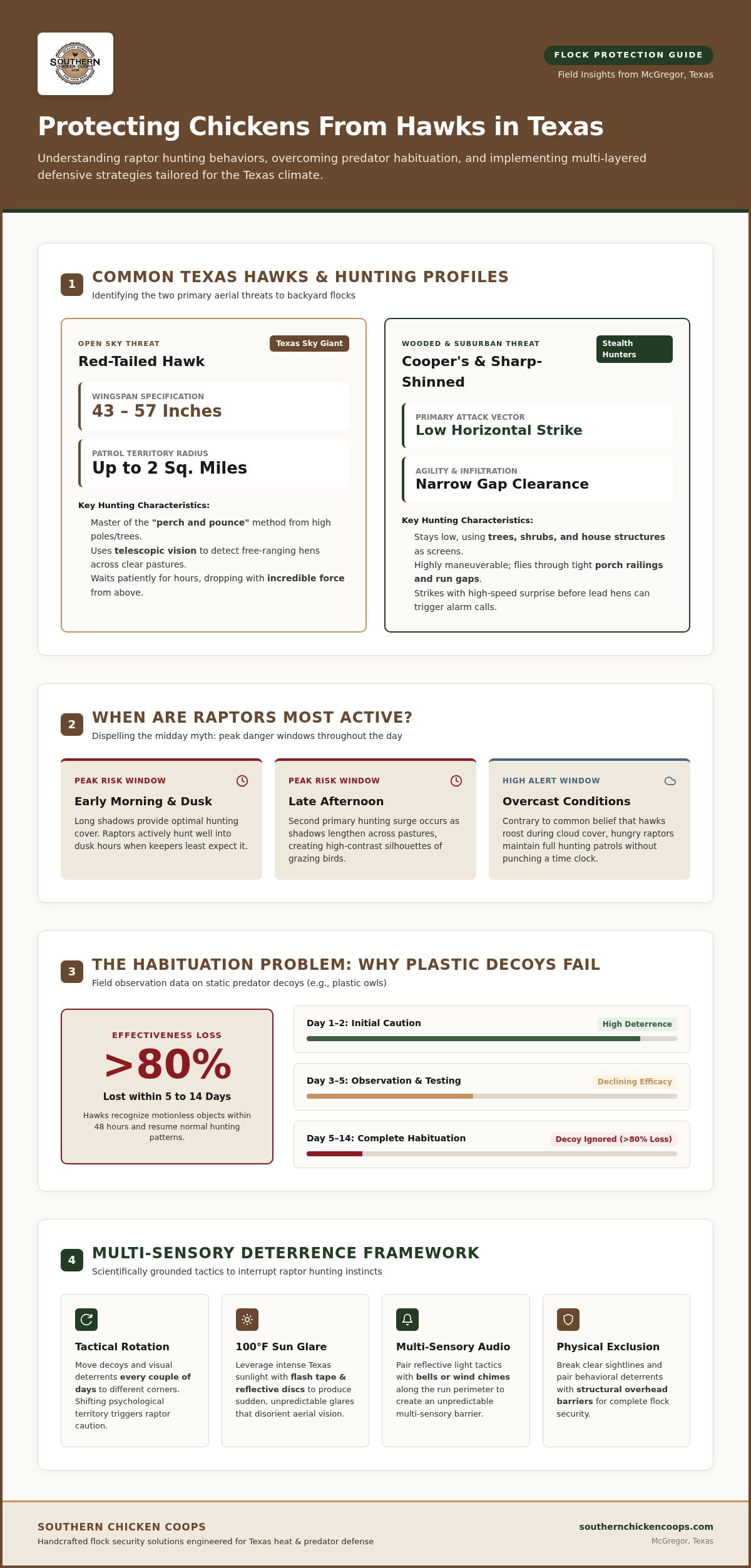
Most folks think they only need to look up during the high noon sun, but local hawks are actually most active in the early morning and late afternoon when shadows are long. A hungry raptor doesn't punch a time clock. We’ve seen hawks hunting well into the dusk hours or even on overcast days when you might think they’d be roosting. Vigilance is a full-time job for a chicken keeper, but understanding who is watching from above is the first step toward a secure home.
The Red-tailed Hawk: The Texas Sky Giant
The Red-tailed Hawk is the bird you’ll likely see most often circling over our local fields or perched on a telephone pole along the highway. They are patient masters of the "perch and pounce" method, often waiting for hours for a single moment of vulnerability before dropping with incredible force. Understanding red-tailed hawk hunting patterns is vital because these birds have telescopic vision that makes a free-ranging hen look like an easy target. A mature Red-tailed Hawk typically possesses a wingspan between 43 and 57 inches and will patrol a hunting radius of up to two square miles around its nest.
Cooper’s and Sharp-shinned Hawks: The Stealth Hunters
While the big hawks circle high, the Cooper’s and Sharp-shinned hawks are the ones that keep us on our toes in wooded areas or suburban yards with more landscaping. These smaller, agile hunters don't usually soar in the open; instead, they stay low and use trees, shrubs, or even your own house as a screen for a surprise attack. They are incredibly maneuverable and can fly through narrow gaps in porch railings or run structures with terrifying ease. Unlike the larger raptors that dive from the clouds, these stealth hunters rely on speed and a horizontal strike, often appearing out of nowhere before your hens can even sound the alarm. Protecting chickens from hawks in Texas requires a different strategy for these fliers, as they aren't afraid to navigate tight spaces to reach their prize.
The Science of Hawk Deterrence: What Actually Works?
We’ve all seen those plastic owls sitting on coop roofs, bleached white by the sun and covered in bird droppings. It’s a common sight in Central Texas, but truth be told, they don't do much for protecting chickens from hawks in Texas after the first day or two. Hawks are remarkably smart. They observe, they learn, and they eventually realize that the predator on your roof hasn't moved a muscle in 48 hours. To truly safeguard your flock, we have to outthink these birds rather than just trying to scare them with a piece of plastic.
The Habituation Problem
Stationary deterrents fail because of a process called habituation. Field observations indicate that static decoys lose over 80% of their effectiveness within five to fourteen days. A hawk’s survival depends on its ability to distinguish between a real threat and a lawn ornament. If you want to keep them guessing, you've got to rotate your tactics. We recommend moving your deterrents every couple of days to different corners of the yard. The psychological impact of movement is what triggers a hawk's caution. When something changes in their hunting territory, they're much less likely to risk a dive.
Reflective Deterrents in the Texas Sun
We can actually use our intense 100-degree summer sun to our advantage. Flash tape and reflective discs work by creating sudden, unpredictable glares that temporarily disorient a raptor's vision. When these are placed strategically around the run perimeter, they catch the light and create a no-fly zone of sorts. Combining these light-based tactics with sound, like small bells or wind chimes, creates a multi-sensory system that’s much harder for a hawk to ignore. Research into Cooperative Extension predator management strategies highlights that while these tools help, they work best when paired with physical exclusion.
Broken sightlines are another secret weapon in your arsenal. If a hawk can't see a clear path to its target, it can't plan a high-speed dive. By adding structures or tall plants that interrupt their view, you're making your yard a much less appealing restaurant. A predator-proof setup isn't just about strong wire; it's about making the environment look difficult to hunt in. Hawks are calculating animals. They weigh the effort and risk against the reward.
If your run has bunkers or visual breaks, the hawk will likely move on to a neighbor's yard that looks like an open buffet. Protecting your girls means addressing the hawk's intelligence. They want an easy, predictable meal. When we build our handcrafted coops, we focus on these details to ensure your backyard stays a place of peace rather than a hunting ground for aerial predators.
Physical Barriers: Netting vs. Solid Roofs in Texas Heat
We often hear from folks who feel stuck between a solid roof and open netting. In our part of the world, this decision is about more than just security; it’s a matter of survival. Protecting chickens from hawks in Texas requires a barrier that stops a high-speed dive without turning your run into an oven when the August sun bears down. While a solid roof provides the best shade, it can also trap stagnant, hot air if it isn't designed with proper elevation and venting.
Choosing the Right Netting Material
If you decide on netting for a large area, please avoid the thin, plastic bird netting found at most garden centers. It’s flimsy and often becomes a "death trap" where birds get tangled and perish. This creates a heartbreaking scene and a legal headache, as native raptors are shielded by Migratory Bird Treaty Act protections. Instead, look for knotted polyethylene netting that is UV-treated to withstand our harsh Texas light. To effectively stop a heavy Red-tailed hawk mid-strike, your overhead netting should be a heavy-duty commercial flight-pen grade with a mesh size no larger than two inches.
For the most secure runs, 1/2-inch hardware cloth remains the gold standard. It’s a rigid, welded wire that prevents a hawk from even reaching a talon through the gaps to snag a bird. However, a full hardware cloth roof provides zero shade on its own. We recommend a hybrid approach to keep your flock comfortable while maintaining a 100% secure overhead barrier.
Ventilation and Shading Strategies
The key to a cool run is constant airflow. When we look at the Polka model design, we see a blueprint for success: a tall, walk-in structure that encourages hot air to rise and escape through high-flow gables. You can achieve this by layering 50% to 70% UV-resistant shade cloth directly over your hardware cloth. This setup blocks the hawk's view and the sun's rays while allowing a 360-degree breeze to flow through the mesh. It ensures your girls stay cool and protected without the risk of heat stroke that comes with poorly vented solid roofs.
Strategic Landscaping and Run Design
Many Texas homesteads are beautiful precisely because of their wide-open vistas, but for a hen, a clear view of the horizon feels like standing in a spotlight. While we've already discussed the importance of mesh and roofs, the way you shape the land around your coop is just as vital for protecting chickens from hawks in Texas. Strategic landscaping creates what we call "run-to-cover" zones. These are specific spots where your birds can duck out of sight in a heartbeat if a shadow passes overhead. We often suggest placing your coop near natural windbreaks or existing clusters of trees, provided those trees don't offer a perfect high-altitude branch for a hawk to sit and watch the yard.
Planting for Protection
Native Texas shrubs are your best allies in the fight against aerial predators. Plants like Agarita or Dwarf Yaupon Holly are hardy enough to survive our intense droughts while providing dense, prickly cover that chickens love and hawks avoid. You want to create a "bramble" effect by spacing these low-profile bushes every 20 feet. This ensures your flock is never more than a few seconds away from a safe hiding spot. Just remember to prune the higher branches; you don't want to accidentally build a lookout post that helps a raptor get a better angle on the run.
Guardian Animals in Central Texas
We often hear from neighbors asking about roosters or livestock guardian dogs like Great Pyrenees or Anatolian Shepherds. A good rooster is an excellent early-warning system. He’ll spot a hawk long before you do and sound a specific alarm that sends the hens scurrying for cover. Some folks also find success with geese or turkeys, as their larger size and loud nature can be enough to make a hawk reconsider its target. However, a guardian animal is an assistant, not a replacement for a solid structure. Even the bravest dog can't be everywhere at once, and a well-crafted home remains the only 100% guarantee of safety.
Our signature Polka model provides a generous 6'x12' footprint that integrates these safe zones right into the frame of the building. Because we offer professional delivery to your prepared, level lot in McGregor or the surrounding areas, you can rest easy knowing your coop is positioned exactly where it needs to be for maximum security and natural shade. If you're ready to give your flock the protection they deserve, view our custom chicken coops to find the perfect fit for your landscape.
Built-In Protection: The Southern Chicken Coops Approach
We've spent a lot of time discussing the birds in the sky, but now we want to talk about the ground they land on. When we build coops in our McGregor shop, we aren't just putting together wood and wire. We're building a sanctuary. Our signature Polka model is a 6'x12' powerhouse designed for the specific challenges of our region. Protecting chickens from hawks in Texas requires more than a thin frame; it needs the structural integrity to withstand a 70mph wind gust and a determined predator at the same time. Many generic coops fail because they can't handle the physical stress of a Texas thunderstorm, which can leave the structure weakened and vulnerable to aerial attacks.
Engineering Security in the Polka Model
We use heavy-duty wire integrated directly into solid timber framing. This isn't just for show. It creates a seamless barrier that aerial predators can't pry open. Our custom poultry housing is built one at a time, allowing us to focus on every screw and joint. Because we're fellow poultry enthusiasts right here in McGregor, we treat every coop as if it were housing our own beloved hens. We believe in stewardship, which means building something that protects your investment and your birds for the long haul. We can even adapt your build for high-predator acreage by adding extra reinforcement where you need it most.
Delivery and Setup for Maximum Safety
A coop is only as safe as its foundation. This is why a properly prepared lot is the first line of defense. If a lot isn't level, the frame can twist over time, creating tiny gaps that a clever hawk or a snake might exploit. Our professional delivery service ensures your coop is placed perfectly on your prepared site. We don't just drop it off; we make sure it's situated to provide maximum structural safety. This hands-on approach is why we don't offer DIY kits or nationwide shipping. We want to ensure the quality is right before we leave your property, giving you true peace of mind.
If you're ready to stop worrying every time you hear a hawk cry, it's time for a permanent security solution. You can start by Requesting your custom Texas coop quote today. We look forward to being your partners in creating a safe, beautiful home for your flock that honors the lifestyle you've built.
Creating a Haven for Your Texas Flock
We've shared how to outthink local raptors by understanding their hunting habits and why a hybrid approach to roofing is the best way to beat the heat. Protecting chickens from hawks in Texas is a journey of stewardship, and we're honored to walk that path alongside you. It's about more than just security; it's about the peace of mind you feel when you look out your back window and see a happy, safe flock thriving in the sun.
Our family is here to help you turn these strategies into a reality. Every one of our coops is handcrafted one at a time right here in McGregor, Texas. With our signature Polka 6'x12' model, you get a durable, beautiful structure that integrates all the security features we've discussed today. Plus, our professional delivery ensures your coop is placed on a level, safe lot without any gaps for predators to exploit. We take great pride in ensuring your girls have the very best protection possible.
Protect your flock with a handcrafted Southern Chicken Coops today. We can't wait to help you build a home that your girls will love for years to come.
Frequently Asked Questions
Do hawk decoys or plastic owls actually work in Texas?
Hawk decoys and plastic owls provide very limited protection. While they might startle a bird of prey initially, local hawks are intelligent and quickly habituate to stationary objects. Research suggests these decoys lose their effectiveness within 48 hours once the predator realizes the "owl" hasn't moved. If you choose to use them, you'll need to move them to a new location every single day to keep the hawks guessing.
What is the best netting for a chicken run to stop hawks?
The best netting is heavy-duty, knotted polyethylene flight-pen grade netting. It's built to withstand the intense Texas UV rays that cause standard plastic bird netting to become brittle and snap. We suggest a mesh size of no more than two inches to prevent a hawk from diving through. This material provides a strong physical barrier while still allowing the high airflow your flock needs during our humid summer months.
Can hawks kill full-grown chickens, or just chicks?
Yes, mature hawks can absolutely kill full-grown chickens. While they often target smaller birds, a hungry Red-tailed hawk has a wingspan up to 57 inches and enough power to take down an adult hen. Protecting chickens from hawks in Texas is a year-round job because these predators are large enough to strike your most prized layers. Don't assume your older birds are safe just because of their size.
How do I protect my chickens from hawks during free-ranging?
Free-ranging is safest when you provide "run-to-cover" zones every 20 feet. Native shrubs like Agarita or Dwarf Yaupon Holly offer excellent natural hiding spots. You can also place small A-frame shelters throughout the yard. These structures give your hens a place to duck into immediately when they hear an alarm call, making it much harder for a hawk to plan a successful horizontal strike or vertical dive.
Will a rooster protect my hens from a hawk attack?
A rooster is a wonderful early-warning system, but he isn't a 100% guarantee of safety. He'll often spot a predator long before you do and sound a specific alarm that tells the hens to seek cover. While some roosters will fight to protect their flock, a large hawk can still cause fatal injuries. We see roosters as an added layer of defense rather than a replacement for a secure, handcrafted run.
Is it legal to trap or relocate hawks in Texas?
It's illegal to trap, kill, or relocate hawks in Texas. All native raptors are protected under the federal Migratory Bird Treaty Act and state wildlife codes. Violations can lead to heavy fines and even jail time. Since you can't legally harm the birds, the only reliable solution is to outsmart them with physical barriers like hardware cloth and strategic landscaping that makes your backyard an unappealing place to hunt.
How much shade does a hawk-proof coop need in Central Texas?
In Central Texas, your coop needs enough shade to reduce the radiant ground temperature by 10 to 15 degrees. We recommend using 50% to 70% UV-resistant shade cloth over your run. This setup blocks the hawk's view from above while allowing heat to escape through the mesh. When we deliver our Polka model coops, we ensure they're positioned to take advantage of natural shade while maintaining the 360-degree ventilation required for our climate.
Why is hardware cloth better than chicken wire for hawk protection?
Hardware cloth is the gold standard for protecting chickens from hawks in Texas because it's a rigid, welded wire. Standard chicken wire is actually designed to keep chickens in, not to keep strong predators out. A hawk can reach its talons through the large gaps in chicken wire or even tear through the thin gauge. The 1/2-inch mesh of hardware cloth prevents predators from reaching your birds while standing up to Texas weather.


