

A row of nesting boxes won’t help much if your hens don’t feel comfortable using them. If you’re comparing dimensions, planning for your flock, or finding eggs on the coop floor, a practical nesting box size and placement guide can help you make the laying area work better.
The right setup should suit the size and habits of your hens. This guide covers starting dimensions for standard, large, and bantam breeds, how many boxes to provide, and where to place them. Aim for a quiet, sheltered location below the roosting bars that’s easy for hens to reach and for you to clean. In Texas, consider sun and rain exposure as part of the plan.
Key Takeaways
- Use this nesting box size and placement guide to plan a laying space that fits your hens and is practical to reach.
- Choose dimensions based on your birds’ size, then watch whether they can use the boxes comfortably.
- Place boxes in a calm, sheltered part of the coop, away from busy traffic and below the roosting bars where practical.
- Estimate how many boxes your flock needs, then observe which ones hens actually use and adjust if needed.
- Consider access, cleanliness, and weather exposure when planning a coop for your flock.
Nesting Box Size and Placement: What Makes a Box Comfortable for Hens?
A nesting box gives a hen a sheltered place to lay, away from the movement of the flock. It has a different purpose from roosting bars, where chickens sleep, and the coop floor, where they walk and scratch. Nest-box planning is about creating a comfortable, usable laying spot; whole-coop sizing is about giving the flock enough room to live.
The right setup depends on your birds’ size, habits, and coop layout. A general Nest box overview provides broader context, but the practical test is whether your hens can enter, settle, turn around, and leave without feeling crowded. Treat standard dimensions as a starting point, since a box that suits one bird may not suit another.
What do hens need from a nesting box?
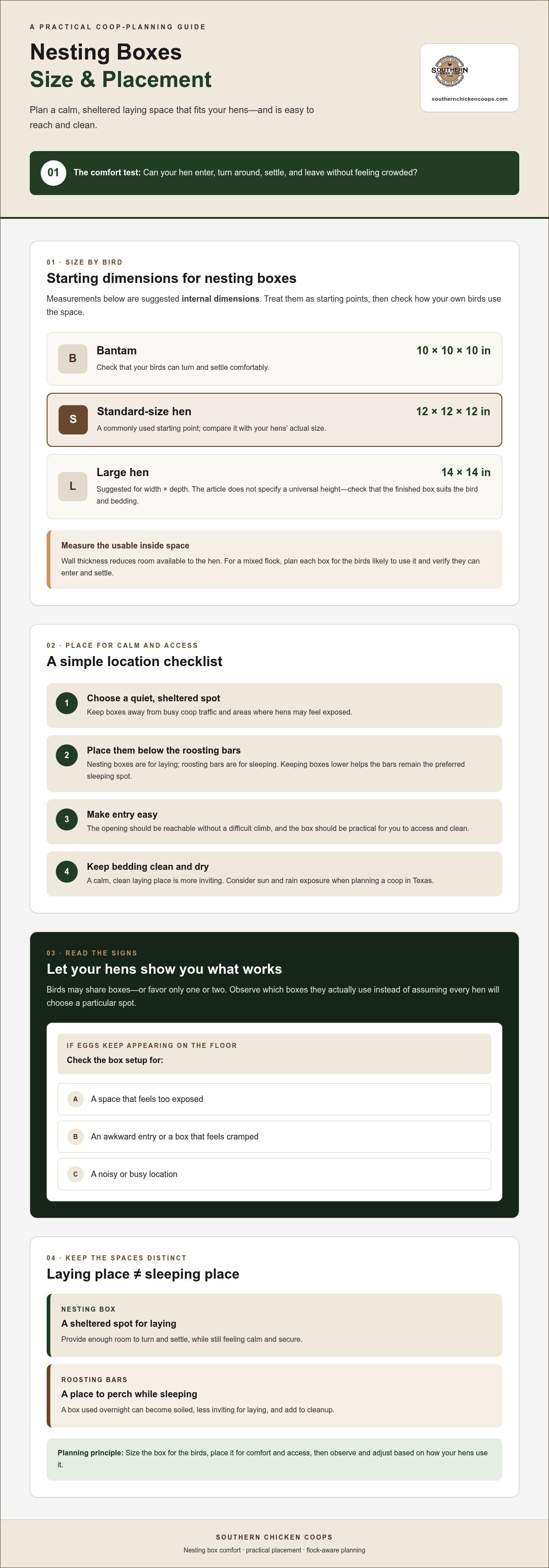
Think calm and secure. Choose a spot away from busy coop traffic and provide clean, dry bedding. A hen needs enough room to turn and settle without feeling exposed or squeezed. Make sure the opening is easy for your birds to reach and doesn’t require a difficult climb.
Hens may share boxes, and a flock might favor one or two spots even when other boxes are available. Watch where your birds choose to lay instead of assuming every hen will use a particular box. If eggs keep appearing on the floor, check whether the boxes feel too exposed, are awkward to enter, or sit in a noisy part of the coop.
How are nest boxes different from roosting bars?
Hens generally use nesting boxes to lay and roosting bars to perch while they sleep. Keeping these spaces separate helps make the boxes less likely to become sleeping spots. A box used overnight can become soiled, making it less inviting as a laying place and adding to your cleanup.
As a practical starting point, place nesting boxes lower than the roosting bars so the bars remain the preferred sleeping spot. There isn’t one height or spacing measurement for every coop. If you need precise dimensions for your layout, check trusted poultry-extension guidance.
When planning a new coop or adapting its layout, consider box access alongside flock movement, cleaning, and weather exposure. These details are part of planning a coop that suits your birds, but they don’t replace sizing the entire coop for the flock.
How to Choose Nesting Box Dimensions for Your Hens
A comfortable box gives a hen room to enter, turn, and settle without feeling cramped, while still feeling sheltered. Treat standard measurements as a starting point, not a rule for every bird. The useful question in this nesting box size and placement guide is whether the space suits the hens expected to use it and the way the coop is arranged.
What size nesting box do standard hens need?
A commonly used starting size for standard hens is 12 inches wide, 12 inches deep, and 12 inches high, measured inside the box. Penn State Extension’s Small Scale Poultry Housing is a useful reference for planning poultry housing. Compare the starting dimensions with your birds’ actual size and behavior. A box that feels too tight can make turning awkward; one that’s much larger may feel less sheltered.
Should large breeds, bantams, or mixed flocks use different sizes?
Bird size affects how much usable room a hen needs. Larger birds may benefit from a wider and deeper space, while bantams can often manage a more compact box. For a mixed flock, plan each box for the birds likely to use it, then observe whether they can enter and settle comfortably. These example dimensions are starting points, not guarantees for every breed or individual hen.
| Bird size | Suggested internal dimensions | Verification notes |
|---|---|---|
| Bantam | 10 × 10 × 10 inches | Check that your birds can turn and settle comfortably. |
| Standard-size hen | 12 × 12 × 12 inches | A commonly recommended starting point; compare with your hens’ actual size. |
| Large hen | 14 × 14 inches for width and depth | Allow enough usable room; confirm suitable height for the birds and box design. |
For the large-hen example, the measurements specify width and depth, not a universal height. Check that the finished interior leaves room for the bird and bedding without making entry difficult. Measure usable inside space rather than outside dimensions, since wall thickness reduces the room available to the hen.
If a box seems too cramped, watch for hesitant entry or difficulty turning. If it feels overly spacious, consider whether it still provides a calm, sheltered place to lay. When planning a coop, box dimensions and access can be considered alongside your flock’s needs. You can explore custom coop options as one part of planning a suitable home for your hens.
Where to Place Nesting Boxes in a Coop, Including Texas Backyards
A well-sized box also needs a sensible location. Choose a quiet, sheltered part of the coop where hens can reach it without pushing through busy areas near feeders, doors, or other flock activity. A little privacy can make the spot more inviting. Convenient access for you makes it easier to gather eggs and check bedding.
Plan for both kinds of access: hens should be able to enter easily, and you should be able to reach the boxes without awkwardly disturbing the flock. For backyard layout ideas, see our Texas backyard coop preparation guide. Box placement is one part of the layout, not a substitute for considering the whole coop.
How high should nesting boxes sit?
There isn’t one height that fits every coop. Position boxes so your hens can reach them comfortably and, where practical, keep them below the roosting area to discourage overnight use. The University of Georgia's Management Guide for the Backyard Flock describes nesting boxes positioned about 2 feet off the ground with a perch. Use that as a reference, then account for your birds’ size and the coop layout rather than forcing a height that makes entry difficult.
A stable approach or landing area may help if the box opening is raised, but its design should suit the structure and the birds. Check that hens can get in and out confidently and that the route stays clear of routine coop traffic.
How can placement account for Central Texas weather?
In a Texas backyard, check where direct sun and wind-driven rain reach the coop. When the layout allows, place the box opening in a sheltered area, away from harsh sun and rain that could wet the bedding. Check the spot at different times of day and after rain. Conditions at the entrance matter as much as the box itself. Consider protection at the laying area alongside the coop’s broader design.
For regional context beyond nest-box placement, see our Texas chicken coop hot weather guide. Thoughtful placement and an easy route for egg collection can make daily flock care simpler. If you’re planning a coop, box access and position are practical details to discuss as part of a layout suited to your flock.
How Many Nesting Boxes Do You Need, and How Can You Encourage Use?
Box count is a useful starting point, but it can’t predict which nests your hens will favor. Plan for the flock you have, then watch how the birds use the boxes during regular laying. This step can help you spot a shortage or a setup problem before floor-laid eggs become routine.
- Count your hens. A commonly used rule of thumb is one nesting box for every 3 to 5 hens, a recommendation found in guidance from Dine-A-Chook, Cackle Hatchery, and Audrey’s Little Farm. Treat it as a planning estimate, not a guarantee that every hen will have a separate box or use one on schedule.
- Consider usable size. Boxes need to fit the birds expected to use them. If your flock includes larger hens, account for their space needs rather than choosing a box count based on numbers alone.
- Observe actual use. Note where eggs appear and whether hens are queuing, crowding, or avoiding a box. Several birds may prefer the same nest even when other boxes are available. Keep alternatives for busy laying periods and adjust based on what you see.
How many hens can share one nesting box?
The 3-to-5-hens-per-box range is a common flock-planning guideline, not a promise that a particular ratio will suit every coop. Even a small flock may benefit from more than one option, while hens can still choose a favorite. Look for waiting or competition, and make sure another comfortable box is available when the preferred spot is occupied.
What should you adjust if hens avoid the boxes?
Start by observing where and when eggs are laid. Change one likely issue at a time, then give the flock a chance to respond. Check whether the box is too bright or disturbed, the bedding is uncomfortable or soiled, the entrance is blocked, or the dimensions don’t suit the birds.
- Floor eggs: Check whether the boxes are easy to find and enter.
- Soiled nests: Look for signs hens are sleeping in the boxes or whether bedding needs attention.
- Crowding: Watch for queues or hens being displaced during laying periods.
- Nest avoidance: Review light, disturbance, bedding, access, and fit before moving the boxes.
A simple layer of clean, dry bedding can make a nest more inviting. Keep it fresh and check it routinely. If you’re planning a coop around your flock’s needs, explore custom coop options and consider how box access and layout fit into the overall plan.
Plan Nesting Boxes Into a Coop That Fits Your Flock
A comfortable laying area is one part of a well-planned coop. First, consider the size of the hens who’ll use the boxes. Choose a calm, sheltered location and check that both the birds and egg collector can reach it easily. Then consider exposure to sun and wind-driven rain. This nesting box size and placement guide can help you plan that area, but it can’t replace sizing the full structure for your flock’s space and everyday needs.
For broader housing considerations, see our handcrafted chicken coops in Texas guide. Planning before construction can help nest-box access, roosts, doors, and your route through the coop work together.
What should you share when planning a coop?
Before discussing a layout with a coop builder, gather a few practical details:
- Flock size and bird size: Note how many hens you keep and whether they’re standard-size, larger, bantams, or a mix.
- Available space: Measure the area where the coop will sit and consider how the flock will move through the interior.
- Egg-collection access: Decide how you’d like to reach the boxes to gather eggs and check their condition.
- A simple sketch: Mark possible nest-box locations, roosts, doors, and the route you’ll use to enter or reach the laying area.
Your sketch doesn’t need to be polished. It gives you and the builder a shared starting point for discussing whether the layout feels practical. Confirm exact dimensions and features directly with the builder, including what’s part of the current coop design rather than assuming a particular configuration.
How can a handcrafted coop fit your flock’s needs?
Southern Chicken Coops is a family-owned business in McGregor, Texas, that handcrafts custom coops one at a time and offers semi-custom designs. Flock size, bird dimensions, and preferred access can help guide a conversation about the overall coop layout. Nest-box planning can be one consideration, but that doesn’t mean standalone boxes or nest-box installation are offered.
Bring your flock notes and sketch as you consider what will make daily care comfortable and straightforward. To discuss your needs and semi-custom coop options, talk with Southern Chicken Coops about a handcrafted coop.
Give Your Flock a Thoughtful Place to Lay
A comfortable laying area comes together through a few considered choices: select box dimensions that suit your hens, place the boxes somewhere calm and sheltered, and make sure both birds and keeper can reach them easily. Then observe how your flock uses the space. Their habits can show whether the setup is working.
Nest-box planning is one part of a coop that fits your flock. Southern Chicken Coops handcrafts custom coops in McGregor, Texas, with semi-custom options available. As you plan, discuss your flock’s needs and how access fits into the broader layout. Completed coops are delivered to customers’ prepared, level lots.
Ready to plan a coop for your flock? Talk with Southern Chicken Coops about a handcrafted coop. A thoughtful layout can make everyday care and egg gathering more straightforward.
Frequently Asked Questions
How big should a nesting box be for a standard-size chicken?
A typical starting size for a standard-size hen is 12 inches wide, 12 inches deep, and 12 inches high, measured inside the box. University of Georgia Cooperative Extension offers this as a common guideline, not a guarantee that every hen will use the box. Breed and individual bird size can affect comfort, so compare your planned dimensions with reputable poultry-extension guidance and observe whether your hens can enter and turn easily.
How many nesting boxes do I need for 10 hens?
A useful rule of thumb is one box for every 4 to 5 hens, so 10 hens might start with 2 or 3 boxes. University of Georgia Cooperative Extension gives this ratio as flock-planning guidance, not a guarantee of how birds will behave. Hens may favor the same box, so watch for queues, crowding, or unused nests. Observe where eggs are laid and adjust box availability if needed.
Can nesting boxes be placed on the floor?
Yes, a floor-level box can work in some coop layouts if hens can reach it comfortably and it stays clean and undisturbed. Keep it away from busy paths, feeders, and sleeping areas, and check that bedding doesn’t become wet or soiled easily. There’s no single height that suits every coop. Choose a stable, practical position for your birds, then watch whether they use the box consistently.
How high should nesting boxes be off the ground?
The right height depends on your flock, coop layout, and how safely hens can reach the opening. University of Georgia Cooperative Extension describes boxes about 2 feet above the ground as a reference, but that isn’t a universal requirement. Keep boxes stable and accessible and, where practical, lower than the roosting areas so hens are less likely to sleep in them. Consider your birds’ size and ability to enter comfortably.
Should nesting boxes be inside or outside the chicken coop?
Either arrangement can work, depending on the coop design, weather protection, predator security, and how easily you can clean the boxes and collect eggs. An exterior-access box still needs a secure, sheltered design, not an exposed opening. For Texas flocks, look for a position protected from direct sun and rain. This nesting box size and placement guide can help you weigh access and shelter before settling on a location.
Why are my chickens laying eggs outside the nesting boxes?
Check whether the boxes feel comfortable and accessible, with suitable dimensions and clean bedding. Excessive light, disturbances, or blocked entrances may also put hens off. Observe where and when eggs appear, then change one factor at a time so you can see what helps. A new laying pattern may take observation before you decide the layout needs changing. If the behavior continues or birds seem ill, seek experienced poultry guidance.
Do nesting boxes need bedding?
A clean, dry bedding layer can cushion eggs and help make a box comfortable for laying. Replace material that becomes damp or soiled, and check the nests regularly to keep them in good condition. No single bedding material is best for every coop or flock, so choose an appropriate, safe option and follow trusted poultry-care guidance. Bedding can support comfort, but it won’t solve problems caused by poor access or an unsuitable box location.
Can nesting boxes be built into a custom chicken coop?
Nesting-box layout can be discussed as part of planning a custom coop, but the final features and dimensions depend on the builder and design. Southern Chicken Coops handcrafts coops in McGregor, Texas, and offers semi-custom options. Ask directly about current configurations and measurements rather than assuming a particular coop includes nesting boxes. The company offers custom coops and coop delivery, not standalone nest boxes or DIY kits.


