

The best multi-purpose poultry housing in Texas combines a well-ventilated coop with a secure outdoor run, sized for your flock and how you plan to keep it. A fixed setup suits birds housed in one place, while a movable house can work for keepers rotating birds across pasture. Either way, the layout should protect chickens from predators and harsh weather while making daily care practical.
It’s natural to focus first on how many birds a coop can hold, but usable space, airflow, and the placement of feeders, perches, and nests matter just as much. In Texas, account for summer heat as well as rain and cooler weather so the shelter works through changing conditions.
This guide explains how to compare housing systems and plan dimensions, indoor and outdoor space, ventilation, and nest placement. It also covers when a custom-built coop can bring those decisions together in a sturdy, functional home for your poultry.
Key Takeaways
- Choose fixed or movable housing based on how you’ll manage the flock and whether pasture rotation is part of your plan.
- Plan the coop and run around the species and flock size; space needs differ between laying hens, quail, turkeys, and other birds.
- Make airflow, shade, weather protection, and predator resistance central to the layout, especially for Texas conditions.
- Place perches, feeders, and waterers so birds can reach them comfortably without crowding the main living area.
- Size and position nest boxes with the flock in mind to create a calmer, more practical laying space.
Which housing system is best for poultry?
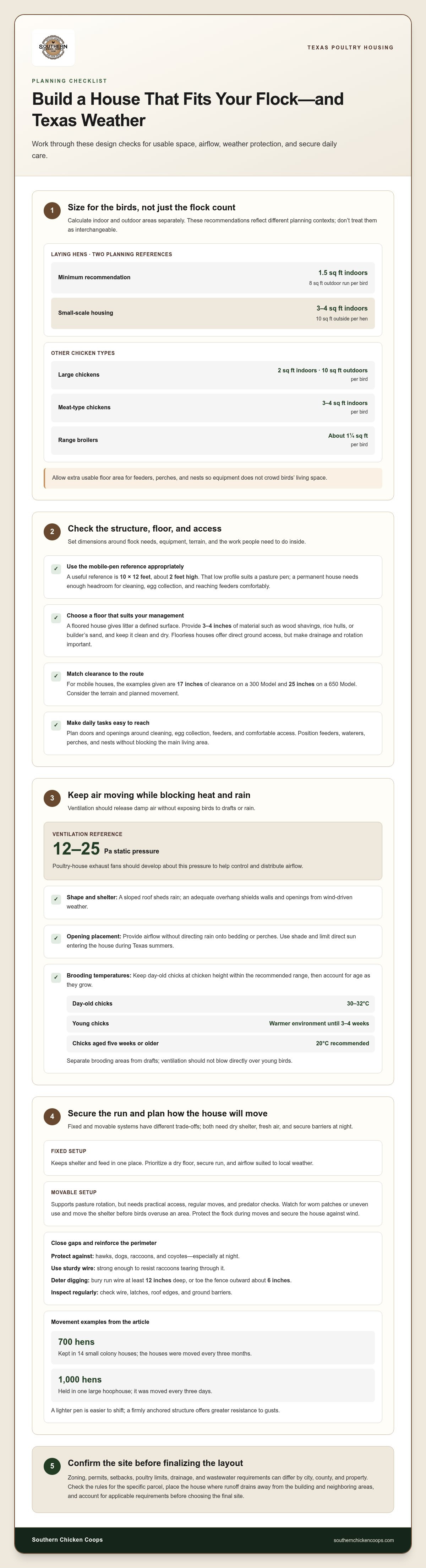
For multi-purpose poultry housing in Texas, the right system depends on flock purpose, site, and daily care. A fixed coop with an attached run keeps shelter and feed in one place. A movable coop supports pasture rotation, but requires regular moves and predator checks. Both systems need dry shelter, fresh air, and secure barriers at night.
Ventilation must release damp air without leaving birds exposed to drafts or rain. Poultry-house exhaust fans should develop about 12-25 Pa of static pressure to help control and distribute airflow. The coop also needs protection from winter cold and summer heat. Place openings to support air movement while keeping rain from blowing onto perches and bedding.
Predator control depends on closing gaps as well as building a sturdy run. Chickens need protection from hawks, dogs, raccoons, and coyotes, especially at night. Use wire strong enough to resist raccoons tearing through it, and secure doors and roof edges. To deter digging, bury run wire at least 12 inches deep along the border, or toe the fence outward about 6 inches.
Moving a house periodically can help manage the area birds use, but rotation should follow pasture conditions. Watch for worn patches and uneven use, then move the shelter before birds overuse one area. Protect the flock during each move and secure the house against wind. A lighter pen is easier to shift, while a firmly anchored structure offers greater resistance to gusts.
Texas state and local rules depend on the property’s location and proposed use. Zoning, permits, setbacks, and poultry limits can differ between cities and counties. Identify the rules for the specific parcel before choosing a site or layout.
Funding may involve agricultural loans, grants, or cost-share programs, each with its own eligibility and project requirements. The right fit depends on whether the housing supports a farm operation, what work the funding covers, and the program’s application terms.
For a fixed system, prioritize a dry floor, secure run, and airflow suited to local weather. For a movable setup, plan practical access for moving it and a rotation approach that protects pasture. In either case, inspect wire, latches, roof edges, and ground barriers regularly. One weak opening can compromise an otherwise secure layout.
House dimensions, roof design, and openings
Set dimensions from the flock’s indoor-space needs, then allow room for equipment and access. A useful reference for mobile poultry pens is 10 by 12 feet, about 2 feet high. That low profile suits a pasture pen, but a permanent house needs enough headroom for people to clean, collect eggs, and reach feeders comfortably. Plan the door and openings around those daily tasks.
Roof shape affects shade, rain protection, and interior comfort. A sloped roof sheds rain, while an adequate overhang helps shield walls and openings from wind-driven weather. Position doors and windows to provide airflow without directing rain onto bedding. In a Texas summer, shaded openings and a roof that limits direct sun can reduce heat entering the house.
Mobile houses vary in both capacity and weight. One reported system kept 700 hens in 14 small colony houses, moved every three months; another large hoophouse held 1,000 hens and moved every three days.
Ground clearance matters when a house moves over pasture. A 300 Model mobile chicken house has 17 inches of clearance, while a 650 Model has 25 inches. These examples show why clearance should suit the terrain and the movement plan. For a stationary structure, a solid floor creates a defined surface for clean litter; provide 3-4 inches of material such as wood shavings, rice hulls, or builder’s sand.
Floorless houses give birds direct access to the ground, which can suit pasture-based management. They also make drainage and rotation important, since wet ground can affect the living area. Floored houses provide a fixed surface, but bedding still needs to stay clean and dry. Choose according to flock management, terrain, and how often the housing will move.
Brooding needs also shape house design. Day-old chicks should be kept at 30-32°C at chicken height, and young chicks need a warmer brooding environment until they are 3-4 weeks old. Chicks aged five weeks or older need a recommended temperature of 20°C. Separate the brooding area from drafts, and arrange openings so ventilation does not blow directly over young birds.
Texas requirements for poultry-house setbacks, drainage, and wastewater depend on local rules and the property. Set the house where runoff drains away from the building and neighboring areas, and account for applicable setback and wastewater requirements before finalizing its location.
Indoor and outdoor space requirements by bird type
Plan space around bird type and housing system, not just flock size. Laying hens need room to rest, feed, and reach the outdoor run; meat-type chickens have different space needs. Calculate indoor and outdoor areas separately, then ensure doors and paths let the flock move between them without bottlenecks.
For laying hens, one recommendation gives a minimum of 1.5 square feet indoors and 8 square feet in the outdoor run per bird. Small-scale housing recommendations are more generous, with 3-4 square feet indoors and 10 square feet outside per hen. These figures describe different planning contexts, so don’t treat them as interchangeable. A larger indoor allowance can make it easier to fit feeders, perches, and nests without crowding the usable floor.
Other chicken types also call for distinct allocations:
- Large chickens: 2 square feet indoors and 10 square feet outdoors per bird.
- Meat-type chickens: 3-4 square feet indoors per bird. Range broilers are commonly stocked at about 1¼ square feet per bird.
- Bantams: 2-3 square feet indoors and 5-8 square feet in the outside run per bird.
- Quail: 1 square foot indoors and 4 square feet outdoors per bird.
Use space guidance that matches both the flock and housing system. A range-broiler stocking figure is not the same as an allowance for a small-scale laying flock. Treating them as identical can leave a house crowded once equipment takes up floor space. Recalculate as the flock grows instead of relying on the original layout.
For other poultry, the listed examples include 6 square feet indoors and 20 square feet outdoors per turkey, and 5 square feet indoors per pheasant. Pigeons need at least 4 square feet per breeding pair. These differences reflect why a single “per bird” figure doesn’t suit every poultry house. A mixed flock needs separate consideration for each bird group, especially where size and movement habits differ.
Space also depends on what the indoor area must accommodate. Roosting houses without feed or nest boxes inside are allotted 1¼ square feet per hen, while range houses with feed and nest boxes inside are allotted 2 square feet per hen. Winter housing is allotted 2.3 square feet per hen when insulation and ventilation eliminate condensation. These examples show how equipment and seasonal use affect the layout.
Before construction, sketch the indoor area, run, and positions of feeders and perches. Check that birds can reach the outdoor space easily and move through openings without bottlenecks. This helps prevent blocked routes and equipment taking up space intended for the flock. For a changing flock, a custom layout can account for bird type and intended use from the start.
Natural ventilation and building orientation
Texas poultry housing must manage heat, moisture, and fresh-air exchange across changing weather. In hot climates, ventilation capacity should reach at least 5m3 per chicken per hour; inlet area should be 1.5cm2 per m3 of ventilation.
Draft-Free Airflow and Moisture Control
Draft-free ventilation removes damp air without directing cold or fast airflow over resting birds. That balance matters because wet litter and lingering moisture can make it harder to keep the space clean and healthy.
Arrange openings so incoming air mixes above the birds before moving through the house. Inlet placement and airflow paths matter: poorly directed air can create drafts in one area while leaving stale air inside another. During brooding, laying birds require 60-80% relative humidity; after brooding, the stated range is 50-70%. These figures make moisture control part of ventilation planning, not a separate chore.
Building orientation can make better use of natural airflow and shade. Consider the prevailing wind, then position openings to encourage cross-flow without exposing birds to direct gusts. Roof overhangs and shaded openings can help keep sun and rain out. Because wind and sun exposure vary by property, assess airflow at the actual building site.
Ventilation for Hot Climates
Hot-climate ventilation moves enough air to help birds release body heat. For tunnel houses, the recommended air speed is 2.5-3 m/s for broilers and commercial layers. That target relies on a clear path from air inlets to exhaust fans, with no obstructions that interrupt flow. Fan capacity must suit the house and flock, rather than being chosen by appearance alone.
Mechanical ventilation uses exhaust fans to draw air through planned inlets. Poultry-house fans should develop static pressure of about 12-25 Pa to help control and distribute airflow. A discharge cone can increase fan performance by 5-10%. These details matter because a fan only helps if air reaches the birds evenly and exits without short-circuiting.
Natural ventilation relies on openings and outdoor air, so it changes with wind and temperature. Mechanical systems provide more controlled air exchange when natural airflow is not enough. In Texas heat, plan the two approaches together: keep useful openings clear, provide suitable fan capacity, and avoid blocking the intended airflow route.
Insulation helps moderate temperature swings, while ventilation removes accumulated heat and moisture. Neither replaces the other. For young birds, airflow must also respect their brooding environment; day-old chicks need 30-32°C at chicken height. A design that accounts for bird age, heat, and moisture supports steady production and helps reduce conditions associated with disease.
Nest size, placement, and quantity
For laying hens, nest boxes need enough room, suitable placement, and enough openings for the flock. A chicken nest box should measure 12 inches by 12 inches by 14 inches. Keep nest access separate from busy feeding areas so hens can reach it without crossing the main traffic route. A little planning helps make egg collection and daily checks more straightforward.
Set nests at least 2 feet off the ground and at least four feet away from roosts. This keeps nesting and nighttime resting areas distinct. Place boxes where hens can enter comfortably and people can gather eggs without disrupting the flock. Use clean, dry nesting material, and replace it when it becomes soiled or damp. Damp material can make a nest less inviting.
Plan nest quantity from the number of females. Provide two nests for the first four hens, then add one nest for every four hens after that. Small-scale poultry housing also uses a guide of at least one nest for every 4-5 females. These recommendations differ slightly, so use the flock size and the nesting space available when planning. If several hens share too few boxes, access can become crowded.
A workable housing layout also includes the equipment birds use each day. A standard-size chicken needs at least 3 inches of feeder space, while a nipple watering system needs one nipple for every 6-8 birds. For flocks larger than 25 birds, place feeders in separate areas so birds can reach feed throughout the house. Leave clear paths between feeding, watering, and nesting zones.
Lighting and perches complete the setup. A small poultry house can use a low-intensity electric light of 40 watts or less, and one foot-candle of light supports year-round egg production. Hens need 14-16 hours of lighting to maintain a high rate of egg production. Provide perches so chickens have a comfortable place to roost. Keep perches away from nest openings, so droppings don’t fall into nesting areas.
These measurements help turn a floor plan into practical daily space. As a flock grows, recalculate nest numbers, feeder access, and perch length together. Don’t add boxes in a way that blocks an opening or narrows the route between water and feed. Keep nests easy to inspect and accessible as birds move around the coop.
Ready to shape these details into a practical coop layout? Plan a nest-ready coop around your flock’s needs.
Southern Chicken Coops: Custom Chicken Coops
Southern Chicken Coops can help turn your flock’s space and layout needs into a practical custom coop. Its signature Polka model measures 6'x12' and is designed for durability and functionality in the Texas climate. Semi-custom designs let you tailor housing to your poultry needs, whether you’re planning around bird space, nest placement, or the way you’ll use the coop day to day.
Once you’ve mapped out your flock’s needs, a handcrafted structure can bring those priorities together. Southern Chicken Coops builds custom chicken coops and delivers completed coops to a prepared, level lot.
To discuss a coop for your flock, contact Southern Chicken Coops or visit southernchickencoops.com.
Build a Housing Plan That Can Grow With Your Flock
Turn your layout into a plan that works over time. Consider how your flock may change, how daily chores fit your routine, and which parts of the setup may need room to adapt. Planning these elements together helps you make practical decisions for your birds’ care, rather than adding features one at a time without considering how they fit.
For multi-purpose poultry housing in Texas, that means shaping a coop around your site, flock, and priorities. Southern Chicken Coops offers custom chicken coops and delivery, with handcrafted housing brought to your prepared, level lot.
If you’re ready to talk through a coop that suits your poultry plans, contact Southern Chicken Coops. We’d be glad to help you take the next step toward a welcoming, well-planned home for your flock.
Frequently Asked Questions
What is multi-purpose poultry housing in Texas?
In Texas, multi-purpose poultry housing is a setup planned to shelter birds for different purposes, such as egg production, meat, or a mixed flock. It combines indoor shelter, outdoor access, and the equipment each group needs. For example, a household raising laying hens alongside dual-purpose breeds should plan for both nest access and comfortable movement, rather than assuming every bird has identical needs.
What poultry housing designs work for broilers, layers, and mixed flocks in Texas?
Broilers need a layout centered on accessible floor space and feeding, while layers need nest access and perches. Dual-purpose breeds, including Buff Orpingtons and Black Australorps, can be raised for both meat and eggs, so their housing should support both uses. In a mixed flock, organize distinct areas for resting, feeding, and laying, and make sure smaller birds can reach food and water.
How much space per bird is recommended for poultry housing in Texas?
Space depends on bird type and housing system. For example, ten laying hens at the basic recommendation need 15 square feet indoors and 80 square feet in an outdoor run. Small-scale recommendations instead use 3-4 square feet indoors and 10 square feet outdoors per hen, so the same flock would need 30-40 square feet inside and 100 outside. Choose the applicable approach before fixing the flock size.
How do fixed, mobile, and hoop-style poultry houses compare for Texas farms?
A fixed house keeps shelter and daily equipment in one place, suiting a site-based routine. A mobile house supports pasture rotation, but moving it requires monitoring the ground and protecting birds during relocation. Hoop-style houses provide a covered option that can suit larger flock arrangements. Compare each system by how it fits your land, flock management, and willingness to move the housing or manage pasture rotation.
What are common poultry housing risks in Texas, including predators, disease, storms, and flooding?
Predators can exploit weak wire, gaps, or unsecured doors, while storms can expose birds to wind-driven rain or damage poorly secured structures. Standing water can leave the house and run wet. Spilled feed can attract wild birds or rodents, and contact with manure can raise disease risks. Keep feeding areas clean, limit manure exposure, and choose a site that drains away from the birds’ living space.


