
Local alternatives to national coop brands include Texas-made chicken coops from Southern Chicken Coops, a McGregor-based builder of handcrafted, ready-to-use coops. The practical comparison is not just local versus national: consider the coop’s design, capacity, construction, fit for your property, and delivery.
National brands can be familiar and easy to search, but a Texas builder may offer designs shaped with local conditions in mind. When comparing chicken coops, look beyond the name: check the space available for your flock, the construction details, and how the coop will reach your property. Southern Chicken Coops offers its Polka model and semi-custom designs for backyard keepers, homesteaders, and small farms.
Key Takeaways
- Local brand awareness helps independent businesses stand out by making their expertise and community ties easier to recognize.
- A clear local website can help people discover nearby options and quickly understand what those businesses offer.
- Regional relevance matters: local needs and conditions can shape which coop is a practical fit.
- Learn how to distinguish a locally rooted alternative from a familiar national brand without assuming one choice suits everyone.
- For a coop tailored to your needs, explore how custom coop options and delivery can support your flock and property.
Your local
The word “coop” can describe two different things: a cooperative business or a chicken coop. That distinction matters when looking for a locally made alternative to a nationally marketed poultry shelter. REI, Ace Hardware, Carpet One, and NAPA Auto Parts are retail cooperatives, not chicken-coop makers. Their cooperative ownership model doesn’t tell you whether a nearby builder designs or delivers poultry housing.
Retail cooperatives bring independent businesses together under shared ownership or branding. The first retailer cooperative was founded in England in 1844, and retail cooperatives now include about 50,000 independent business-owner members. That structure lets participating businesses remain independently owned while cooperating in areas such as purchasing or marketing. It’s different from a single national company selling its own branded products through a network of stores.
For a chicken keeper, compare the builder, the coop’s features, and its suitability for the intended site. A local business can provide a direct connection to the people making the product, helping you understand the design and available customization. Southern Chicken Coops builds its coops in McGregor, Texas, and delivers completed coops to a prepared, level lot. Locality is most useful when it answers practical questions, not simply because a business uses “local” in its name.
Online visibility helps people find that connection. A local website can explain the business’s location, the type of chicken housing it makes, and the communities its work is intended to serve. Clear language helps distinguish a poultry-coop builder from a retail cooperative, a reseller, or a company whose name includes “coop” for another reason. For example, a page describing custom chicken coops communicates a different offer from a page describing member ownership or shared purchasing.
A memorable local business is easier to recognize when its name, location, photographs, and product descriptions tell a consistent story. For chicken keepers, a clear explanation of the coop’s dimensions, features, and intended use is more helpful than a vague slogan. Southern Chicken Coops builds quality homes for hens in McGregor, Texas.
When comparing local and national coops, focus on the fit with your flock and property. Consider available space, how the coop is designed, the regional weather, and delivery arrangements. A design intended for Texas conditions may be relevant to a Texas buyer, but the word “local” alone does not establish quality or suitability. Compare the actual product details with your needs.
- Identify the business model. A cooperative is an ownership structure; a chicken-coop maker is a product provider. One business could fit both descriptions, but the terms aren’t interchangeable.
- Look for a clear local presence. A named location and useful website details help show where a business operates and what it makes.
- Match the offer to the need. Compare design, customization, regional considerations, and delivery rather than relying on a familiar national name.
Consumer-owned cooperatives generally serve their members through shared ownership and decision-making. That model may matter when choosing where to shop, but it does not identify a local chicken-coop builder. Keep the ownership question separate from the product question. For poultry housing, compare the builder’s designs, construction details, and delivery information.
A recognizable name may help people discover a business, but clear product information helps them decide whether it fits. Southern Chicken Coops explains its work plainly: it builds handcrafted chicken coops in Texas and offers semi-custom designs and delivery. That gives nearby chicken keepers a concrete local alternative to compare with national brands.
Location local
Local searches often begin with a place name. Someone looking for a chicken coop in Texas may want a builder familiar with the region and clear information about delivery. Southern Chicken Coops is based in McGregor, where its coops are built, and delivers completed coops to a prepared, level lot.
A study cited in the research reports that 97% of consumers go online to find products and services available in their areas. That figure points to the importance of being findable where customers live, not merely having a recognizable name. For a poultry-coop business, a local page can connect the product category with a place such as McGregor, Texas. It should explain the business’s regional focus in plain language, then help visitors understand what it offers.
Location details matter when they answer practical questions. Before choosing a coop, consider whether the design suits your property, whether the site is ready for delivery, and how the coop will be positioned. Southern Chicken Coops delivers to a prepared, level lot, so site preparation is part of planning for a local purchase.
A useful local website might organize information around these reader needs:
- Location: Name the town or region served, using consistent wording across relevant pages.
- Product relevance: State clearly whether the business makes chicken coops, sells other coop-related products, or serves another purpose.
- Regional context: Explain how local weather or property needs influence the information presented.
- Delivery details: Describe delivery where it applies, so location and logistics are not left disconnected.
These details also help readers distinguish a local provider from a national retailer. A national brand may have broad recognition, while a local business can make its regional relevance clear through specific descriptions. For example, a page about Texas conditions speaks more directly to a Texas chicken keeper than generic copy written for every region. That does not make one business automatically better. It helps the reader judge which information matches the setting.
Clear wording also avoids confusion between “co-op,” a cooperative business, and “coop,” a poultry shelter. A page that identifies chicken coops and names its Texas location makes the product and regional connection easy to understand. When comparing options, look for specific product descriptions rather than relying on a business name alone.
Consistency matters across a business’s online presence. If one page names McGregor and another uses a different regional description, readers may struggle to understand the connection. Keep location language accurate and aligned wherever the business describes its work. Then make the surrounding content genuinely useful, such as explaining the design choices that matter for a local property or flock.
Treat location as a starting point, not a verdict. First, consider whether the coop’s design suits your flock and site. Then compare its features and construction with your needs, and include delivery and site preparation in your plans. A local option becomes a meaningful alternative when its details fit the project.
For a Texas-focused example of local coop information, explore regional chicken coop options and consider how location connects with the needs of your flock.
A location-focused page can also explain partnerships without blurring what the business itself offers. Cooperative marketing between different brands can involve sharing locations, bundling products, and running special promotions. If such an arrangement is relevant, describe the participating businesses and make clear which products or services each provides. That keeps a shared location or combined offer from making a reader guess who is responsible for a particular item. It also lets visitors assess whether the partnership is useful to their needs and their area.
Keep the local connection easy to understand: identify the place or service area, explain the business’s own role, and present any shared offer as a separate detail. A reader should be able to tell whether a location is a business site, a partner’s site, or simply part of a promotion. Clear wording can connect local discovery with practical next steps while preserving the distinction between the brands involved. This is especially helpful when the page discusses a product alongside services offered by another business. A precise description gives visitors a clearer basis for deciding whether the information fits their location and purpose.
Local regional
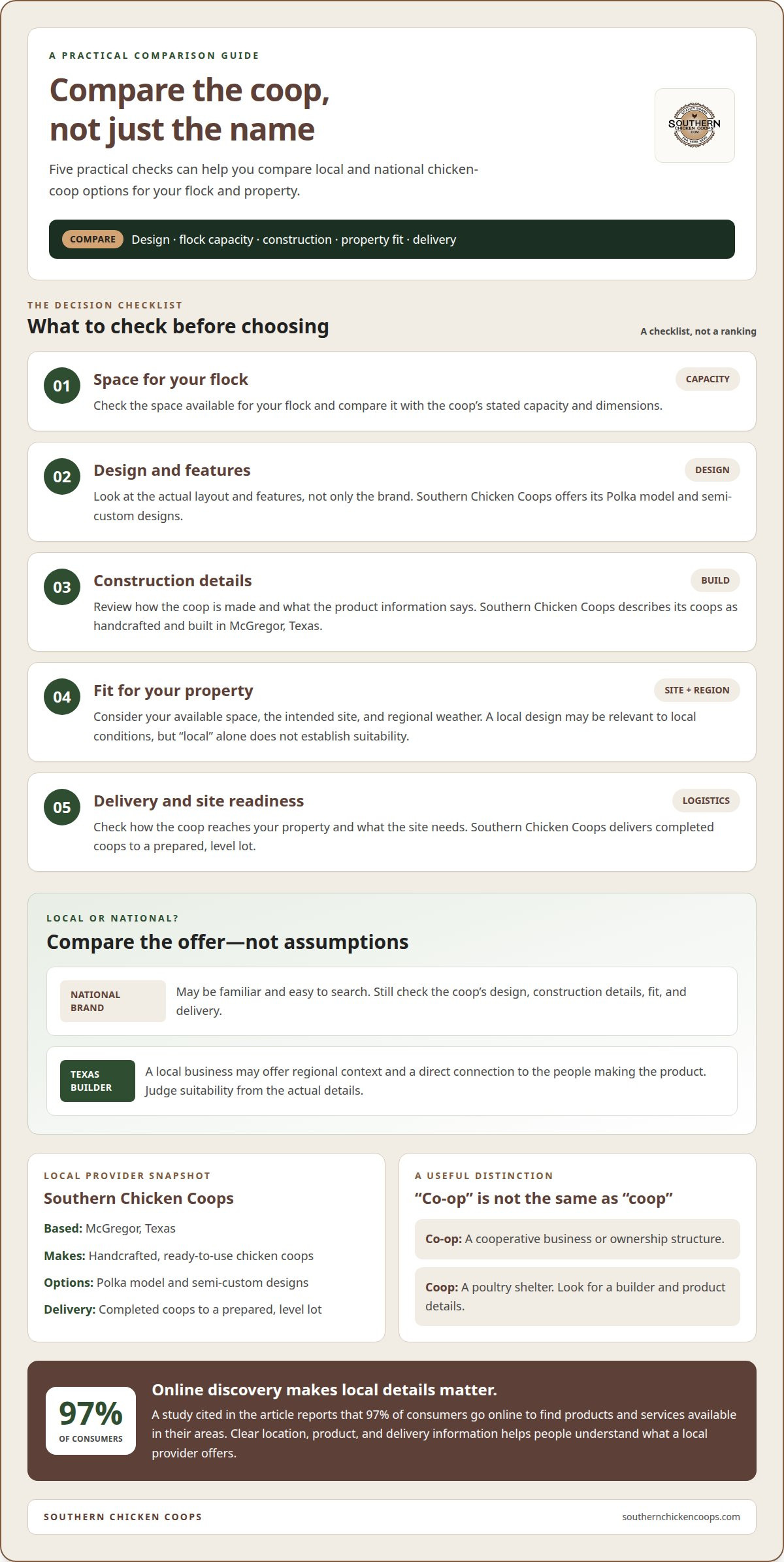
A regional business may understand the needs of nearby chicken keepers, but its location alone does not establish that a coop is right for a particular flock. For people comparing local alternatives to national coop brands, the useful questions are what the business builds, how the design fits the property, and what delivery involves.
Cooperative ownership provides one way to understand regional business relationships. A farmers’ cooperative is owned and run by farmers working together to market, aggregate, and sell their products. That differs from a company that builds chicken coops. Both may serve local communities, but their purposes and ownership structures aren’t interchangeable. Knowing the distinction helps readers interpret what a “coop” business actually does.
Food cooperatives offer a concrete example of local identity taking shape over time. Park Slope Food Coop in Brooklyn began in 1973. Its name connects the organization to a specific neighborhood, while its cooperative structure gives members a role in the business. That example shows how a local name can signal community roots. It doesn’t mean every regional business is a cooperative or serves the same purpose.
Regional markets can also form around the products people make and use nearby. Estimated sales of local food in the United States totaled $6.1 billion in 2012. That figure relates to local food, not chicken-coop sales. Still, it illustrates a broader point: local identity can help people recognize products connected with a region. For poultry housing, regional relevance instead comes through the builder’s stated focus and how the coop suits its setting.
For a reader comparing businesses, consider these distinctions:
- Ownership: A farmers’ cooperative belongs to participating farmers; a local builder may have a different business structure.
- Purpose: A food cooperative markets food, while a coop maker provides poultry housing.
- Regional fit: A Texas-focused design may address different conditions than broad, general-purpose product information.
- Local identity: A town, neighborhood, or regional name is most useful when the business explains its actual work.
A national company may serve a broad market, while a regional builder may focus on a narrower area. Neither label proves a coop suits a particular flock. Texas buyers can compare specific product details, including the coop’s size, features, and construction, with their property and intended use.
Regional awareness also depends on how a business communicates. A page that names Texas but says little about its work gives readers limited context. Clear descriptions can explain the product category, the design approach, and the regional conditions considered. A local name paired with useful information makes the connection easier to understand. That’s stronger than relying on hometown language without explaining its relevance.
Local alternatives become meaningful when regional recognition leads to a better-informed comparison. Start by distinguishing cooperative ownership from chicken-coop manufacturing. Then identify the business’s geographic focus and read how it relates to the product. Finally, weigh the design information against your property and flock. This approach keeps community identity in view without treating it as a substitute for practical fit.
If regional conditions are shaping your decision, explore regional coop options and consider how location relates to the housing your flock needs.
Evaluating a builder involves looking at clear product details and whether the business explains why its design is intended for that setting. Regional promotion can help a business speak to a nearby audience, but visibility should not be confused with evidence about a product. Quick service restaurant franchise stores with nearby locations may pool funds for regional marketing and advertising. That example concerns restaurant promotion, not poultry housing, and it does not establish anything about coop construction or performance. It is useful only as a reminder that regional activity can involve shared promotion among businesses, rather than shared ownership or a common product. A regional campaign, a cooperative structure, and a locally focused builder describe different things.
When assessing a poultry-housing business, readers can separate its geographic focus from the information it provides about design, materials, assembly, and suitability. A regional label may explain whom a business hopes to reach, but it cannot answer every practical question about a coop. Look for clear product details and explanations tied to the setting, rather than treating local promotion as proof of fit. That approach keeps the comparison grounded in the needs of the flock and the claims the builder actually makes. It also leaves room for regional identity to be meaningful without assuming that every nearby business has the same structure or offers the same kind of service.
Southern Chicken Coops: Coop Delivery
Southern Chicken Coops offers custom chicken coops and coop delivery for chicken keepers seeking a locally focused option. Its semi-custom designs allow the coop to be tailored to a keeper’s needs, while the regional focus keeps Texas conditions in view. That can be a useful next step when you’ve decided a locally made coop better fits your flock and property than a general national option.
Choosing a design starts with your flock and the space available. Include the site in your plans: the lot should be level and prepared for delivery. Southern Chicken Coops delivers completed coops to a prepared, level lot, connecting your design choice with the next step of bringing the coop to your property.
If you’re considering a custom chicken coop or delivery, contact Southern Chicken Coops to discuss your plans.
Choose a Coop That Fits the Life You’re Building
A coop is part of the daily rhythm of caring for a flock, so let the choice reflect how you plan to use your space over time. Before settling on a familiar name, picture the routine around feeding, gathering eggs, and tending your birds. That practical vision can help you decide which details matter most and which choices simply look appealing at first.
For anyone comparing local alternatives to national coop brands, start with the needs of your flock and property, then compare designs and delivery. Southern Chicken Coops builds custom chicken coops in Texas and delivers completed coops to prepared, level lots. Contact Southern Chicken Coops to discuss a design that fits your plans.
Contact Southern Chicken Coops to talk about your coop plans. A well-considered home for your flock starts with a clear picture of the care you want to provide, and we’re here to help you take that next step with confidence.


