

What if the hen you suspect is only following the flock’s first broken egg? Thoughtful coop design to prevent egg eating starts with one nesting box for every 4-5 hens, secluded nest spaces, and egg collection at least twice a day. To look for the egg eater, quietly observe which hens visit the nests and what happens when an egg breaks.
Finding a broken egg can be frustrating, especially when it’s hard to tell whether one hen started the habit or others joined in. A thoughtful coop design to prevent egg eating can make eggs less visible and accessible while giving hens a comfortable place to lay.
Space, enrichment, frequent collection, nest curtains, and careful observation can all help. Here’s what to consider when egg eating continues, so you can take a steady, flock-minded approach.
Key Takeaways
- Start by checking whether a broken egg, weak shells, or a flock habit may be contributing, then observe nest activity to narrow down which hen is involved.
- Plan for one nesting box per 4-5 hens, and consider privacy features that keep eggs less visible.
- Use perches, foraging opportunities, and other enrichment to help keep hens occupied and reduce boredom-related pecking.
- Collect eggs at least twice a day; more frequent collection can help when egg eating is active.
- Choose nesting-curtain fabric that won’t unravel, and introduce curtains gradually so hens can adjust to the change.
1. Why Do Chickens Start Eating Their Eggs?
Egg eating can start with an accident. Young hens just beginning to lay may produce weak-shelled eggs, and a cracked egg exposes its contents. A hen that tastes the egg may peck at others later. Once an egg breaks, flockmates can join in, turning one mishap into a repeated behavior.
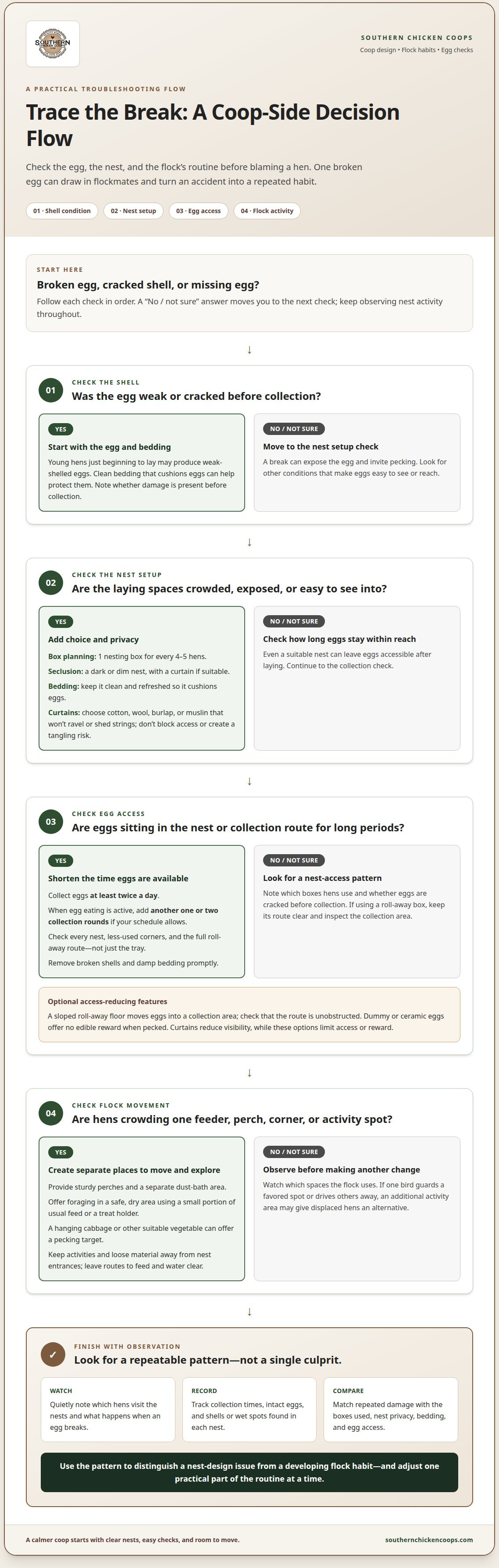
Look at the nest itself before blaming a particular hen. A crowded or exposed laying area can leave eggs within easy reach and visible to passing birds. Plan for one nesting box for every 4-5 hens, with clean bedding that cushions eggs. A dark or dim box with a curtain offers a more secluded laying place and keeps eggs out of sight after the hen leaves.
Nest-box curtains can also help retain warmth in cold conditions, potentially reducing the chance of eggs cracking or freezing. They provide privacy, but shouldn’t block access or hang where hens could become tangled. After adding a curtain, observe how your flock uses each nest.
What materials and bedding work best for nest boxes designed to discourage egg eating? Choose curtain fabric such as cotton, wool, burlap, or muslin that won’t ravel or shed strings. Straw can help keep curtains cleaner than shavings. Avoid sawdust and sand as coop bedding, and refresh clean nest bedding regularly so hens continue using it.
Roll-away nesting boxes move eggs out of reach soon after laying. A sloped nest floor lets an egg roll into a collection area, away from pecking hens. Dummy or ceramic eggs offer another simple deterrent: pecking them brings no edible reward. These features limit access and reward, while curtains reduce visibility.
How much do DIY and commercial roll-away nesting boxes cost in the United States? Costs vary with materials, box dimensions, and the egg-collection mechanism. The design and components determine the total, since a straightforward build and a more involved collection system have different material and labor needs.
What are the risks or drawbacks of roll-away nest boxes for hens and egg collection? Eggs may not reach the collection area if the slope or route is obstructed. A separate tray can also make eggs less visible during routine checks. Keep the route clear and inspect the collection area when gathering eggs.
When broken eggs keep appearing, note which boxes hens use and whether eggs are cracked before collection. Combine that pattern with observations of curtains, cushioned bedding, and egg access to help distinguish a design problem from a developing habit.
2. Flock space and enrichment
A coop’s layout shapes how hens spend time laying, feeding, and resting. If birds crowd around the same feeder, perch, or corner, some have fewer chances to move away and explore. Give them distinct activity areas, such as a feeding spot, sturdy perches, and a dust-bath area.
How many nesting boxes are needed per laying hen? Plan for one nesting box for every 4-5 hens. That gives laying birds a choice of nest spaces, while the rest of the coop supports feeding, movement, and enrichment.
Foraging gives hens a reason to scratch and search rather than peck at eggs. Scatter a small portion of their usual feed in a safe, dry area, or use a treat holder that makes birds work for a bite. Keep the activity away from nest entrances so foraging hens don’t disturb birds trying to lay.
A hanging vegetable can add movement and interest to the day. Suspend it where hens can reach it without crowding beneath a perch or blocking a walkway. A cabbage or other suitable vegetable provides a pecking target; move it when the flock loses interest. Treat holders offer another option for food enrichment in a defined spot.
Perches give hens a place to rest and observe the coop. Arrange them so birds can reach them without competing for one favored rail. A dust-bath area offers a separate activity for natural scratching and bathing. Keep these features away from the laying area so movement and loose material don’t spill into nests.
Enrichment works best as a mix, rather than a single toy left untouched. Try a perch, a dust bath, and a foraging activity, then watch which ones the flock uses. If hens gather around one treat holder, move or change the activity to encourage exploration elsewhere. Small adjustments can make more of the coop useful throughout the day.
Space also means keeping routes between important areas clear. Leave the path from roosts to feed and water open, and don’t put a hanging treat where it narrows a passage. Notice whether one bird repeatedly guards a favored spot or drives others away. Rearranging enrichment or adding another activity area can give displaced hens an alternative.
These choices support a calmer routine and address boredom-related pecking without treating every broken egg as a space problem. Pair room to move with useful activities, then observe how the hens respond. Their patterns around perches, dust baths, and foraging spots can show where the coop needs adjustment.
3. Frequent egg collection
Eggs left in a nest remain available to curious beaks, accidental cracks, and flockmates that learn to peck. Collecting eggs at least twice a day reduces the time they sit within reach. A morning round and a later-day round create a simple routine, even when several hens share the laying area.
Make each collection a deliberate pass through every nesting place. Check the main nest boxes, less-used corners, and the collection area of a roll-away box. An egg may remain behind if it doesn’t roll clear, so check the full route, not just the tray. Remove broken shells and damp bedding promptly, since egg residue can attract attention.
During an active egg-eating problem, add another one or two collection rounds if your schedule allows. Extra checks shorten the time eggs are available to pecking, especially during laying hours. Keep the timing consistent enough to see whether fewer eggs are cracked or missing after the change.
Keep a simple record to make the routine more useful. Note collection times, intact eggs, and any shells or wet spots found in each nest. Repeated damage in one box suggests a different pattern from broken eggs across several boxes. The record can also help distinguish eggs that were eaten from eggs that were never laid.
What steps can help stop established egg-eating behavior alongside coop design changes? Remove eggs promptly, clear shell or yolk residue, and observe the flock to identify the hen involved. Temporarily separating an identified egg-eating hen may help interrupt the habit and prevent others from copying it.
Keep complete poultry feed as the main part of the flock’s diet, and offer treats sparingly. Mealworms can provide a protein-rich treat, while oyster shell can be available as a calcium source. These steps address possible nutritional needs, but don’t replace timely egg collection or investigation of repeated breakage.
If the habit continues after access to eggs is reduced, consult a veterinarian or poultry expert. Persistent egg eating can be a reason to review the flock’s health and nutrition alongside the nest setup. Bring collection notes, including which boxes show damage and when you found it, to make the discussion more specific.
Consistency matters more than a complicated schedule. Two daily collection rounds give keepers a clear baseline, and extra rounds can help during an active problem. Pair the routine with careful observation, then use what you find to decide whether the next step is flock management, nest adjustments, or expert guidance.
4. Common causes of egg eating
Egg eating often starts when an egg breaks by accident. A young hen may lay an egg with a weak shell, and a hard landing or rough nest can crack it. Once the yolk is exposed, the hen may peck at it. Flockmates may join after seeing or tasting the broken egg. That first incident can teach birds where to find food, so repeated breakage deserves attention.
Nutrition is another part of the picture. Hens need complete poultry feed as the main part of their diet, while treats should remain a small share. Most layer feed contains 16 to 18% protein. Calcium also supports eggshell strength, and oyster shell can be offered free choice as a calcium source. If shells are consistently thin or break easily, review feed and calcium access alongside nest conditions.
A coop design to prevent egg eating should account for where eggs land, rest, and collect. An egg dropped onto a hard surface, pressed beneath another hen, or left against a rough edge may break before a bird deliberately pecks it. Note whether damage appears in one box or several. Repeated breakage in one nest points to a local design or bedding issue; scattered damage may have another cause.
Flockmates can learn the behavior after an egg breaks. Promptly removing eggs and shell fragments limits access to the same reward. If you repeatedly see a particular hen pecking intact eggs, temporary separation may help interrupt the habit and prevent others from copying it. Keep observing the flock afterward, since the original trigger may remain.
Cooked eggs don’t automatically make hens habitual egg eaters. The key is whether birds encounter exposed egg contents in the nest and receive a reward from pecking. Feed cooked eggs without leaving recognizable shells or leftovers in the laying area. Continue providing complete feed, and keep treats modest rather than using them as a substitute for balanced nutrition.
As part of a coop design to prevent egg eating, match each adjustment to the evidence. Record where cracked eggs appear, inspect the shells, and note whether birds peck before collection. Improve cushioning where eggs hit a hard surface, review feed and calcium access if shells are weak, or temporarily separate a confirmed egg eater. If the behavior persists, a veterinarian or poultry expert can help review health and nutrition.
5. Curtains to discourage egg eating
A curtain across a nest entrance reduces the view inside, making a freshly laid egg less obvious to passing hens. It also gives a laying hen a more secluded place. Keep the opening easy to enter and leave, so the curtain shields the nest without becoming an obstacle.
How can nest-box entrances and curtains reduce egg pecking? A partial fabric covering blocks the direct view of eggs and gives the laying hen privacy. This can make it harder for other hens to notice eggs or peck at a hen using the box.
Choose fabric carefully. Cotton, wool, burlap, and muslin are options for nesting-box curtains. The cloth should not ravel or shed strings, since loose strands can catch in a chicken’s crop and cause impaction or choking. Inspect cut edges before hanging a curtain, and replace the fabric if it starts to fray.
Introduce the change gradually. Hang curtains over only a few boxes at first, leaving other entrances uncovered while the flock adjusts. Watch whether hens pass through the fabric, hesitate, or avoid a newly covered nest. If a curtain hangs too low or bunches at the entrance, adjust it so hens can move through comfortably.
Attach fabric by sewing it, using staples, or hanging it from a curtain rod. Whichever method you choose, secure the top edge and keep fasteners out of the hens’ path. A loose curtain can shift across the opening, while exposed staples or dangling ties can create hazards. Check each attachment after installation and whenever you remove the fabric for cleaning.
Privacy has another effect to consider: a dark, hidden nest may encourage a hen to become broody and sit on eggs. Curtains can also block other hens’ view of a broody bird, which may discourage them from following her example. They can help prevent flockmates from pecking at a laying hen’s vent, too. Observe how your hens use the boxes rather than assuming every flock will respond alike.
Pair curtains with a clear routine: keep entrances unobstructed, remove eggs regularly, and observe which boxes hens choose. If egg pecking continues, curtains may be only one part of the response. The flock’s behavior and nest use can point to other changes worth making.
If you’re planning a coop around private, practical nesting spaces, explore a custom chicken coop tailored to your flock’s needs.
Southern Chicken Coops: Coop Delivery
Southern Chicken Coops builds custom chicken coops and delivers them for keepers planning a more functional home for their flock. If your current setup makes it difficult to provide private nesting areas, clear routes, or space for enrichment, a custom coop can be designed around how your hens use their space.
Share your flock’s needs and the features you want to prioritize, such as accessible nest boxes and room for perches or foraging. Southern Chicken Coops builds the 6'x12' Polka model and semi-custom designs suited to Texas conditions, giving you options to consider as you plan a durable coop layout. Coop delivery helps bring the finished housing to your property.
For a coop planned around your flock and daily routine, contact Southern Chicken Coops.
Build a Better Routine for Your Flock
A lasting change begins with noticing how your hens use their surroundings. Treat each broken egg as useful information: look for patterns, make one practical adjustment, and give the flock time to respond. A thoughtful coop design to prevent egg eating supports that steady approach by making good habits easier to maintain. The goal isn’t simply to hide eggs, but to create a dependable environment where hens can lay, move, and settle comfortably.
As you plan what comes next, consider how your current layout fits your flock’s daily rhythm and where a better-built space could help. A well-considered change can serve the birds and make routine care feel more manageable. If you’re ready to discuss a coop shaped around your needs, start a conversation with Southern Chicken Coops. Take the next step at your own pace, with your flock’s well-being at the center.
Frequently Asked Questions
How Do You Find the Egg Eater?
Observe nest activity quietly and note which hens arrive before or after damaged eggs appear. A hen that lays an egg isn’t necessarily the one pecking it, so watch what happens after she leaves. Check the nest promptly for fresh peck marks, shells, or yolk, and compare findings across boxes. If you identify a hen repeatedly pecking intact eggs, temporary separation can help interrupt the habit.
Why Do Chickens Start Eating Their Eggs?
Egg eating can start when a hen discovers the contents of an accidentally broken egg. Weak shells in young layers, poor cushioning, or nutritional needs can contribute to breakage or pecking. Flockmates may join after finding exposed egg, and repeated access can turn curiosity into learned behavior. Look for patterns: shell condition, nest location, and timing of damage can help identify the trigger.
What Coop and Nesting-Box Designs Help Prevent Chickens From Eating Eggs?
Choose a layout that gives hens comfortable access to nests while keeping eggs less exposed to passing birds. Options include partially curtained entrances, cushioned bedding, and roll-away boxes that move eggs into a separate collection area. Leave clear routes to nests and keep boxes clean so hens can use them without crowding or disturbance. The best combination depends on how your flock moves through the coop.
What Size and Slope Should Roll-Away Nesting Boxes Have?
Size the nest so a hen can enter, turn, and settle without pressing against the sides. The floor needs enough slope for an egg to roll into its collection area, without a hard drop or obstruction along the route. Test the finished path with an egg and adjust the surface if it stalls or rolls roughly. Nest dimensions and slope depend on the box design and egg path.
How Should Nest Boxes Be Positioned and Lit to Discourage Egg Eating?
Place nest boxes where hens can reach them without crossing a busy feeding or roosting area. A dim, secluded nest can make eggs less visible, while a curtain can screen the entrance. Keep the opening easy to find and the interior accessible for laying and cleaning. Observe which boxes hens choose; nearby activity, exposure, or an awkward approach may explain why they avoid one.
How Do Roll-Away Nest Boxes Protect Eggs From Hens, and What Are Their Pros and Cons?
A roll-away box directs a newly laid egg into a separate tray, reducing hens’ access to it. This can limit pecking, but the design adds a route that needs regular inspection. Bedding or debris can obstruct movement, and eggs in a covered tray may be less noticeable during collection. Check both the nest and tray, and watch whether hens use the box comfortably.
What Coop Design Changes Prevent Broken Eggs That Can Trigger Egg Eating?
Focus on where eggs land, rest, or move. Add clean, cushioning bedding, smooth rough edges near the nest, and make sure eggs don’t roll into hard corners. In a roll-away setup, keep the collection path clear and inspect the tray for debris. If breakage occurs in one box, adjust that box first; damage in several locations may call for broader layout changes.


