

The strongest starting point for predator-proof fencing for chicken runs is 1/2-inch welded wire across the sides, paired with a secure latch, a covered top, and a dig-resistant barrier at the base. Each layer closes a different route in: sturdy mesh resists entry, while a roof and apron help address threats from above and below.
Choosing a fence can feel like a tradeoff between strength, visibility, and ease of installation. Chicken wire may be familiar, but it is not a reliable barrier against determined predators. Chain link, welded wire, poultry netting, and electric fencing each serve different purposes. The details matter as much as the material, especially where a door closes, a roof meets the sides, or the fence meets the ground.
This guide compares common fencing options and explains how to combine them with secure latches, overhead covers, and buried or outward-extending barriers. These practical steps can help you plan a chicken run with fewer weak spots and a safer place for your flock.
Key Takeaways
- Compare fencing by its resistance to chewing, pulling, and squeezing through gaps, not just by how sturdy it looks.
- A two-step door lock can make a run harder for raccoons to open; pay attention to weak points where the latch meets the frame.
- Choose an overhead cover that closes gaps along the edges as well as shielding the run from climbing and aerial predators.
- A ground-level barrier can deter digging when it extends outward from the fence or is buried securely.
- Fence height is only one part of protection; consider how dogs, foxes, and coyotes might get over, through, or under the enclosure.
1. Comparing chain link, welded wire, poultry netting, and electric fencing
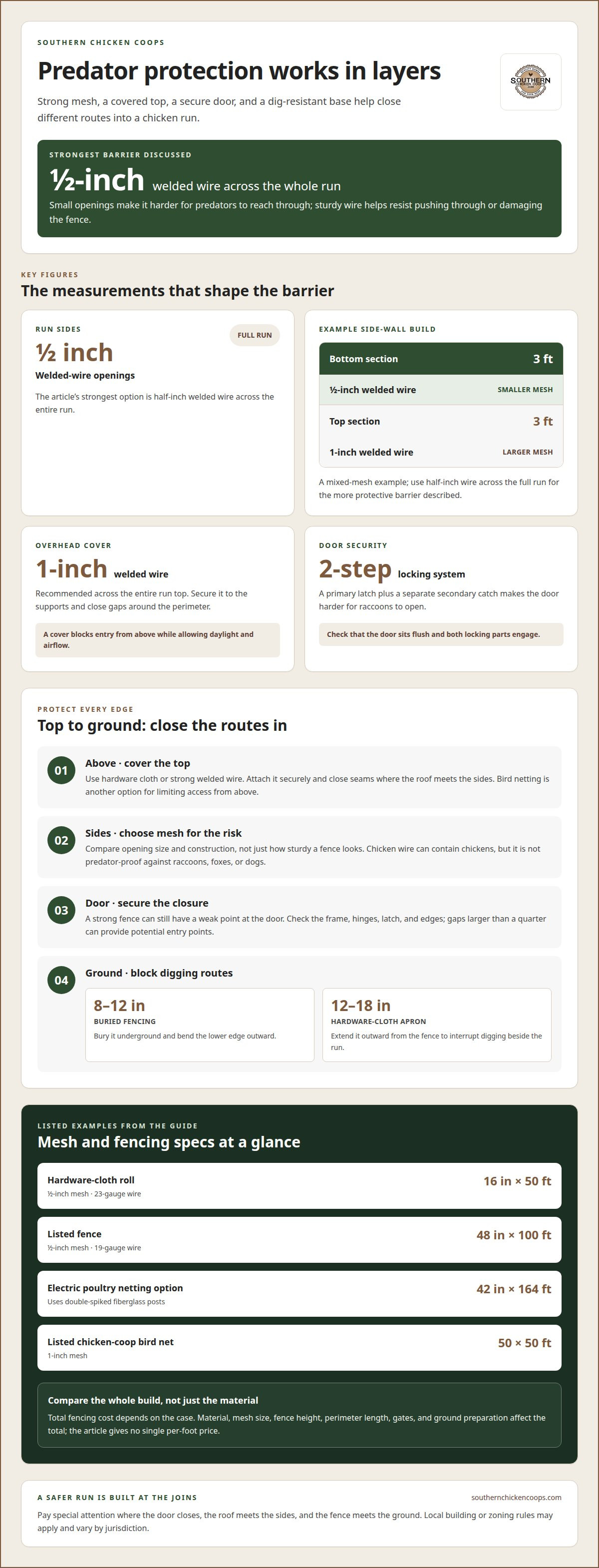
For predator-proof fencing for chicken runs, mesh opening size and construction matter as much as the fence material. Half-inch welded wire across the whole run is the strongest barrier discussed here. Its small openings make it harder for predators to reach through, while sturdy wire helps resist attempts to push through or damage the fence.
Chain link can form a substantial perimeter, but compare its openings with the risks around your flock. A predator may exploit gaps in a fence or at its edges, so a strong frame alone doesn’t close every entry point. Poultry netting offers a different approach, and electric poultry netting can add a deterrent layer. One listed electric option measures 42 inches by 164 feet and uses double-spiked fiberglass posts.
Welded wire allows a useful combination of mesh sizes. One example uses 1/2-inch welded wire for the bottom 3 feet of the sides, then 1-inch welded wire for the top 3 feet. For a more protective barrier, use 1/2-inch welded wire across the full run. Half-inch hardware cloth is also a common enclosure choice, especially where small openings matter.
Chicken wire isn’t predator-proof. It can help contain chickens, but it isn’t strong enough to keep raccoons, foxes, or dogs out. Hardware cloth provides a stronger barrier. A listed roll measures 16 inches by 50 feet, with 1/2-inch mesh and 23-gauge wire; another listed fence measures 48 inches by 100 feet, with 1/2-inch mesh and 19-gauge wire. These examples show why both opening size and wire construction deserve attention.
Protect the base as carefully as the sides. Bury fencing 8 to 12 inches underground and bend its lower edge outward to discourage digging. Another option is a hardware-cloth apron extending 12 to 18 inches outward from the fence. The horizontal barrier can make a predator digging beside the run encounter mesh before reaching underneath.
Local building codes or zoning rules may apply, depending on the property and project. Requirements vary by jurisdiction, so review the rules for your location before building the run.
There isn’t one per-foot price for predator-proof fencing. The price depends on the case and is given after a quote request; material, mesh size, fence height, perimeter length, gates, and ground preparation affect the total.
2. Securing the run door with a predator-resistant latch
Even a strong fence can have a weak point at the door. Raccoons can manipulate simple closures, so one catch may be less secure than a two-step locking system. The extra action makes the door harder to open accidentally or with a curious paw. Choose a latch that closes firmly and stays secured when the run is unattended.
Start with the door frame. A door that twists or sags can leave openings beside the latch, even if the latch is sturdy. Set the door so it meets the frame evenly, then check the top, bottom, and latch side for gaps. Gaps larger than a quarter can provide potential entry points for predators. Adjust the fit instead of relying on hardware to compensate for a poor closure.
Next, inspect the hinges and their attachment points. A secure latch cannot hold a door shut if the hinges loosen or pull away from the frame. Open and close the door several times, watching for movement, rubbing, or misalignment. Fasten the hinges to sound framing and position them so the door swings smoothly without leaving a wide opening along its edge.
Use a two-step locking system on the run door. For example, a primary latch can hold the door closed while a separate secondary catch adds another action before it opens. Position both so they engage reliably when the door closes. Avoid a loose hook or a catch that can slide out of place during ordinary movement.
Make a closure check part of your daily routine. After closing the run, confirm that:
- The door sits flush against the frame.
- The hinges remain secure and the door doesn’t sag.
- Both parts of the two-step lock are engaged.
- No opening remains around the latch or along the edges.
This quick check can catch a missed latch before evening, when a closed run matters most. Recheck the hardware after heavy use or if the door starts to drag. A latch that once aligned may no longer catch properly if the frame shifts or hinges loosen. Keep the locking action easy for people to use, while ensuring the door cannot swing open without both steps.
Treat the door as part of the whole enclosure, not an afterthought. The mesh, frame, hinges, and latch must meet without gaps at their joins. A well-fitted two-step latch supports careful construction, while regular alignment checks help keep the entrance dependable through everyday use.
3. Covering runs against climbing and aerial predators
A roof closes a route that side fencing cannot: entry from above. Hawks and other aerial predators can approach an uncovered run, while climbing predators may reach its top edge. A cover creates a continuous barrier only if it meets the sides without open seams. Plan the roof material and its connections together instead of laying a loose sheet over the frame.
For a sturdy overhead barrier, use hardware cloth or strong welded wire. One recommendation is 1-inch welded wire across the entire run top. That creates a physical cover while leaving the run open to daylight and airflow. Choose a material that can be attached securely to the roof supports, then close gaps around the perimeter. A loose edge or unfinished corner can undermine an otherwise well-covered run.
Bird netting is another option for limiting access from above. A listed chicken-coop bird net measures 50 by 50 feet and has 1-inch mesh. Before choosing a net, match its coverage to the run’s roof area and shape. Stretch it across the full top, and fasten the edges to the frame. Netting can cover a wide span, but it doesn’t provide the same rigid surface as wire mesh.
A pergola-style roof offers a framed approach. Space its roof boards about 2 inches apart, then consider how the remaining openings will be covered. Boards alone leave open spaces overhead, so they should not be treated as a complete barrier against aerial access. Adding mesh over or beneath the boards can close those spaces while keeping the roof structure orderly and supported.
Pay particular attention to transitions. At each corner, make the mesh continuous where the roof meets a side panel, and attach it firmly. Where two pieces meet, overlap them enough to prevent a direct opening, then secure both edges to the frame. Check doorways, too. A cover that stops short above the entrance leaves an exposed section, even if the rest of the roof is closed.
Finally, inspect the overhead barrier from inside the run. Look for pulled fasteners, sagging netting, separated seams, and openings where a predator could reach through. A 1-inch welded-wire roof, for example, still needs sound attachment along its supports and edges. Recheck those connections after weather or routine use shifts the covering. A roof works as part of the enclosure, not as a substitute for secure sides, doors, and ground-level protection.
4. Dig-proof fence aprons and buried barriers
A fence that ends at soil level can leave a route beneath the run. A digging predator may work beside the fence and reach the enclosure from below. A mesh apron or buried barrier extends protection into the ground. Plan it around the full perimeter, including corners and the entrance, rather than protecting only the longest sides.
An outward-facing apron lies flat on the ground beside the fence. Attach hardware cloth securely at the fence base, then extend it outward so predators digging near the fence encounter mesh. Landscape staples can hold the apron down, with dirt or gravel over it. Keep the connection to the upright fence continuous: a gap between the vertical mesh and apron can leave the opening the barrier is meant to close.
At corners, shape the mesh to follow the perimeter without leaving a triangular opening. Secure overlapping edges, then cover them with soil or gravel. Around a gate, carry the barrier to the threshold while keeping the door free to swing. These transitions need careful fitting, since a covered straight run can still have an exposed corner or entrance.
A buried barrier takes a different approach: the mesh descends into the ground instead of extending outward across it. Hardware cloth buried around the coop and run can deter digging predators. Connect the buried section to the above-ground fence without a break where the mesh ends. Soil movement or later work around the run can expose the barrier, so inspect the perimeter after changes to the ground.
Where digging or trenching is impractical, concrete blocks along the bottom edge add weight and make digging harder. Set them close to the fence line, leaving no spaces between blocks that create an easy route underneath. Blocks create a different ground-level obstacle than mesh, so check the joins and uneven ground around the run.
Choose a layout that suits the ground and the run’s construction. An outward apron works where there is room beside the fence; a buried barrier may suit areas where the surrounding space must stay clear. Both depend on a connected edge, secure attachment, and careful fitting at corners. The aim is a continuous base, not a loose strip that can shift aside.
After installation, walk the entire fence line and examine each connection. Look for lifted mesh, exposed edges, loose landscape staples, gaps beside concrete blocks, or soil washed away from a buried section. Repair weak spots as they appear. A careful inspection helps keep the ground barrier connected to the fence and the run closed along its lowest edge.
5. How high should chicken run fencing be to stop dogs, foxes, and coyotes?
Fence height alone cannot promise protection from dogs, foxes, or coyotes. Taller sides may make climbing or jumping more difficult, but they will not close an opening underneath or overhead. Plan height alongside a secure top, sturdy sides, a well-fitted door, and a dig-resistant base. Each part addresses a different way predators might reach the flock.
A described run uses 1/2-inch welded wire for the bottom 3 feet of its sides and 1-inch welded wire for the top 3 feet. Together, those sections cover 6 feet of side fencing. Treat this as an example of a layered mesh layout, not a universal height that stops every dog, fox, or coyote.
For a particular run, assess the surroundings as well as the fence. A dog may push against a weak panel, while a climbing predator may use nearby structures to reach the top. Keep objects that provide an easy step-up away from the perimeter, and fasten the mesh to sound framing. Check that the fence meets the ground without an exploitable gap.
A covered run changes the question of height. Instead of relying on taller open sides alone, a continuous overhead barrier closes the route above the enclosure. Strong welded wire across the top can connect with the side panels and limit access from above. Secure the roof edges to the frame, especially at corners and the entrance.
For dogs, foxes, and coyotes, inspect the whole enclosure rather than judging protection by side height alone. Check the door, corners, roof joints, and fence base. A latch that does not hold, a loose panel, or a gap beneath the fence can undermine taller sides. Keep the mesh taut and attachments firm, and repair openings promptly.
Use this practical sequence when planning protection:
- Set the side height to suit the run’s frame and layout.
- Use strong mesh and fasten it securely to the supports.
- Close the top and join it continuously to the sides.
- Protect the ground edge with an apron or buried barrier.
- Check the door and perimeter for gaps or loose connections.
For a run built around a coop, explore custom chicken coop options as part of planning a secure, well-integrated setup. The right enclosure is a connected structure: side height, roof, entrance, and ground barrier work together, rather than relying on one measurement to keep predators out.
Southern Chicken Coops
Southern Chicken Coops can help bring your flock’s housing needs into the wider run plan. If you are considering fence layout, secure access, overhead coverage, and ground barriers alongside a coop, the company offers custom chicken coops tailored to your needs and Texas conditions. Coop delivery is also available to a prepared, level lot.
A well-designed coop and run work together, with access, enclosure, and daily flock care considered as one practical arrangement. To discuss a coop for your setup, contact Southern Chicken Coops.
Plan a Secure Setup for Your Flock
Your next step is to turn general guidance into a layout that fits your property and daily routine. Consider where the run will sit, how you will move through it, and how the coop and enclosure will work together. This planning makes predator-proof fencing for chicken runs part of a complete housing arrangement, rather than a series of disconnected fixes.
Before settling on a design, consider how you care for your flock each day. An enclosure should support practical access and routine checks while fitting the available space and your birds’ needs. A clear plan helps you make thoughtful decisions from the outset and create a setup that is both functional and well-crafted.
Southern Chicken Coops offers Custom Chicken Coops and Coop Delivery for people planning chicken housing. If you’re ready to talk through a coop for your setup, contact Southern Chicken Coops. We’ll be glad to help you take the next step toward a comfortable home for your flock.
Frequently Asked Questions
What fencing materials are best for keeping predators out of chicken runs?
Half-inch welded wire is the strongest choice for a predator-resistant run, while hardware cloth is a common option for enclosure openings. Choose material based on where it will be used: rigid wire mesh can form the sides, and electric poultry netting can provide a different perimeter barrier. Whichever material you select, the finished enclosure depends on secure connections at corners, entrances, and the roofline.
Is 1/2-inch hardware cloth better than chicken wire for a chicken run?
Yes. Half-inch hardware cloth has smaller openings and provides a stronger barrier than chicken wire, which is not strong enough to keep raccoons, foxes, or dogs out. For windows, fasten hardware cloth with screws and washers rather than staples. This helps keep the mesh firmly attached around an opening, where a loose edge could undermine the protection of the rest of the enclosure.
How do you prevent predators from digging under a chicken run fence?
Use a ground-level mesh apron or a buried barrier, and keep it connected to the upright fence. An apron can extend 12 to 18 inches outward; a buried hardware-cloth barrier can reach at least 12 inches deep around the coop and run. Concrete blocks along the bottom edge offer another obstacle. Pay close attention to corners and gate thresholds, where a break can leave an opening.
How do you protect a chicken run from hawks, owls, and climbing predators?
Cover the run with hardware cloth or strong welded wire, then secure the covering continuously to the sides. One option is 1-inch welded wire across the top. Bird netting can also cover an overhead span, but it isn’t as rigid as wire mesh. For any cover, close the perimeter edges and inspect seams so a gap at a corner doesn’t leave an access route.
What is the best way to secure gates and fence seams on a chicken run?
Fit the gate evenly within its frame, secure its hinges, and use a two-step locking system. At fence seams, overlap adjoining mesh edges and fasten them firmly to the supporting structure. Check the corners and gate threshold as well as the latch side. Openings larger than a quarter can become potential entry points, so close gaps rather than relying on a strong latch alone.
What common chicken run fencing mistakes let predators in?
Common mistakes include relying on chicken wire as the only barrier, leaving the run uncovered overhead, and overlooking gaps where mesh meets the ground or gate. A weak latch or loose seam can also compromise an otherwise sturdy fence. Keep feed in metal containers with tight-fitting lids, and remove scraps and spilled grain before dark so food does not attract unwanted visitors near the run.


