

Imagine it's 4:00 PM on a July afternoon in Central Texas, and the thermometer is pushing 105 degrees. You check on your flock, only to find your favorite hen panting heavily in a coop that feels more like a cedar-clad oven than a sanctuary. It's a heartbreaking moment every Texas poultry owner fears. This often happens because many coops are built with materials that just weren't meant for our intense climate. Knowing what to look for in a Texas chicken coop is the difference between a structure that rots in five years and one that serves your family for a decade or more.
We know you want a home for your girls that's as sturdy as it is beautiful; one that stands up to the humidity and those clever midnight visitors like raccoons or snakes. In this guide, we'll share our hard-earned wisdom on selecting materials like heat-reflective metal roofing and 19-gauge hardware cloth. You'll discover how specific design choices protect your birds from scorching heatwaves while providing the peace of mind you deserve. Our goal is to help you build a legacy of health and safety for your flock.
Key Takeaways
- Learn how to select the right wood for your frame to balance natural rot resistance with the long-term health of your birds.
- Discover what to look for in a Texas chicken coop to drop interior temperatures by up to 15 degrees using professional-grade radiant barriers.
- Identify the specific gauge of hardware cloth required to stop persistent local predators that easily breach standard chicken wire.
- Compare bedding and flooring materials that withstand humidity while making your daily chores simpler and more efficient.
- Understand why regional design choices, like those found in our signature 6x12 Polka model, are essential for a coop built to last over a decade.
The Texas Challenge: Why Material Choice Dictates Flock Survival
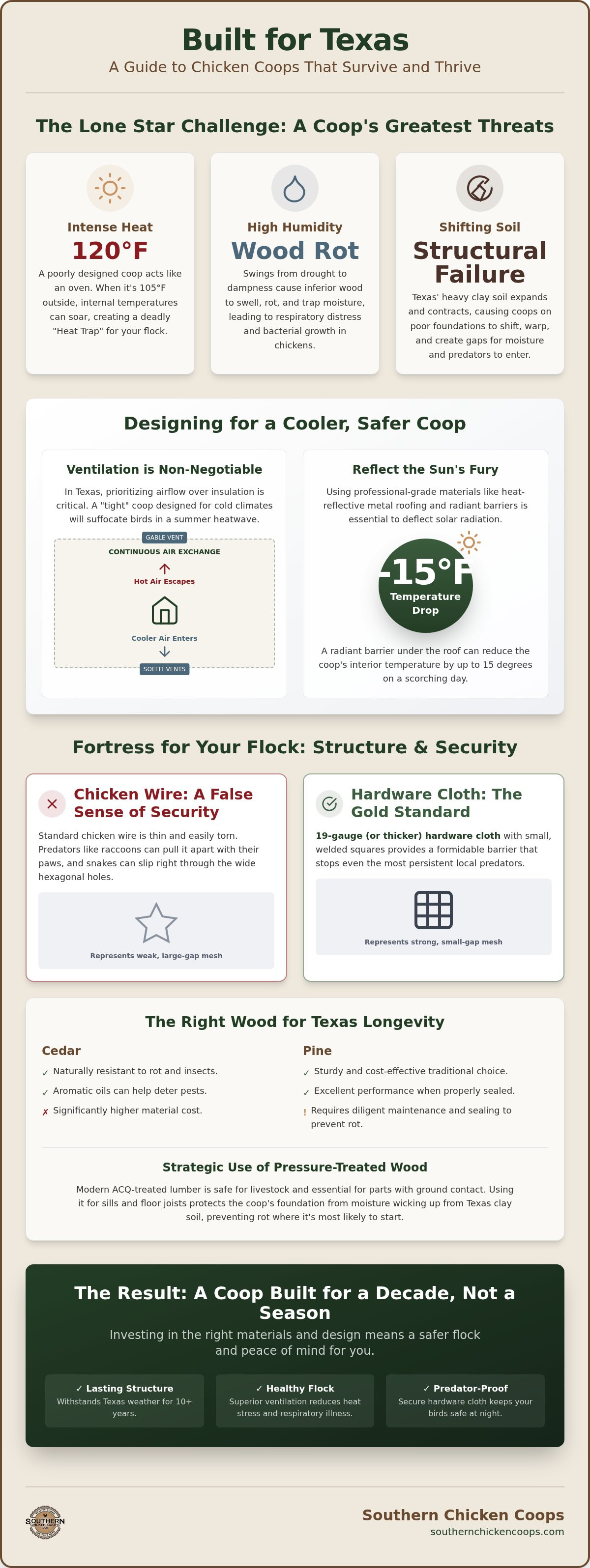
When we sit down to design a new home for your birds, we start by looking at the sun. In our part of the world, the heat isn't just an inconvenience; it's a genuine threat to your flock's life. A poorly built coop made from thin, dark materials acts like a solar oven. Inside, temperatures can easily climb to 120°F, even when the outside air is only 95°F. This "Heat Trap" effect is exactly what to look for in a Texas chicken coop to avoid at all costs. We focus on thermal mass reduction in every handcrafted build, choosing materials that shed heat quickly rather than soaking it up all afternoon.
Texas weather is also a game of extremes. We swing from bone-dry droughts to humid Central Texas stretches that make inferior wood swell and rot. If you choose materials that can't breathe or handle moisture, you're setting your flock up for respiratory distress. Chickens have incredibly sensitive lungs. When heat and high humidity get trapped in a coop, it creates a breeding ground for bacteria. We view our building process as a form of stewardship, ensuring the materials we select protect the well-being of the animals you've been entrusted with.
Prioritizing Ventilation Over Insulation
Many people look at poultry housing systems designed for northern climates and think they need thick, heavy insulation. In Texas, that's a dangerous mistake. A "tight" coop designed to keep a bird warm in a Maine blizzard will suffocate a bird in a Waco summer. We prioritize airflow above all else. Our designs include deep soffit openings and large gable vents that allow hot air to rise and escape naturally. This draws in a cooler breeze from below. It's about constant movement, not just having a few holes in the wall. Understanding these regional ventilation needs is vital when deciding what to look for in a Texas chicken coop.
Durability in Central Texas Soils
The ground beneath us in McGregor and the surrounding Blackland Prairie is mostly heavy clay. It's stubborn stuff. It swells when it rains and shrinks into deep cracks during a dry spell. If your coop sits directly on this soil, moisture wicks right up into the wood, causing rapid rot and structural failure. We've seen many coops fail because the foundation couldn't handle the shifting earth. A proper foundation, like the one we provide for our signature 6x12 Polka model, ensures the structure stays level and dry. This prevents the shifting that leads to gaps where predators might enter, keeping your flock secure through every flood and drought.
Structural Integrity: Selecting the Right Wood for Texas Longevity
The skeleton of your coop is where its story begins. In Texas, we don't just build for the rain; we build for those straight-line winds and sudden gusts that can topple a flimsy structure in minutes. Structural thickness isn't just a design choice; it's a safety requirement for any long-term flock. We hand-select every piece of lumber for our builds in McGregor to ensure the grain is tight and the boards are straight. This level of care prevents the bowing and racking that often happens to cheaper, mass-produced coops after a single season of Texas sun.
When you are deciding what to look for in a Texas chicken coop, you'll likely weigh the benefits of cedar versus pine. Cedar is beloved for its natural rot resistance and its ability to repel insects, though it does come with a higher cost. Pine is a sturdy, traditional choice that performs beautifully if it's sealed correctly. We prioritize the respiratory health of your birds by ensuring any wood used inside the nesting area is properly cured and ventilated. A thick, heavy-duty frame is what keeps the doors square and the predators out, even as the ground shifts beneath the structure.
The Truth About Pressure-Treated Wood
There's a lot of old information floating around about treated wood being toxic to birds. Decades ago, lumber was treated with arsenic, but modern ACQ (Alkaline Copper Quaternary) treatments are much safer for use near livestock. We believe in using these materials strategically, specifically for the sills and floor joists that face the most moisture. This protects the foundation of your coop from the damp earth without exposing your hens' living quarters to the treatment. Ground-contact rated lumber is essential for Texas homesteads because it is specifically engineered to withstand the constant moisture and microbial activity found in our heavy clay soils.
Siding Materials: Aesthetics vs. Protection
The exterior skin of your coop is its first line of defense against the brutal sun and wood-boring insects. While traditional plywood is a common sight, we often lean toward LP SmartSide because of its incredible resistance to fungal decay and termites. These engineered materials stay stable even when the Texas heat is at its peak, preventing the gaps that snakes love to crawl through. When you finish your coop, using light-colored, UV-reflective paints can significantly lower the temperature of the wood itself. This practice follows standard poultry heat management principles by reducing the total heat the structure absorbs during the day.
Choosing the right materials can feel like a big responsibility, but it's part of the stewardship of raising a healthy flock. If you'd like to see how we put these standards into practice, our handcrafted coops are built to stand the test of time and weather.
Roofing and Siding: Deflecting the Intense Texas Sun
If you've ever stepped onto an asphalt driveway in August, you know how much heat those dark surfaces hold. Standard asphalt shingles do the same thing to a chicken coop, turning the roof into a radiator that beams heat directly onto your resting hens. When you are researching what to look for in a Texas chicken coop, the roof material is perhaps the most critical decision for flock survival. We've found that Galvalume and light-colored metal roofing are the gold standards for our McGregor climate, offering a level of protection that shingles simply can't match.
Beyond the material itself, the geometry of the roof plays a vital role. A steep pitch helps shed water quickly during our famous flash floods, but the overhang is what provides that vital shade for the siding. Deep eaves keep the afternoon sun off the walls and prevent rain from blowing into the nesting boxes. It's these small, thoughtful details that turn a simple shelter into a sanctuary. We design every roof to act as a shield, ensuring your birds have a cool, dry place to retreat when the weather turns harsh.
Galvalume and Metal Roofing Benefits
Galvalume is a steel substrate coated with a mix of aluminum and zinc. It offers superior corrosion resistance and, more importantly, high reflectivity. In high-wind regions like ours, metal panels stay secure while shingles often peel away during a storm. We recommend white or silver finishes because they have the highest solar reflectance index. This choice creates a much cooler microclimate inside the coop. To prevent leaks during those heavy spring downpours, we use high-quality fasteners with EPDM washers, ensuring a watertight seal that lasts for decades.
Implementing Radiant Barriers
Adding a radiant barrier is the "secret" to a comfortable coop during a 100-degree heatwave. These foil-faced barriers reflect up to 97% of radiant heat back away from the structure. For them to work effectively, you must have a small air gap between the barrier and the roofing material. This gap allows the heat to dissipate before it ever enters the living space. We've seen these barriers drop interior temperatures by as much as 15 degrees on a triple-digit day. It's a technology we proudly feature in our custom chicken coops Texas families trust for their backyard flocks.
Predator-Proofing: Hardware Cloth vs. Chicken Wire
We often hear folks say they've "fenced in" their birds with standard chicken wire. It's a common mistake, but here's the hard truth: chicken wire is only designed to keep chickens in; it won't keep a single hungry predator out. In our neck of the woods, a determined raccoon can pull chicken wire apart like it's wet paper. When you're deciding what to look for in a Texas chicken coop, security has to be a top priority. We've seen too many heartbreaks that could have been avoided with the right mesh.
The gold standard for Texas security is 19-gauge, 1/2-inch galvanized hardware cloth. Knowing what to look for in a Texas chicken coop means understanding that our local predators aren't just strong; they're smart. This "Texas Trinity" of raccoons, snakes, and coyotes requires a serious barrier. Hardware cloth is stiff and welded, making it nearly impossible for animals to tear or squeeze through. We don't rely on simple staples to hold it in place, either. Predators can pop staples right out of the wood. Instead, we use screws and fender washers to sandwich the mesh against the frame, creating a bond that won't budge even under heavy pressure.
Stopping Snakes and Small Rodents
In Central Texas, snakes are a constant presence. A hungry rat snake can squeeze through surprisingly small gaps to get at your eggs or even young chicks. Using a 1/2 inch mesh is the gold standard for Texas snake protection because it's small enough to stop most adult snakes while still allowing for that vital airflow we discussed earlier. To stop the diggers, we recommend an "apron" of hardware cloth that extends 12 to 18 inches out from the base of the coop. You can bury this apron or pin it to the ground to stop coyotes and foxes right where they start to dig.
Raccoon-Proof Latches and Hardware
Raccoons are essentially toddlers with bolt cutters for teeth. They are incredibly dexterous and can easily slide a simple bolt latch open. If a lock only requires one hand or one motion to open, a raccoon can eventually figure it out. We prefer two-step locking mechanisms, such as spring-loaded carabiners or eye hooks with safety clips. Your hinges matter just as much as your locks. We use heavy-duty hinges that won't sag over time, because even a half-inch gap at the top of a door is an invitation for a predator to start prying. Ensuring your flock is safe is a sacred trust we take seriously. If you're ready for a coop that offers this level of security from day one, you can explore our predator-proof custom chicken coops built right here in McGregor.
Interior Comfort: Bedding and Flooring for a Healthier Coop
Once the exterior of your coop is built to withstand the elements, we focus our attention on the space where your birds spend their most private moments. The internal environment is what keeps your flock thriving day in and day out. When you're determining what to look for in a Texas chicken coop, the flooring and bedding choices are just as vital as the roof overhead. A healthy interior prevents the buildup of ammonia and keeps the air clear, which is especially important during those long, humid stretches in Central Texas.
We believe every detail matters, from the nesting box materials to the way the floor handles moisture. Our goal is to create a cool, dark sanctuary for egg-laying that feels safe and comfortable. We often suggest using soft straw or hemp inside the nesting boxes to provide a cushion that stays dry. This focus on internal well-being is a hallmark of our 6x12 chicken coop for sale, where we've optimized the layout to ensure your birds have plenty of room to move without kicking up excessive dust or debris.
The Best Bedding for Texas Heat
In our experience, hemp bedding is a fantastic choice for the Texas climate. It’s highly absorbent and produces very little dust, which protects your birds' respiratory health when the air gets dry and stagnant. While many folks use pine shavings successfully, we always suggest avoiding cedar shavings entirely. The aromatic oils in cedar can irritate a chicken's sensitive lungs. Some of our neighbors also use the Deep Litter Method, which involves letting bedding compost slowly over time. In the South, this requires careful moisture management to ensure it doesn't become a breeding ground for flies or mold. Sand is another popular option because it stays cool underfoot, though it can be heavy to manage if you don't have a solid cleaning routine in place.
Easy-Clean Flooring and Lot Prep
The foundation of a healthy coop starts with a floor that's easy to sanitize. We often recommend solid wood floors with a protective overlay, like linoleum or a specialized waterproof coating. This prevents droppings from soaking into the wood, making your weekly clean-up a breeze and stopping rot before it starts. Understanding what to look for in a Texas chicken coop also means looking at the ground beneath it. Preparing your site with concrete pavers or a leveled gravel pad ensures proper drainage and keeps the structure away from standing water. This preparation is a key part of our process for a delivered chicken coop Texas owners can trust to last for a decade or more.
Building a Legacy of Safety for Your Texas Flock
Choosing the right home for your birds is a journey of stewardship. We've explored how heat-reflective Galvalume roofing and 19-gauge hardware cloth are non-negotiable for anyone living in our climate. By prioritizing airflow and selecting lumber that withstands the shifting Central Texas soil, you ensure your coop remains a sanctuary for years to come. Knowing what to look for in a Texas chicken coop means looking past the aesthetics and focusing on the materials that truly protect your birds from 100-degree days and midnight visitors.
If you're ready to skip the stress of sourcing heavy materials and building in the heat, we're here to help. Our coops are handcrafted one at a time in McGregor, TX, by local farmers who understand exactly what our weather demands. We'll even handle the delivery to your prepared lot so your girls can move in immediately. It's our privilege to help you create a beautiful, durable home that honors the lifestyle you've chosen.
Build Your Dream Coop with Southern Chicken Coops and enjoy the peace of mind that comes with a well-crafted home. Your flock is in good hands.
Frequently Asked Questions
Is pressure-treated wood safe for my chickens?
Modern ACQ-treated wood is safe for your birds and essential for parts of the coop that touch the damp Texas soil. We use it for the sills and floor joists to prevent rot. While older treatments used arsenic, today's methods are safe for livestock. We recommend using it for the structural base while keeping the nesting areas natural. This balance is exactly what to look for in a Texas chicken coop to ensure it lasts for decades.
What is the best roofing material for a coop in Texas heat?
Galvalume or light-colored metal roofing is the superior choice for our climate. Unlike asphalt shingles, which soak up the sun and turn your coop into an oven, metal reflects the heat away. We always recommend white or silver finishes to maximize this cooling effect. When paired with a radiant barrier, a metal roof can drop interior temperatures significantly. It's a life-saving choice for your flock during those brutal July and August heatwaves.
Can snakes get through standard chicken wire?
Yes, most egg-thieving snakes can slip right through the large gaps in standard chicken wire. Chicken wire is only strong enough to keep your hens in; it won't stop a hungry rat snake or a determined raccoon. You need 1/2-inch hardware cloth to create a real barrier. This smaller mesh size is the gold standard for security in Texas. It keeps out the smallest predators while still allowing for the cross-ventilation your birds need to stay healthy.
Do I need to insulate my chicken coop for Texas winters?
You generally don't need to insulate a coop for our winters. Chickens are surprisingly hardy and carry their own jackets of feathers. In Texas, trapping humidity and ammonia inside a tight, insulated coop is much more dangerous than the cold. Focus on keeping them dry and out of direct North winds instead. Proper ventilation remains your best friend year-round. It's about keeping the air moving while ensuring the roosting area stays draft-free.
What gauge hardware cloth is best for predator proofing?
We recommend 19-gauge, 1/2-inch galvanized hardware cloth for the best protection. This thicker wire is much harder for predators like raccoons to tear or chew through compared to the thinner 23-gauge options often found in big-box stores. When you're deciding what to look for in a Texas chicken coop, check the weight and stiffness of the mesh. A sturdy, heavy-duty screen is what provides that true peace of mind when the sun goes down.
How do I prevent my coop floor from rotting in Texas humidity?
Preventing rot starts with keeping the wood away from standing water. We build our coops in McGregor with pressure-treated sills and recommend placing the structure on a level pad of gravel or concrete pavers. Inside, using a waterproof overlay like linoleum protects the wood from moisture in the bedding. This makes cleaning easier and stops rot from the top down. Proper drainage around your site is the final step in ensuring your floor stays solid for years.
Should I paint the inside of my chicken coop?
Painting the interior isn't strictly necessary, but it has several benefits. A light-colored interior makes it easier to spot mites or cracks where pests might hide. It also reflects more light, which can help with egg production during the shorter days of winter. If you do paint, choose a low-VOC, non-toxic exterior grade paint. This creates a smooth surface that's much easier to wipe down during your deep cleaning sessions twice a year.
Is metal or wood better for a chicken coop frame in Texas?
We believe a high-quality wood frame is better for the Texas climate. Metal frames can heat up quickly in the sun and transfer that heat into the living space. Wood has better natural thermal properties and doesn't hold the heat as intensely. It's also much easier to securely fasten hardware cloth and nesting boxes to a sturdy wood frame. Our handcrafted designs use heavy-duty lumber to provide the structural integrity needed to withstand our local windstorms.


