

Have you ever stood on your porch during a July heatwave, watching the shimmering air and wondering if your hens are actually okay in that store-bought kit? We've lived through those same stifling afternoons and the sudden, violent spring storms that sweep through McGregor, so we know that a standard coop often isn't enough. Finding a truly weatherproof chicken coop Texas birds can actually thrive in requires looking past the cute aesthetics to the grit of real craftsmanship. We believe your flock deserves a sanctuary that stands firm when the wind howls and stays cool when the sun is relentless.
We understand the frustration of seeing a cheap coop rot after one rainy season or losing sleep over predators prowling the perimeter. You want a home for your birds that lasts a decade, not just a summer. In this 2026 guide, we'll share exactly what makes a housing structure resilient against our unique climate and local wildlife. You'll learn the vital role of airflow, the necessity of heavy-duty hardware cloth, and how we design for longevity so you can finally enjoy the peace of mind that comes with a secure, beautiful home for your girls.
Key Takeaways
- Discover why a truly weatherproof chicken coop Texas summers won't destroy relies on constant cross-ventilation rather than just insulation.
- Identify the critical building materials and joinery techniques that prevent rot and help your coop stand firm against sudden spring windstorms.
- Distinguish between simple chicken wire and professional predator-proofing to ensure your hens stay safe from clever local wildlife like raccoons and coyotes.
- Explore how the Polka model's handcrafted design offers a 10-year solution for families seeking lower daily maintenance and higher flock safety.
Defining the Weatherproof Standard for Texas Backyard Coops
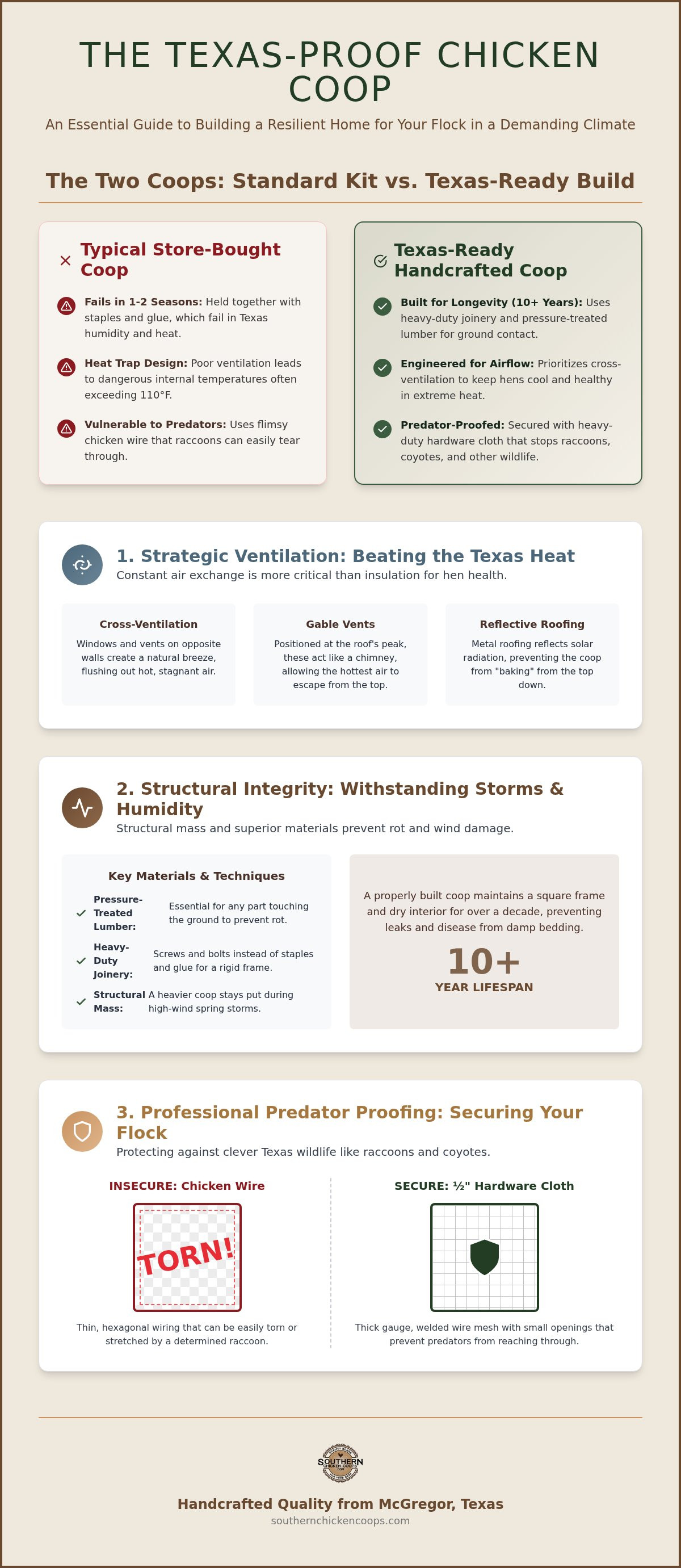
Texas weather asks a lot of its residents, and your flock is no exception. We've seen it all in McGregor; mornings that start with a humid, heavy mist and afternoons where the sun feels like a physical weight. True weatherproofing here isn't about sealing things out. It's about managing the shift. We define a weatherproof chicken coop Texas birds can actually survive in as a structure that prioritizes high-volume airflow and structural mass over simple insulation.
Many folks start their journey with a big-box kit, lured by the low price and cute trim. Those kits usually fail within two seasons because they're held together with staples and glue. Texas humidity swells the thin wood, and the relentless sun warps the panels until the doors don't shut. We build with the understanding that regional materials are non-negotiable. Using pressure-treated lumber for any ground contact is the only way to handle our soil and moisture levels without the frame rotting away in a year or two.
The Texas Heat Challenge: More Than Just Shade
Shade is a start, but it's rarely enough. Without a design that moves air, the ambient temperature inside a coop can easily spike to 110°F or higher during a typical August stretch. This level of heat stress is dangerous. It causes egg production to plummet and can lead to heart failure in heavier breeds. In the broader context of poultry farming, proper housing design is the first line of defense for animal welfare. Radiant heat from roofs can bake a flock from the top down, which is why we emphasize ventilation at the highest points of the structure to let that hot air escape.
Storm Resilience: Handling Central Texas Winds
When those spring thunderstorms roll across the plains, they bring straight-line winds that can toss a lightweight kit into the neighbor's yard. Structural mass matters. A handcrafted coop has the weight to stay put when the sky turns green. We also focus on heavy-duty roofing and precise joinery to ensure torrential downpours don't lead to internal leaks. Damp bedding is a breeding ground for disease. Keeping the interior dry is vital for your hens' respiratory health. Before we deliver a coop, we always remind our neighbors that a level, stable foundation is the secret to keeping the frame square for the next decade.
Ventilation Strategies: Keeping Hens Cool in 100°F+ Weather
Most coop designs you find online are built for snowy northern winters, but here in McGregor, our biggest enemy is the stagnant, 100-degree air. A truly weatherproof chicken coop Texas birds can thrive in must "breathe" 24 hours a day. We rely on passive ventilation, which uses the natural movement of rising hot air to pull cooler air in from below. Scientific studies on Poultry House Ventilation show that consistent air exchange is more important than raw shade for preventing respiratory distress and heat exhaustion in your flock.
Cross-ventilation is the secret to a comfortable coop. By positioning windows and vents on opposite walls, you create a path for the breeze to sweep through the structure. We also install gable vents at the very peak of our coops. Since heat rises, these vents act like a chimney, exhausting the hottest air from the roosting area before it can settle on your hens. During our longest summer stretches, we often recommend replacing solid panels with hardware cloth sections to transform the coop into a screened-in porch for your birds.
The Mechanics of Airflow
Positioning is everything. When we deliver a coop, we suggest orienting it to catch the prevailing south-to-north summer breeze that helps cool Central Texas. Height matters just as much as direction. Taller ceilings in the roosting area prevent heat pockets from forming right where your birds sleep. Our 6x12 chicken coop for sale models utilize this vertical space to ensure that even on the stillest afternoons, there is enough volume for air to circulate. If you're looking for a structure that truly breathes, we'd be honored to show you our handcrafted designs.
Roofing Materials and Heat Reflection
In the McGregor sun, the choice of roofing can change the internal temperature by several degrees. We generally prefer metal roofing over traditional shingles because metal reflects a significant portion of solar radiation rather than absorbing it. Large roof overhangs are another essential feature we include. These eaves provide natural shade to the coop walls throughout the day, preventing the wood from soaking up heat. For families in particularly sun-drenched spots, we can even integrate reflective barriers under the roof panels to further shield your hens from the overhead glare.
Structural Integrity: Built to Withstand High Winds and Humidity
A weatherproof chicken coop Texas families can rely on isn't just about keeping rain out; it's about the bones of the building. In our McGregor workshop, we've seen how the combination of high humidity and sudden wind gusts can pull a flimsy structure apart. We don't use the thin staples or quick-dry glues found in mass-produced kits. Instead, we lean on traditional handcrafted joinery. This method ensures every corner is square and every joint can handle the natural expansion and contraction that happens when a dry Texas summer turns into a wet autumn.
The soil in our region presents its own set of challenges. Ground moisture can quickly wick into untreated wood, leading to soft spots and rot before the first year is over. We prioritize pressure-treated lumber for any part of the coop that touches the earth. This choice is vital for longevity, as it creates a barrier against the dampness that lingers after a heavy downpour. For the exterior, we select siding that resists swelling and peeling, ensuring the coop remains a beautiful, functional part of your property for a decade or more. As noted in the guide to Small Scale Poultry Housing, using durable, weather-resistant materials is the primary way to reduce long-term maintenance and keep your birds safe.
Framing for Longevity
We build our coops with the same pride a master carpenter puts into a home. While cheap kits use thin slats that feel like balsa wood, we use standard 2x4 construction. This extra mass isn't just for show; it provides the structural weight necessary to keep the coop from shifting during those intense Central Texas thunderstorms. A heavy, well-framed coop won't vibrate or rattle in the wind, which keeps your hens calm and secure during the roughest weather. Every screw and bolt we use is heavy-duty and galvanized to prevent the rust that often snaps inferior hardware.
Anchoring and Foundation Safety
The foundation of a truly resilient coop starts before we even arrive for delivery. We always ask our neighbors to ensure they have a level lot prepared. A flat surface prevents the frame from twisting, which keeps doors swinging freely and latches catching perfectly. For those with coops on open acreage or wind-swept fields, we can discuss specific anchoring techniques to provide even more stability. Proper placement also helps manage water drainage. By avoiding low spots where water pools, you stop premature rot at the base and keep the interior bedding dry and healthy for your flock.
Predator-Proofing: Keeping Texas Wildlife Out
A truly weatherproof chicken coop Texas families can trust must protect against more than just the sky. In our part of the country, the local wildlife is as persistent as the summer sun. Coyotes, bobcats, and clever raccoons view a backyard flock as a target, and they're surprisingly good at finding the weak spots in a structure. We've learned that a coop isn't truly resilient unless it acts as a fortress against these local threats. Protecting your birds is a matter of stewardship, and it starts with moving beyond basic materials that aren't up to the task.
One of the most common mistakes we see is the use of standard chicken wire. While it's fine for keeping your hens in a specific area, it won't keep a hungry predator out. Raccoons can reach through those large gaps, and larger animals can tear the thin wire apart with ease. We believe in a higher standard of protection. Every opening and run area should be secured with galvanized hardware cloth, which provides a rigid, bite-proof barrier that keeps even the smallest paws and snakes at bay.
The Hardware Cloth Standard
We recommend using 1/2-inch or 1/4-inch hardware cloth for every vent, window, and run panel. This mesh is significantly stronger than wire and won't stretch or snap under pressure. How you fasten it is just as important as the material itself. We don't just use light staples; we use heavy-duty fasteners that bite deep into the wood frame. To stop digging animals like skunks, dogs, or coyotes, we also suggest a "predator apron." This involves extending the hardware cloth horizontally along the ground around the base of the coop, which prevents predators from tunneling under the frame.
Securing the Roosting Area
Nighttime is when your flock is most vulnerable. A secure coop door needs to be as strong as the walls it sits in, featuring latching mechanisms that a raccoon cannot manipulate with its nimble fingers. We prefer two-step latches or carabiner-style locks that require a level of dexterity animals simply don't have. Our custom chicken coops Texas designs integrate these security features directly into the build, including elevated roosting bars. By keeping your hens high off the ground at night, you provide a secondary layer of defense against ground-dwelling predators. If you want to ensure your flock is safe every night, we invite you to explore our predator-proof designs today.
The Southern Chicken Coops Difference: Handcrafted in McGregor
At Southern Chicken Coops, we've always believed that our work is about more than just carpentry. It's a matter of stewardship. Bill and Tina Drivdahl started this family business in McGregor with a simple goal: to provide a truly weatherproof chicken coop Texas families can rely on for years to come. We don't operate like a large factory or a big-box retailer. Instead, we build our coops one at a time with a level of professional pride and neighborly sincerity that you just won't find in a mass-produced kit. This personal touch ensures that every structure leaving our workshop is built to the highest standards of integrity and devotion.
Choosing a handcrafted home for your birds means you're investing in a structure designed for our specific climate. We understand the local challenges because we live here too. We don't just sell products; we offer a partnership in your homesteading journey. Our commitment to your flock's safety is deeply personal, rooted in the belief that every animal deserves a well-crafted, secure home that celebrates the beauty of the rural lifestyle we all cherish.
The Signature Polka Model
The Polka model is our flagship design, and it has become the benchmark for durability across Central Texas. Measuring 6x12 feet, it's perfectly sized for a flock of 10-12 hens. We often call it the "Goldilocks" size for Texas backyards because it offers enough space for your birds to thrive without taking over your entire property. Every Polka model is handcrafted with specific attention to the details we've discussed, from high-volume ventilation to heavy-duty predator protection. You can see the quality in every shingle and screw, knowing that your coop was built by hands that care about the safety of your animals as much as you do.
- Optimized footprint for 10-12 happy hens.
- Hand-built joinery that resists the warping effects of the Southern sun.
- Easy-to-clean design that lowers your daily maintenance burden.
- Integrated ventilation features designed specifically for 100°F+ heatwaves.
Professional Delivery to Your Texas Lot
We choose to handle our own delivery because we want to ensure the structural integrity of your coop from our shop to your backyard. We've seen too many flimsy DIY kits fail because of poor assembly or low-grade materials. By delivering a fully assembled, handcrafted home, we take the hard work and the guesswork out of the process for you. We serve McGregor, Waco, and the surrounding Central Texas region, bringing our expertise directly to your gate. All we ask is that you have a prepared, level lot ready for us. This ensures your weatherproof chicken coop Texas home stays square and secure for its entire lifespan. We'd love to welcome you into our community of happy hen owners and help you protect the lifestyle you've worked so hard to build.
Building a Legacy for Your Backyard Flock
Building a homestead is a journey of stewardship, and choosing the right home for your birds is a big part of that responsibility. We've explored how finding a weatherproof chicken coop Texas flocks can thrive in depends on high-volume airflow, heavy-duty joinery, and the uncompromising security of hardware cloth. These aren't just features; they're the foundation of a safe, healthy life for your hens. Bill and Tina Drivdahl are proud to offer coops designed specifically for our unique climate, handcrafted right here in McGregor.
We don't believe in the shortcuts of flimsy kits. Instead, we focus on the professional pride and personal care that goes into every 6x12 Polka model we build. When you choose a handcrafted structure, you're choosing peace of mind for the next decade of Texas storms and heatwaves. We would be honored to help you protect your flock and simplify your daily chores. Please view our handcrafted Texas chicken coops and the Polka model today to see the difference that quality craftsmanship makes. We look forward to welcoming you into our community of local chicken keepers.
Frequently Asked Questions
How do I stop my chicken coop from blowing over in a Texas storm?
You stop a coop from blowing over by prioritizing structural mass and secure anchoring. Unlike flimsy kits, our handcrafted coops use heavy 2x4 framing that provides the weight needed to stay grounded during high winds. For coops placed in open fields or acreage, we recommend using ground anchors or heavy-duty stakes. A solid foundation on a level lot also ensures the wind can't get underneath the structure to lift it.
Can chickens survive a 100-degree Texas summer in a coop?
Chickens can absolutely survive 100-degree summers if their housing is designed to breathe. The key is preventing heat pockets by using high-volume ventilation and reflective roofing. We design our coops with tall ceilings and gable vents to exhaust hot air constantly. Providing a truly weatherproof chicken coop Texas birds can thrive in means ensuring they have constant access to shade and moving air, which keeps their internal temperatures within a safe range.
What is the best material for a chicken coop roof in Texas?
Metal is the superior choice for a Texas coop roof because it reflects solar radiation rather than absorbing it like traditional shingles. This reflection helps keep the interior significantly cooler during our long, sun-drenched afternoons. We also use generous roof overhangs to provide natural shade to the coop walls. This combination prevents the "oven effect" that often occurs in smaller, poorly designed structures made with dark or heavy materials.
Do I need to insulate my chicken coop for Texas winters?
You generally don't need to insulate a coop for our winters, as chickens are quite hardy in the cold if they stay dry. In Texas, the bigger risk is moisture buildup and poor air quality. Insulation often traps humidity, which can lead to respiratory issues or frostbite. It's much better to focus on a draft-free roosting area that still allows for high-level ventilation to let moisture escape while keeping the birds protected from direct north winds.
Is hardware cloth really better than chicken wire for predator protection?
Hardware cloth is the only reliable choice for keeping Texas predators like raccoons and bobcats out of your coop. Chicken wire is designed to keep chickens in, but it's thin enough for a coyote to tear or a raccoon to reach through. We use galvanized hardware cloth on every opening because it's bite-proof and rigid. It provides a level of security that ensures your flock is safe from the cleverest local wildlife throughout the night.
How much ventilation does a chicken coop need in the South?
A coop in the South needs significantly more ventilation than those in northern climates. We aim for high-volume air exchange that allows the breeze to move through the structure at all times. This includes large windows, gable vents, and screened run areas. Proper airflow doesn't just cool the birds; it also removes ammonia and moisture from the bedding. In a weatherproof chicken coop Texas owners rely on, ventilation is the most critical design feature for year-round health.
What should I do to prepare my lot for a chicken coop delivery?
To prepare for your delivery, you must ensure your chosen spot is completely level and cleared of debris. A level lot is essential because it keeps the coop's frame square, ensuring doors and latches continue to function perfectly for years. We also need a clear, accessible path for our delivery equipment to reach the site. Taking the time to grade the area or set a stable base like crushed stone prevents water from pooling around the foundation.
Why are pre-built coops better than DIY kits for Texas weather?
Pre-built, handcrafted coops are superior because they use regional materials and traditional joinery that DIY kits simply can't match. Most kits use thin wood that warps or rots in our high humidity within two seasons. We build our coops one at a time in McGregor using heavy-duty lumber and hardware designed to withstand 100-degree heat and violent storms. This craftsmanship results in a home that lasts a decade, rather than just a few months.


