

If you're raising a Brahma or a Jersey Giant, is your current coop a safe sanctuary or a slow cooker? We've seen too many neighbors struggle with flimsy, store-bought kits that simply aren't built for the weight of these birds, and finding a quality chicken coop for large breeds Texas weather won't destroy is a common frustration. It's a heavy burden to worry about your hens overheating when the thermometer climbs past 105 degrees, or to wonder if a thin latch will stand up to a hungry coyote at midnight.
We believe your flock deserves a home as sturdy and reliable as your own. In this 2026 guide, you'll discover how to house your heavy breeds safely using the same handcrafted durability we use in our McGregor workshop. We'll show you how intentional airflow and master craftsmanship turn a simple shelter into a structural cooling system that keeps your giants comfortable even in the peak of August. We'll walk through the essential features for housing large birds, from predator-proof foundations to the specific ventilation needs that protect your investment and give you true peace of mind.
Key Takeaways
- Learn why heavy breeds like Brahmas require reinforced roosts and 14-inch nesting boxes to prevent injuries and ensure long-term comfort.
- Discover why a specialized chicken coop for large breeds Texas heat won't destroy must prioritize structural ventilation to keep your heavy birds safe.
- Explore the layout of the 6'x12' Polka model and why its 72-square-foot footprint is the ideal home for a dozen large breed hens.
- Get a step-by-step checklist for preparing your McGregor or Waco property for professional delivery, from finding natural shade to leveling your lot.
- Understand the lasting value of handcrafted local craftsmanship in protecting your flock from predators and the harsh elements.
Why Large Breed Chickens Need Specialized Housing in Texas
We've spent a lot of time in our McGregor workshop thinking about the "Gentle Giants" of the poultry world. If you've ever held a Jersey Giant, a Cochin, or a Brahma, you know they aren't just slightly bigger chickens; they're a different class of bird entirely. These breeds can easily reach 10 to 12 pounds, yet most store-bought coops are designed for four-pound Leghorns. That mismatch is where the trouble begins. A heavy bird jumping off a roost puts immense pressure on the frame, and we've seen flimsy floors sag and roosting bars snap because the materials weren't chosen with a 12-pound hen in mind.
Beyond the structure, we have to consider the birds' peace of mind. Large breeds need more personal space to avoid flock bullying. When a bird that size feels cornered, their stress levels skyrocket. Providing ample room is a form of stewardship that keeps the peace. As noted in a comprehensive overview of poultry farming, the design of a bird's environment is the foundation of its overall well-being and productivity.
Square Footage Requirements for Heavy Breeds
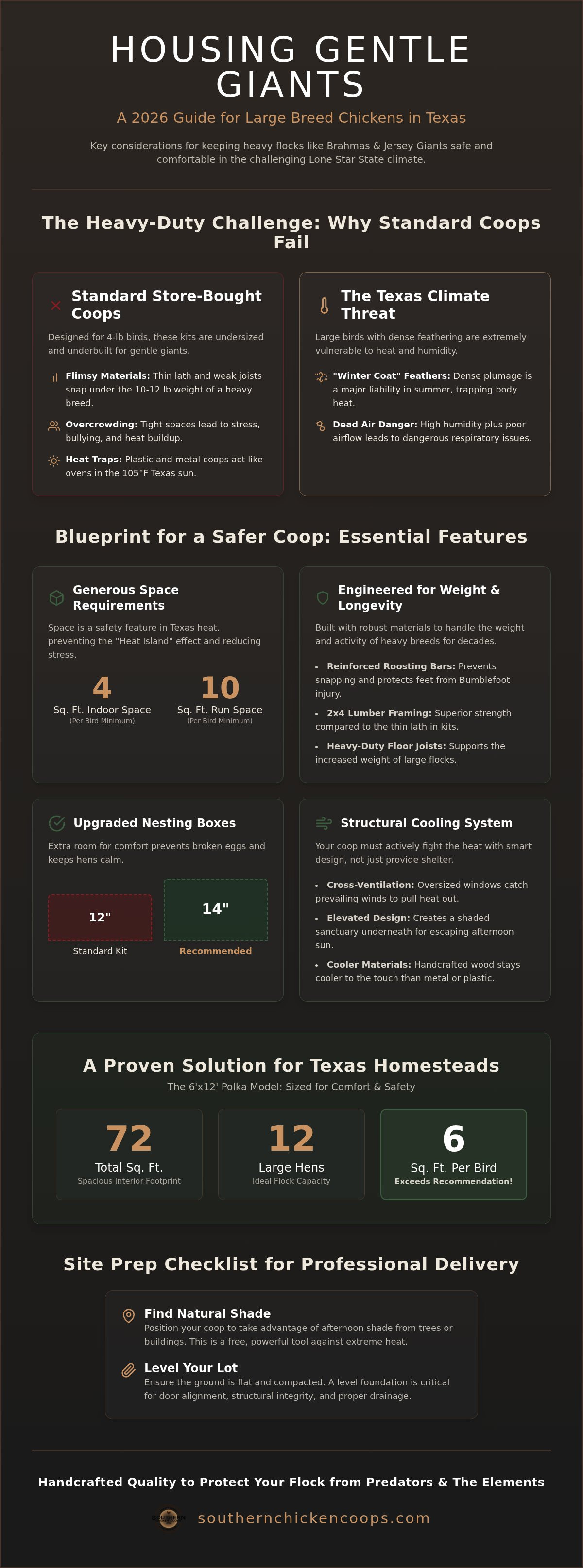
In the Texas heat, space is a vital safety feature. We recommend 4 square feet of indoor space per bird as a baseline to prevent the "Heat Island" effect, where body heat builds up in tight corners. For the 2026 season, we recommend a minimum of 4 square feet of interior coop space and 10 square feet of run space per bird to ensure your Brahmas have enough room to circulate air around their bodies. This extra room also prevents soil compaction in the run. Large birds pack the dirt down quickly, which can ruin drainage during our sudden Central Texas downpours and lead to muddy, unhealthy conditions.
The Texas Heat Factor: A Heavy Breed's Greatest Enemy
Large breeds have dense feathering that acts like a heavy winter coat. This is a major liability during a 100-degree July day in Waco or McGregor. Choosing a chicken coop for large breeds Texas climates require means looking at thermal mass. Plastic and metal coops often act like ovens, absorbing sun and radiating heat back onto the birds long after dusk. We prefer handcrafted wood because it stays naturally cooler to the touch. Humidity in our region also makes "dead air" dangerous. Without structural ventilation that allows for a constant cross-breeze, the moisture from their breath can lead to respiratory issues. Your coop shouldn't just be a box; it needs to be a structural cooling system that protects your investment from the elements.
Essential Design Features for Large Breed Coops in the Lone Star State
Building a chicken coop for large breeds Texas heat won't buckle requires a shift in how we think about structural integrity. Most mass-produced kits use thin wood that sags under the weight of a single heavy hen. We use reinforced roosting bars because a 10-pound bird jumping down can exert significant force. This prevents the bar from snapping and protects your hens from Bumblefoot, a common foot injury caused by landing on hard or uneven surfaces after a night of rest.
Nesting boxes need a thoughtful upgrade as well. A standard 12-inch box is simply too tight for a full-grown Jersey Giant or a fluffy Cochin. We've set 14x14 inches as our new standard for these birds. This extra room prevents broken eggs and keeps the hens calm while they work. For more expert guidance on managing your birds, the Texas A&M AgriLife Extension Service provides invaluable research on housing small flocks in our specific region.
When selecting a chicken coop for large breeds Texas summers make unbearable, ventilation becomes your most important safety feature. We position oversized windows to catch the south-to-north prevailing winds common in Central Texas. This ensures air moves through the coop rather than swirling in corners. It creates a constant, gentle breeze that pulls heat away from their heavy feathers and prevents the buildup of ammonia and moisture.
Engineering for Weight and Longevity
We build our frames with 2x4 lumber instead of the thin lath found in many store-bought options. Heavy-duty floor joists are a necessity for large breeds, as their waste is more voluminous and heavier than that of standard birds. We also prefer elevated designs for our builds. This provides a shaded sanctuary underneath where the birds can escape the afternoon sun while benefiting from increased airflow. If you're ready for a permanent housing solution, our handcrafted coops are built to handle these demands for decades.
Predator Protection for Central Texas Wildlife
Coyotes, raccoons, and snakes are a constant reality in McGregor and Waco. Standard chicken wire is far too weak; a determined raccoon can tear right through it with ease. We use hardened hardware cloth for all openings to ensure nothing gets in. We also recommend the "apron" method, which involves extending mesh outward from the coop base and burying it under the soil. This stops digging predators from getting under the floor. You can learn more about our safety standards in our guide on custom chicken coops Texas families rely on to keep their flocks secure.
The 6'x12' Polka: A Proven Solution for Texas Homesteads
We've seen many folks start their journey with a small coop only to realize their Brahmas and Jersey Giants need much more room to thrive. That’s why we developed the 6'x12' Polka. It’s our signature model, offering a total footprint of 72 square feet. This size is particularly ideal for a flock of 10 to 12 large breed hens because it balances a manageable footprint with the generous interior volume these birds require. When we build a chicken coop for large breeds Texas families can trust, we focus on creating a space where the birds don't feel crowded, even when they’re stuck inside during a summer thunderstorm.
Managing heavy birds is simply easier when you can stand up straight. The Polka is a walk-in design, which means you aren't crouching or straining your back while collecting eggs or refreshing water. We use high-quality siding and roofing materials specifically chosen to reflect the harsh Texas sun. Unlike plastic or thin metal that absorbs and holds heat, our handcrafted wood stays remarkably cool to the touch. For those just starting out, these tips for backyard poultry beginners from AgriLife Today explain that a well-ventilated, spacious house is the best defense against regional environmental stress.
Airflow Mastery in the Polka Design
We designed the Polka with a specific roof pitch that works with our window placement to create a natural chimney effect. As the Texas sun warms the coop, the hot air rises and escapes through the top vents, pulling cooler air in through the lower windows. This constant movement is vital. Our handcrafted approach ensures that every joint is tight and every screen is secure, providing a level of heat resistance that mass-produced kits simply can't match. The integrated run allows your birds 24/7 access to fresh air, which is the most effective way to prevent respiratory issues in heavy-bodied breeds.
Customizing for Your Specific Flock
Every homesteader has a different vision for their property. While the Polka has a standard layout, we offer semi-custom options to fit your specific needs. You might need extra roosts for a growing flock or specialized nesting configurations for particularly large Cochins. We also help you choose colors that harmonize with your landscape, ensuring your coop is a beautiful addition to your home. If you're looking for a permanent, reliable 6x12 chicken coop for sale, the Polka is built with the stewardship and integrity your birds deserve.
Preparing Your McGregor or Waco Property for Delivery
Preparing for your new coop is an exciting time, but it requires a bit of thoughtful groundwork to ensure your birds stay safe and your structure stays level for years to come. We take great pride in our professional delivery process. We want to make sure your McGregor or Waco property is fully ready before our truck pulls into the driveway. Because a chicken coop for large breeds Texas weather won't damage is a significant investment, the foundation it sits on is just as important as the craftsmanship we put into the walls.
- Step 1: Site Selection. Look for a spot with natural afternoon shade. In Central Texas, the sun is most punishing between 2:00 PM and 6:00 PM. Placing your coop under the canopy of a few large oaks can make a 10-degree difference in the interior temperature.
- Step 2: Clearing and Leveling. A level lot is essential for the doors and windows to function correctly. While concrete blocks are a common choice, we often recommend a gravel pad for better drainage.
- Step 3: Access. Our delivery truck needs a clear, wide path to your prepared site. Ensure there are no low-hanging branches or narrow gates that might block the way.
- Step 4: Predator Audit. Before the coop arrives, check the surrounding area for tall grass or debris where snakes and raccoons might hide.
Managing Central Texas Soil and Drainage
If you live in our corner of the state, you're likely familiar with "black gumbo" soil. This heavy clay expands significantly when wet and shrinks during a drought, which can cause structures to shift. A solid foundation of crushed stone or compacted gravel helps distribute the weight of the coop and prevents the soil from pulling the frame out of alignment. You can find more detailed advice in our guide on preparing your backyard for a chicken coop to ensure your site is ready for the long haul.
Optimizing for the Texas Sun
When thinking about placement, consider the prevailing winds. In the summer, we want those south-to-north breezes to flow directly through the coop windows. Positioning the coop so the longest side faces the wind provides maximum cooling for your heavy-bodied birds. We deliver move-in ready coops rather than DIY kits because we believe your time is better spent enjoying your flock than struggling with a pile of lumber in the heat. If you're ready to upgrade your property, you can schedule your custom coop delivery today and let us handle the heavy lifting.
Handcrafted Quality: Why Local Texas Craftsmanship Matters
Choosing a chicken coop for large breeds Texas families can rely on for years is a decision rooted in stewardship. In our McGregor shop, we don't treat our work as a simple commercial venture. It's a calling. We build every structure one at a time, ensuring that every joint is tight and every piece of lumber is sound. This personal touch is what allows us to sleep well at night, knowing your heavy Brahmas and Jersey Giants are protected by a home built with integrity. When we talk about craftsmanship, we're talking about a commitment to the living creatures that depend on us for their safety and comfort.
Buying local means more than just supporting a McGregor business. It means you're working with neighbors who understand the specific challenges of Central Texas. We don't ship our coops across the country because we believe in providing personal, neighborly service right here in our community. This allows us to focus on long-term durability and ensures that your coop arrives in perfect condition, ready to serve as a beautiful and functional part of your property for decades to come.
The Downside of Mass-Produced Coop Kits
We've seen many folks seduced by the promises of mass-produced kits found online. These often arrive in boxes filled with thin cedar and are held together by staples rather than screws. While they might look charming in a staged photo, they simply don't hold up to a Central Texas thunderstorm or the physical weight of a 12-pound hen. The hidden costs of these flimsy options become clear within a year when the wood warps, the roof leaks, or a predator finds a weak spot. Investing in a handcrafted chicken coop for large breeds Texas weather won't destroy saves you significant money on repairs and replacements over the next decade.
Meeting Bill and Tina: Your Local Coop Experts
When you work with us, you're working directly with Bill and Tina Drivdahl. We aren't just builders; we're fellow chicken keepers. Our designs are deeply informed by our daily lives at Bird and Bee Farm, where we raise our own flock. We've felt the same 105-degree heat and worried about the same local predators that you do. That personal experience is why we prioritize structural cooling and heavy-duty protection in every build. We're here to guide you through your homesteading journey with the honesty and care of a trusted neighbor. We take great pride in helping you create a safe, beautiful home for your birds, and we're honored to be a part of your story.
Start Your Journey Toward a Safer Texas Homestead
Your gentle giants deserve a home that stands as strong as they do. We've explored how specialized features like reinforced roosting bars and oversized nesting boxes prevent common injuries, while structural ventilation acts as a necessary cooling system during our 100-degree summers. Providing a high-quality chicken coop for large breeds Texas weather won't destroy isn't just about building a shelter; it's about the stewardship and protection of your flock. Every detail matters when the safety of your birds is on the line.
We take immense pride in our family-owned and operated integrity, building every structure one at a time right here in McGregor. Our designs, like the signature 6'x12' Polka, are born from our own experience raising birds at Bird and Bee Farm. We're here to ensure your property is ready for a permanent solution that brings you peace of mind and adds beauty to your land. We believe your work on the homestead is a calling, and we're honored to support it with craftsmanship that lasts.
Explore the Polka and our custom Texas coops today
We look forward to helping you protect your flock and celebrate the many joys of the homesteading lifestyle. You're always welcome to reach out to your neighbors here in McGregor.
Frequently Asked Questions
How many Brahma chickens can fit in a 6x12 coop?
A 6x12 coop provides 72 square feet of total space. While general guidelines might suggest 14 to 16 average chickens, we recommend housing 10 to 12 large breed hens like Brahmas for the best health. Giving these heavy birds more room helps prevent heat stress and social friction. This extra space is essential when choosing a chicken coop for large breeds Texas summers make particularly intense for thick-feathered birds.
Is a wooden coop or a metal coop better for Texas heat?
Handcrafted wood is the superior choice for our local climate. Metal and plastic coops often act like heat sinks, absorbing the sun's energy and radiating it back onto your birds long after the sun goes down. Wood has much better natural thermal resistance, keeping the interior significantly cooler. In our McGregor workshop, we prioritize wood because it provides the structural cooling that heavy-bodied birds need to survive 100-degree days safely.
Do I need to insulate my chicken coop for Texas winters?
Generally, you don't need thick insulation for a chicken coop in Central Texas. Our winters are usually mild, and large breeds like Cochins are naturally cold-hardy. The bigger risk is actually trapping moisture, which can lead to frostbite even in moderate cold. We focus on draft-free ventilation instead. This allows fresh air to circulate above the birds' heads while keeping their bodies warm and dry during a rare freeze.
What is the best way to predator-proof a coop against Texas raccoons?
Use heavy-duty hardware cloth rather than standard chicken wire. Raccoons in our area are incredibly clever and strong enough to tear through thin wire with ease. We secure all windows and vents with 1/2-inch or 1/4-inch mesh to keep them out. We also recommend a predator apron buried around the perimeter. This prevents digging animals like coyotes from getting underneath the structure, ensuring your flock stays safe throughout the night.
Can large breeds like Jersey Giants use standard chicken ramps?
Standard ramps are often too narrow or steep for a 12-pound Jersey Giant. These heavy birds can easily slip or injure their feet on flimsy boards. We build wider, reinforced ramps with extra traction strips to give them a secure footing. A gentle slope is vital for protecting their joints. Ensuring your chicken coop for large breeds Texas terrain supports is properly accessible prevents long-term health issues like Bumblefoot.
How do I keep the water cool for my large breeds during a heatwave?
Keeping water in the shade is the first step toward cooling your flock. We suggest placing waterers under the elevated portion of the coop where the air circulates naturally. On extreme days, adding large ice blocks to the reservoir helps maintain a lower temperature. Since large breeds drink significantly more than smaller birds, providing multiple water stations ensures every hen stays hydrated without having to compete for a cool drink.
What kind of foundation is best for a heavy 6x12 chicken coop?
A level gravel pad or a series of solid concrete blocks is the best foundation for a heavy structure. Because our local "black gumbo" soil shifts so much with the rain, a stable base prevents the frame from warping. We recommend a 4-inch deep bed of crushed limestone. This provides excellent drainage and keeps the wood away from ground moisture, which is essential for the longevity of your handcrafted investment.
Does Southern Chicken Coops offer DIY kits for the Polka model?
We do not offer DIY kits for any of our models, including the Polka. We believe that the structural integrity required for large breeds and the Texas climate is best achieved through our professional, "one at a time" build process in McGregor. Our service includes delivering a fully completed, move-in ready coop directly to your prepared lot. This ensures that every joint is secure and every safety feature is perfectly installed.


