

What if the perfect coop spot is ready, but a low branch or overhead wire blocks the delivery route? That’s why overhead clearance for coop delivery needs to be checked along the entire path, not just above the final placement area. As a general planning benchmark, pre-built coop deliveries often need 14 to 15 feet of overhead clearance. The space required can vary with the coop and delivery setup, so use this figure only as an initial guide.
It’s natural to focus on preparing a level spot for your new coop. But tree limbs, utility lines, roof edges, and tight turns can also create access problems on the way there. This guide walks through how to inspect the route from the street to the prepared site, identify overhead and other access concerns, and get your Texas property ready for delivery. Southern Chicken Coops is family-owned and operated in McGregor, where we handcraft coops and deliver completed coops to a prepared, level lot. A careful route check helps you plan the trip from our shop to your property.
Key Takeaways
- Check the full path from the road to the coop site. Overhead obstacles can cause problems before the delivery setup reaches the final placement area.
- Assess overhead clearance using verified dimensions for the actual coop and delivery setup, rather than relying on a visual estimate.
- Check overhead space, turning room, ground conditions, and placement readiness separately so you can identify different access issues.
- Record each obstacle’s location, description, photo, and measurement source to make your route notes useful for delivery planning.
- A clear route and prepared, level lot help Southern Chicken Coops deliver your completed coop with fewer surprises.
Why overhead clearance matters for chicken coop delivery
Overhead clearance is the open vertical space above the path a delivery setup must travel, including the approach to the final placement area. A route can look wide and easy to access at ground level, yet have a low branch, wire, or roof edge overhead. For a completed coop, the entire route and the approach to its prepared, level lot matter.
The required clearance depends on the specific coop and delivery setup. A trailer carrying a coop may need different vertical space than a vehicle traveling without one, so a general estimate can’t replace measurements for the actual delivery. The civil-engineering concept of clearance in civil engineering includes vertical space as well as horizontal space, a useful distinction when you’re assessing access to your property.
Checking only the intended coop location leaves part of the route unexamined. The delivery setup may pass beneath several obstacles before reaching that spot, and any obstruction along the way can prevent access. Start at the road and work inward to identify pinch points early, while there’s time to plan around them.
Which overhead obstacles can affect delivery access?
On Central Texas properties, scan above driveways, gates, and turns for low tree limbs, utility lines, signs, roof eaves, and covered entries. Look for awnings, carports, porch roofs, and barn entrances, too. Check the full span of each structure, not just its edge, since the delivery setup needs to pass underneath without hitting an obstruction.
Keep overhead problems distinct from other access concerns. A narrow gate limits horizontal room, while soft ground affects whether the route can support travel. Each requires a different kind of assessment.
Why the entire route matters, not just the coop site
Begin where the delivery route leaves the public road, then follow it through the driveway, gates, turns, and any covered passage to the prepared, level placement area. Pay special attention where the path changes direction or passes close to buildings and trees. A clear destination won’t help if a branch, wire, or roof blocks the route earlier.
Assess overhead clearance along the complete delivery route, from road access to the final placement approach.
As you walk, record each possible obstruction and note what needs a closer measurement. A visual inspection can flag a concern, but it can’t confirm whether the space suits a particular delivery setup. Compare the actual route with verified dimensions for the coop and delivery equipment. This property-wide check gives you a practical starting point for the preparation steps ahead.
How to assess overhead clearance before coop delivery
A careful route check turns a general impression into useful delivery notes. Walk the path a delivery setup would take, from the road entrance to the prepared placement area. Bring a phone for photos and a way to record measurements, but never put yourself under a hazard to get a closer look. Document the route safely, then compare your observations with verified dimensions for the specific delivery.
Walk the delivery route from entrance to placement area
Start at the driveway entrance and follow the likely route at an unhurried pace. Look upward at each gate, turn, tree canopy, covered area, and approach to the level lot. A branch that seems high from the yard may hang lower over a driveway. A roof edge or barn entrance can also create a tight overhead passage.
- Begin at road access. Note the driveway entrance and any branches, signs, or structures above it.
- Follow each turn and gate. Look for low limbs, roof eaves, wires, and places where the route narrows or changes slope.
- Check covered passages. Inspect carports, awnings, porch roofs, and barn entrances from a safe position.
- Finish at the placement area. Record the approach to the prepared, level lot, including dips, slopes, and overhead obstacles near the destination.
At each point, note the location and take a clear photo from the road, turn, gate, or destination, as appropriate. Keep overhead concerns separate from ground and width issues: a low limb is a vertical obstruction, a narrow gate limits horizontal space, and soft ground is a surface condition.
Measure and document obstacles without guessing
For each potential obstruction, record its location, a brief description, and what you measured or observed. Use a suitable measuring method only from a safe position. Don’t climb, lean equipment against structures, or reach into an overhead hazard. Never touch, move, or approach overhead electrical lines. Keep a safe distance and leave the area if you can’t inspect it safely.
Compare your notes only with verified height and width dimensions for the specific coop and delivery setup. A visual estimate or general clearance figure does not prove that a route will work. OSHA’s clearance requirements for overhead cranes apply to crane equipment, not as a measurement standard for coop delivery routes.
Photos make your notes easier to review later. Take them from a few steps back so the obstruction and its position on the route are clear, then add a closer view when useful. Label each image with its location and measurement source. This record can help align your property preparation with Southern Chicken Coops’ completed-coop delivery and keep route details from getting lost in memory.
Compare the route, driveway, and placement site before delivery
A route can look open at a glance and still present several different access challenges. On a Central Texas property, a ranch entrance might be wide enough for a vehicle but shaded by a low tree canopy. A long driveway might have a clear overhead path but end at a soft or uneven lot. Assess each condition separately, then compare your observations with verified dimensions for the specific coop and delivery setup.
Overhead clearance versus turning and ground access
Use the comparison below to keep vertical space, maneuvering room, and ground conditions distinct. Visual checks help identify concerns, but dimensions for the actual delivery setup are needed to assess clearances and turning space.
| Area to assess | What to inspect | What to record |
|---|---|---|
| Overhead clearance | Low branches, wires, eaves, or outbuildings over the route | Obstacle location, observed height, photo, and measurement source |
| Turning room | Ranch entrances, gates, bends, and narrow sections | Turn location, available width, and verified setup dimensions for comparison |
| Ground conditions | Soft, rutted, sloped, or uneven areas along the driveway | Surface condition, slope changes, and any sections needing preparation |
| Placement readiness | Prepared, level destination and approach to it | Clear footprint, approach space, and remaining obstacles |
Each finding answers a different question. A low canopy is an overhead concern; a tight turn or narrow gate is a maneuvering concern; soft ground may affect access even when the route is wide and clear above. Don’t let one favorable observation stand in for a full assessment. Compare measured openings and available space with verified dimensions, not a visual estimate or general rule.
For more context on how coop delivery fits into a Texas property plan, see the Texas chicken coop delivery guide.
Check that the destination is ready for placement
The destination needs more than a clear patch of ground. Confirm that the area is prepared, level, and reachable by the assessed route. Consider the coop’s footprint and the separate space needed to approach and position it. A spot may fit the coop but leave too little room to maneuver it into place. Check how the final stretch meets the lot, including any slope, soft soil, or nearby structure that could restrict access.
For a final check, stand at the placement area and look back toward the entrance. Does the route remain open at each turn? Can the delivery setup reach the prepared lot without passing beneath an unassessed obstruction? This perspective can reveal a problem that’s easy to miss when you focus only on the destination. For more planning ideas, explore the backyard chicken coop preparation guide.
Together, these checks give you a practical picture of overhead clearance for coop delivery and the other conditions that affect access. The goal isn’t to guess whether the route will work. Identify what you can observe, then compare it with verified measurements for your delivery.
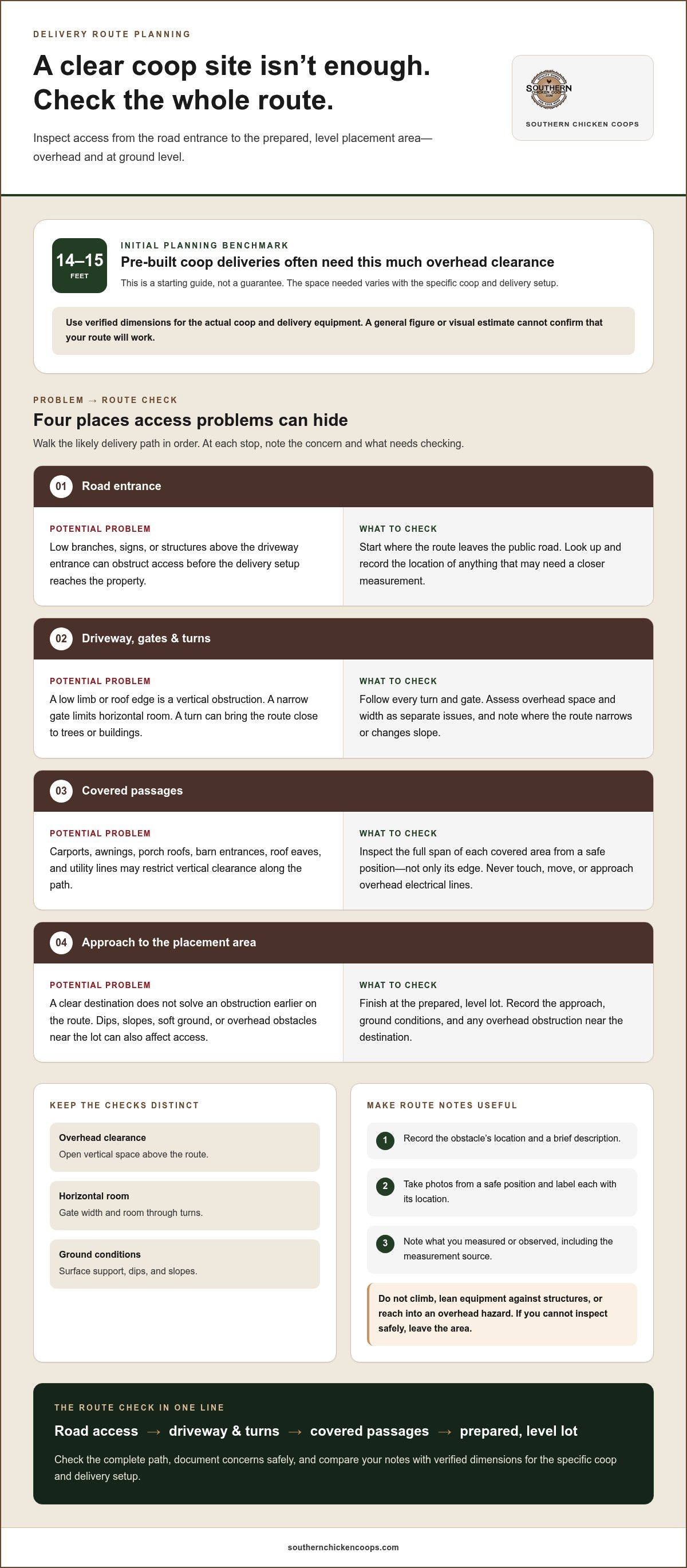
Use this pre-delivery overhead clearance checklist
Use this checklist to turn your route walk into a clear preparation plan. Keep notes, photos, and verified measurements together so each potential issue has a location and next step. For every obstacle, record its location, description, photo, and measurement source. If a measurement isn’t available, mark it as unverified rather than guessing.
- Route entrance: Check the driveway entrance from the road, including any gate, sign, branch, or roof edge above or beside it. Note whether the approach is clear and whether a gate can be opened and left unobstructed for delivery.
- Overhead obstructions: Look for tree limbs, utility lines, eaves, awnings, carports, and covered entries along the route. Record each concern separately. Move items or address branches only when it is safe and lawful to do so. Never cut branches near electrical lines or touch, move, or approach wires. Keep a safe distance and follow utility guidance for line-related concerns.
- Turns and narrow spots: Note each turn, gate, and constriction, along with nearby branches, fences, or outbuildings. Compare available height and width only with verified measurements for the specific coop and delivery setup. A tight turn is a maneuvering issue, not an overhead-clearance measurement.
- Destination: Confirm the placement area is prepared, level, and clear, with room to approach as well as space for the coop’s footprint. Keep those two needs distinct. If you’re planning around a 6x12 chicken coop footprint, use its verified dimensions when laying out the site rather than estimating from memory.
- Delivery-day readiness: Clear movable items from the driveway, gates, and placement approach. Gather route photos, obstacle notes, and measurement sources in one place. Recheck the route after weather or property changes that could affect branches, ground conditions, or access.
What to clear or resolve before delivery day
Handle straightforward preparation on your property, such as opening gates and moving items that are safe and lawful to move. Don’t take on hazardous tree work or electrical-line concerns yourself. Separate owner-preparation tasks from issues that need qualified help or guidance from the utility responsible for the lines.
What to have ready for a final route review
Keep the checklist with photos from the entrance, turns, gates, and destination, plus verified delivery and coop dimensions. A final review can catch changes since your first walk-through and make your route notes more useful for planning. For broader site-preparation context, see the backyard chicken coop preparation guide.
This checklist helps catch route issues before delivery day, while there’s still time to prepare safely. Keep your property plan alongside your coop delivery plans with Southern Chicken Coops so preparation and delivery planning stay aligned.
Plan a smooth chicken coop delivery with Southern Chicken Coops
At Southern Chicken Coops, we handcraft coops in McGregor, Texas, and professionally deliver completed coops to a prepared, level lot. Thoughtful site preparation connects the work that goes into building your coop with a clear plan for bringing it onto your property. Since every driveway, entrance, and placement area is different, a route review is more useful than relying on a general assumption about access.
Your completed checklist gives you a practical way to organize what you’ve observed: route photos, obstacle locations, ground conditions, and measurements compared with verified dimensions for your particular delivery setup. This record helps you coordinate property preparation with delivery planning and keep the details of your site together.
What a prepared delivery site should make possible
A prepared site should offer a clear approach from the property entrance to the designated, level placement area. The route and final spot both matter. Keep the coop footprint in mind, along with the space needed to approach and position the completed structure. Move items that can safely and lawfully be moved, and note anything that remains in the path.
Resolve overhead concerns before delivery. A low branch over a driveway or a roof edge above an approach may affect access even if the destination itself is open. Addressing these concerns in advance makes the route easier to assess and positioning more predictable, while recognizing that properties and delivery setups differ.
Include ground conditions in your plan. A level destination is important, but consider soft, uneven, or sloped areas along the route as well. Keep observations separate from measurements: photos and notes show what’s present, while the dimensions of the actual coop and delivery setup are needed to assess clearances and maneuvering space.
Take the next step with a clear site plan
Before delivery, bring your notes together in one place. Include photographs from the entrance, turns, covered areas, and placement approach, along with each obstacle’s location, description, and measurement source. Revisit the route if weather or property changes may have affected access. If a concern involves overhead electrical lines, keep your distance and follow appropriate utility guidance rather than trying to move or work around them yourself.
This preparation isn’t about making every Texas property look alike. It’s about understanding your route and sharing accurate site details as you plan for delivery. As a family-owned business operated by Bill and Tina Drivdahl, we take pride in crafting coops and helping customers plan for their arrival at a prepared lot. A completed checklist gives your delivery plans a property-specific starting point.
When you’re ready, explore Southern Chicken Coops’ information about coop delivery and handcrafted chicken coops to learn more about receiving a completed coop for your property.
Make room for the next chapter on your property
Once you’ve worked through overhead clearance for coop delivery, picture how the finished space will serve you day to day. A convenient path for carrying feed, gathering eggs, and tending your flock can make the coop feel like a natural part of your homestead, rather than a structure placed at the end of a driveway.
Your route notes can also help you think beyond delivery day. Keep the placement area clear for its intended use, and consider how people will move around it as your flock settles in. If the property changes before delivery, revisit your plan to make sure the route and destination still match what you’ve documented. A little forethought can make the arrival feel like the start of a lasting addition to your home.
Southern Chicken Coops is a family-owned business operated by Bill and Tina Drivdahl, with coops handcrafted in McGregor, Texas, and professionally delivered to prepared, level lots. Explore handcrafted chicken coops and delivery as you plan the right fit for your property.
Frequently Asked Questions
How much overhead clearance is needed for chicken coop delivery?
There isn’t one overhead height that applies to every chicken coop delivery. The space needed depends on the specific coop and delivery setup, including how the completed structure is transported. For accurate overhead clearance for coop delivery, use verified measurements for your project rather than a general rule of thumb. Check the lowest point along your route, including gates, roofed areas, and branches that may hang over the path.
Do tree branches need to be trimmed before a coop is delivered?
Only if a branch obstructs the planned route and it can be addressed safely and lawfully. A limb over a gate or driveway may need attention, while one near electrical lines must not be cut or handled by you. If a branch could interfere with access, document its location and keep clear of wires. Recheck trees after strong Texas winds, which can shift limbs into the route.
Can a chicken coop delivery pass under overhead power lines?
Don’t assume a delivery can safely pass beneath overhead power lines. Never touch, move, or approach the lines to measure them or make room. Keep people and equipment at a safe distance, and follow guidance from the utility responsible for the lines. If the route appears to pass close to wires, mark that section as a safety concern and plan around it before delivery rather than relying on a visual guess.
What should I measure before a chicken coop is delivered?
Measure the tightest overhead opening and narrowest passage, along with the space available at turns and gates. Compare these observations with verified dimensions for the specific coop and delivery setup. Also note the coop’s footprint and the approach space needed to position it at the destination. For example, a gate may clear the coop’s width but still leave too little room for a turn immediately beyond it.
Does the entire driveway need overhead clearance for coop delivery?
Yes. Assess every part of the planned route, not only the coop’s destination. The delivery setup may pass beneath a tree canopy near the road, a branch over a bend, or a roofed entrance farther down the driveway. Texas rural drives can include several distinct access points, so note the lowest or tightest sections. If there’s another possible route, assess it separately rather than assuming it’s clear.
What happens if my property does not have enough clearance for delivery?
Don’t proceed through an access point you know is too low or unsafe. First identify the exact obstacle, then consider whether a safe, lawful change to the route or placement plan could resolve it. Some obstacles, especially concerns involving power lines, need utility guidance or qualified help. Keep photos and measurements with your delivery notes so the property-specific issue can be addressed during planning, before delivery.


