

Last July, we spoke with a neighbor who was heartbroken to find her hens pacing and pecking at each other as the Texas sun beat down. She had followed a generic manual word for word, yet her birds were clearly stressed and overcrowded. It's a worry we see often; you want to provide a sanctuary for your flock, but the conflicting advice online makes it hard to know if you're getting it right. One of the most important questions you'll ever ask as a steward of your birds is, how big should a chicken coop be to keep them safe and peaceful?
We believe that building a home for your animals is a calling rooted in integrity, and that starts with getting the dimensions perfect for our unique climate. In this 2026 guide, we're sharing the exact space requirements and mathematical formulas we use for every handcrafted build in our McGregor workshop. You'll learn the vital difference between coop and run square footage, how to layout the interior to stop bullying, and why air volume is the real secret to keeping your flock cool when the temperature climbs. We'll even show you why our signature 6x12 Polka model is designed to be the ideal home for a dozen healthy hens.
Key Takeaways
- Learn the "Golden Rule" for sizing that balances indoor square footage with the essential outdoor run space your birds need to stay active and healthy.
- Discover exactly how big should a chicken coop be by considering your specific breed's temperament and how extra room naturally prevents bullying.
- Understand why air volume is just as vital as floor space in the Texas heat, ensuring your coop remains a cool sanctuary during our long summers.
- Get the blueprints for a high-efficiency interior, including proper nesting box ratios and the exact roosting bar lengths needed for comfortable shoulder room.
- See why we've found the 6x12 Polka model to be the most resilient and perfectly sized home for a thriving flock of 10 to 12 hens.
The Golden Rule of Chicken Coop Square Footage
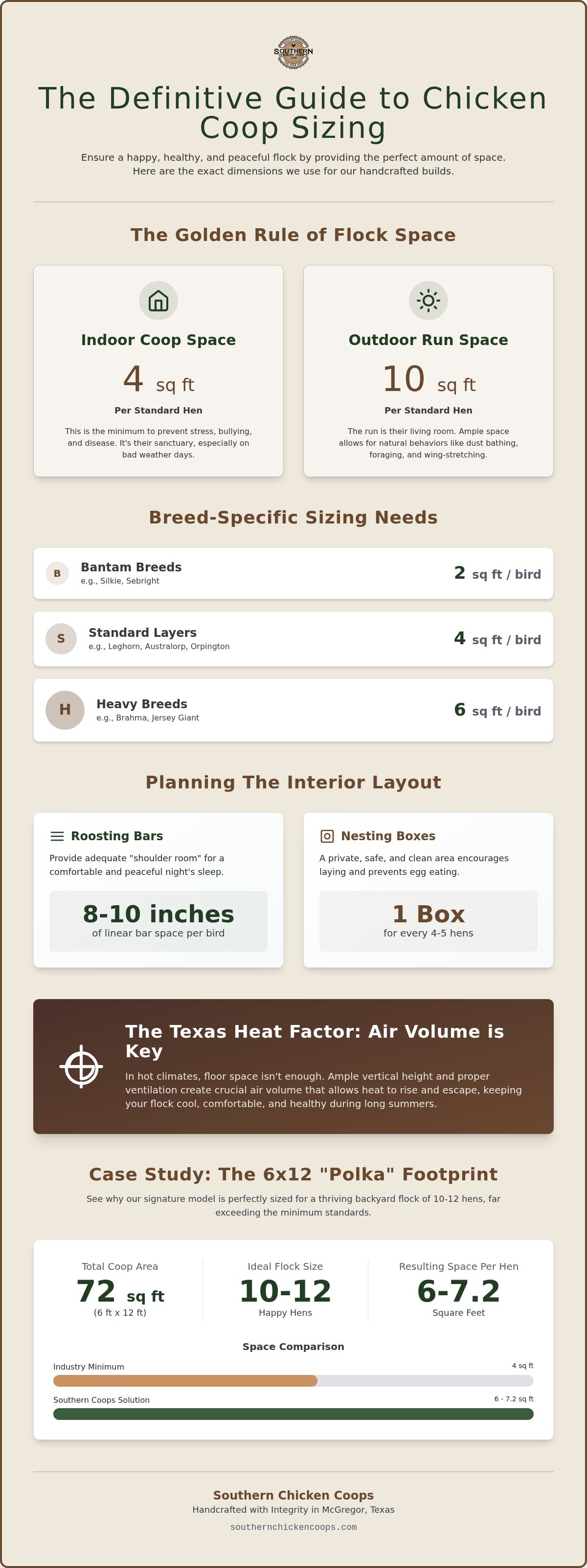
We've spent many years in our McGregor workshop perfecting our designs, and we've learned that the secret to a happy flock is never cutting corners on space. When you ask how big should a chicken coop be, you're really asking how to prevent stress and protect the health of your birds. A cramped bird is a frustrated bird. The industry standard often suggests 2 to 4 square feet per bird inside the coop, but we always lean toward the higher end of that scale. This extra room ensures peace in the pecking order and prevents the bullying that happens when hens feel trapped. Understanding how big should a chicken coop be for your specific property is the first step toward a successful homestead.
Floor space isn't the only metric that matters for a healthy home. Vertical living space, including the height of the roosting bars and the total volume of air above their heads, plays a huge role in their daily well-being. Think of the coop as their bedroom and the run as their sunroom. In our Texas climate, providing more space than the bare minimum is the most effective way to keep temperatures down and spirits up. When birds have room to move, they stay cooler, stay cleaner, and lay better eggs for your family.
Calculating Your Minimum Indoor Space
For most standard breeds like Rhode Island Reds or Leghorns, we recommend a solid 4 square feet of indoor space per hen. If you've fallen in love with heavy hitters like Jersey Giants or Brahmas, you'll need to increase that to at least 6 square feet to accommodate their larger frames and heavier wings. It's also vital to consider lock-down days. When a sudden spring storm rolls through Central Texas and your girls have to stay inside for the day, that extra foot of space is what keeps them from pecking at each other out of frustration.
The Vital Role of the Outdoor Run
In the sweltering heat of a Texas summer, the outdoor run becomes the primary living room for your flock. For birds that aren't free-ranged, we suggest providing 8 to 10 square feet of secured outdoor space per bird. This ensures they have room to stretch their wings and find a dusty spot for a bath without being crowded by their sisters. When you're looking for the best chicken coop for backyard flock, always look for a design that integrates the run and the coop into one sturdy, handcrafted structure. This layout makes it easier for you to manage their footprint while giving them the safety and freedom they deserve.
Factors That Change Your Space Requirements
While the math we discussed earlier gives us a solid foundation, we've found that every flock has its own unique personality. Deciding how big should a chicken coop be isn't just about the number of birds; it's about the kind of birds you've chosen to raise. Some breeds are calm and content to lounge, while others are flighty and need more "personal bubble" space to feel secure. We always tell our neighbors that it's better to build for the flock you want in three years, not just the chicks you have today. Planning for future growth ensures you won't have to start over when you inevitably decide to add a few more "must-have" hens to your backyard.
Your daily routine also dictates the footprint. If your birds spend their entire day in a protected run, the indoor coop can stay closer to the minimum requirements. However, if they don't have a safe place to roam outside, the coop becomes their entire world. In those cases, you'll want to double your indoor square footage to prevent cabin fever. If you're unsure which size fits your specific mix of breeds, we're always happy to chat about our custom chicken coops built right here in McGregor.
Breed-Specific Sizing Needs
Bantams are the small but mighty exception to the rule. Because of their tiny stature, you can often get away with 2 square feet of indoor space per bird. For standard layers like Australorps or Orpingtons, the 4-square-foot mark is your safety zone. Meat birds have very different needs than egg layers. Since they grow quickly and are less active, they don't require the same vertical roosting space, but they still need plenty of floor room to stay clean and healthy.
Managing Flock Dynamics Through Design
The "Pecking Order" is a real biological drive, and space is your best tool to manage it. When birds are too close together, they start picking at feathers or, worse, eating eggs out of boredom and stress. We like to design coops with "out of sight" areas so a bullied hen can find a quiet corner away from the alpha. Additionally, building a predator proof coop for 10 hens requires specific structural dimensions to ensure that while the birds have room to hide, the coop remains easy for you to secure and clean. A well-proportioned coop makes it much harder for a predator to reach a bird through the wire, as the hens have enough room to sleep far away from the edges of the enclosure.
Why Texas Heat Redefines "Enough Space"
Texas summers change the math of poultry keeping entirely. When neighbors ask us how big should a chicken coop be, we tell them to think about air volume rather than just floor square footage. In our McGregor workshop, we've seen how a cramped design traps stagnant, hot air right at the level where your hens sleep. Because heat rises, a coop with a generous ceiling height allows that "heat stack" to move up and away from your birds. This prevents the structure from becoming a literal oven during a July afternoon when temperatures regularly climb into the triple digits.
High bird density doesn't just increase the temperature; it also drives up humidity. Chickens don't sweat; they cool down by panting, which releases moisture into the air. If your coop is too small for the number of birds inside, that moisture builds up, making the air heavy and suffocating. We prioritize cross-ventilation in every design we build to ensure there's a constant path for the breeze to pull fresh air in and push the humid, hot air out. Proper sizing ensures the moisture from droppings doesn't turn the floor into a source of damp heat, which is a leading cause of respiratory issues in our regional flocks.
Ventilation and Airflow Dynamics
We build a weatherproof chicken coop in Texas with intentional airflow gaps integrated into the structure. These gaps are carefully sized relative to the floor space to ensure that air is constantly moving without creating a direct, chilling draft in the winter. For every 10 square feet of floor space, we recommend at least 1 square foot of high-level ventilation. This ratio helps exhaust the ammonia and heat that naturally accumulate in a busy coop.
Mitigating Heat Stress with Extra Elbow Room
Chickens generate a surprising amount of radiant heat from their bodies. When they're crowded together on a roosting bar in 90-degree nighttime temperatures, they effectively heat each other up. They need enough space to spread their wings and let air reach their skin to cool down. If you see your hens panting heavily or holding their wings away from their bodies, it's a clear sign they don't have enough room to dissipate that heat. In McGregor, we always advise placing the coop where it can catch the southern summer breezes, ensuring that every square foot of the interior stays as fresh and cool as possible.
Planning Your Interior Layout: Beyond the Floor
When we sit down to sketch a new build in our McGregor workshop, we look past the empty floor and envision how the birds will actually move. The question of how big should a chicken coop be often misses a vital detail: the internal traffic flow. If you place your feeders and waterers in the center of a small space, you've effectively cut your usable square footage in half. We design our coops to keep the main floor clear, ensuring your hens have plenty of room to scratch and socialize without tripping over their own dinner. A well-planned layout prevents the "morning rush" where hens might squabble over the best nesting spot or a prime position at the waterer.
In Central Texas, we also have to account for local predators like raccoons and coyotes that are surprisingly clever with their paws. If your interior layout forces birds to roost too close to the ventilation gaps or the hardware cloth, they're at risk. A larger footprint allows you to pull the roosting bars toward the center of the structure, keeping your flock safe and out of reach from curious nighttime visitors. If you're ready to provide this level of protection, you can order a handcrafted custom chicken coop designed with these safety margins in mind.
Roosting and Nesting Requirements
Each of your hens needs 8 to 10 inches of roost bar space to sleep comfortably without bumping into her neighbor's wings. For the nesting area, we've found that 12x12 inch boxes are the ideal size for most Texas breeds, providing a cozy, secure spot for egg-laying without being so large that two hens try to squeeze in at once. Chickens naturally follow a height hierarchy; they'll always try to sleep on the highest point available. We make sure the roosting bars are higher than the nesting boxes so your girls don't decide to sleep (and leave messes) where you want them to lay your breakfast.
Access and Maintenance Clearance
We firmly believe that "walk-in" coops are superior because they respect the human side of the stewardship equation. If a coop is too cramped for you to enter comfortably, deep-litter management and daily cleaning become chores you'll dread rather than a peaceful part of your morning. Sizing your doors for easy access makes egg collection a joy and ensures you can reach every corner with a rake or shovel. As you're preparing your backyard for a chicken coop, remember that how big should a chicken coop be also depends on the clearance you need for delivery and your own ability to move around the structure for years to come.
The Southern Solution: Why the 6x12 Footprint Wins
After years of building and listening to our neighbors in the Central Texas community, we've spent a lot of time thinking about the perfect balance for a suburban backyard. We eventually settled on what we call the Polka philosophy. It's a design approach that recognizes that the question of how big should a chicken coop be isn't just about the birds; it's about the longevity of the structure and the ease of use for the family. Our signature 6x12 Polka model provides a total footprint of 72 square feet, which we've found to be the ideal sweet spot for a flock of 10 to 12 hens. This size allows for a spacious indoor house while maintaining a large, integrated run where birds can spend their days safely.
Many folks are tempted by imported kits because of the lower initial price tag, but those "disposable" coops often suffer from what we call dead space. They might claim to house ten birds, but the thin wood and cramped interior layout mean your hens are stressed from day one. In contrast, our handcrafted coops are built one at a time with the resilience needed to withstand Central Texas storms and heat. When you choose a professional build, you also avoid the common DIY sizing mistakes that lead to overcrowding and health issues. Our coop delivery service ensures your new sanctuary arrives exactly where you need it, set up and ready for your girls to move in without the headache of manual assembly.
Inside the 6x12 Polka Model
The beauty of the Polka model lies in how it maximizes every inch of usable space. We've carefully balanced the enclosed house area with the integrated run so that your birds have a seamless transition between sleeping and scratching. Unlike factory-made units that use flimsy materials, our handcrafted approach uses heavy-duty lumber and hardware cloth that keeps predators out and your hens in. You can see the full specifications and photos of our 6x12 chicken coop for sale to see how we've prioritized both form and function for the modern homesteader.
The Value of Local Craftsmanship
Bill and I see our work as a calling rather than a purely commercial venture. We believe that building a home for your animals should be rooted in integrity and a deep respect for the lifestyle. Every coop that leaves our McGregor workshop is a testament to our commitment to the community. We've seen too many neighbors frustrated by kits that fall apart after one season. By choosing a McGregor-made coop, you're investing in a home that will last for years, providing a safe sanctuary for your birds and a beautiful addition to your property. We encourage you to take that next step in your homesteading journey with confidence, knowing that your flock has exactly the space they need to thrive under the Texas sun.
Creating a Lasting Sanctuary for Your Flock
Building a home for your birds is a beautiful act of stewardship that pays dividends in fresh eggs and peaceful mornings. We've seen how getting the dimensions right protects your flock from the stress of overcrowding and the intensity of a Central Texas summer. By understanding how big should a chicken coop be, you're providing the air volume and floor space needed to keep your hens cool, healthy, and happy. Proper sizing isn't just about a number; it's about the safety and well-being of the animals we've been called to protect.
Bill and Tina Drivdahl are here to guide you with the same neighborly sincerity we bring to our own backyard in McGregor, Texas. Our signature 6x12 Polka model is handcrafted one at a time, ensuring your flock has a durable sanctuary specifically designed for our unique regional climate. We invite you to Explore our handcrafted 6x12 Polka coops today to see the difference that professional pride and humble service can make for your homestead. We're honored to help you create a safe, beautiful home that will serve your family and your birds for many years to come.
Frequently Asked Questions
How many chickens can I fit in a 6x12 coop?
A 6x12 coop like our Polka model fits 10 to 12 hens perfectly. With 72 square feet of total footprint, this size balances the indoor sleeping quarters with a generous integrated run. This ensures every bird has enough elbow room to stay cool and avoids the bullying that happens in smaller, cramped quarters. It's the ideal setup for most backyard homesteaders in our community.
Is it better to have a bigger coop or a bigger run?
In our warm climate, a bigger run is often more beneficial for your flock's daily health. While the indoor space is vital for sleeping and laying, the run is where they spend most of their time escaping the heat. When you're deciding how big should a chicken coop be, prioritize the outdoor square footage to ensure they have plenty of fresh air and room to scratch.
What happens if my chicken coop is too small?
A coop that's too small leads to immediate behavioral and health problems. You'll likely see birds pecking at each other's feathers or even eating eggs out of stress and boredom. Small spaces also trap heat and moisture, which quickly creates a breeding ground for respiratory issues and parasites. It's much harder to keep a tiny coop clean and your birds safe from disease.
Can a chicken coop be too big for my flock?
It's very rare for a coop to be too big, especially here in Central Texas. While folks in the far north worry about birds staying warm through body heat, our main challenge is the summer sun. A larger space simply provides better airflow and more comfort. The only downside to an oversized coop is the extra time you'll spend cleaning a larger floor area.
How much roosting space does each chicken need?
You should plan for 8 to 10 inches of roosting bar space for every standard sized hen. This allows them to huddle together for security without being so crowded that they overheat or knock each other off the bar. If you have larger breeds, aim for the full 10 inches to ensure they have enough shoulder room to sleep peacefully throughout the night.
Do I need a nesting box for every chicken?
You don't need a separate box for every bird; one nesting box for every three to four hens is the standard rule. Chickens are creatures of habit and will often wait in line for their favorite box even if others are empty. Providing too many boxes can actually be counterproductive, as birds might start sleeping in them and making a mess where they should be laying.
How tall should a chicken coop be for proper ventilation?
We recommend a ceiling height of at least 6 to 8 feet at the peak to allow for a proper heat stack effect. Since heat rises, a taller roof pulls the warmest air up and away from your hens. This vertical space is a key factor when calculating how big should a chicken coop be to survive a long, sweltering summer in McGregor.
Can I keep chickens in a coop without a run in Texas?
Keeping chickens in a coop without a run is very difficult in the Texas heat unless they are free ranging all day. Without a shaded, breezy outdoor area, the indoor temperature can quickly become dangerous. An integrated run provides a safe sanctuary where they can stay active and cool while remaining protected from local predators like hawks or coyotes.


