

When the Texas sun turns your backyard into an oven, the heavy insulation used in northern coops actually becomes a dangerous heat trap for your birds. We've seen too many well-meaning folks lose their favorite hens to heat exhaustion simply because their housing wasn't built for our 100-degree days. Choosing the best materials for a chicken coop in Texas isn't just about building something sturdy; it's about creating a thermal regulator that breathes. We understand the deep responsibility you feel for your flock's safety, and we believe your girls deserve a home that's as resilient as the land they live on.
You want a coop that won't rot in our humidity or fall prey to a determined raccoon in the middle of the night. It's a common frustration to see cheap wood and thin wire fail after just one season. We're going to share exactly what it takes to build for longevity, focusing on materials that offer peace of mind for ten years or more. This guide covers everything from reflective metal roofing to the specific gauge of hardware cloth needed to stop predators. By the end, you'll know how to design a space that keeps your flock thriving through every scorching summer and sudden storm.
Key Takeaways
- Learn why prioritizing cross-ventilation and heat reflection is more critical for your flock's survival than traditional insulation during a Texas summer.
- Identify the best materials for a chicken coop in Texas to ensure your structure survives high humidity and ground contact for 10 or more years.
- Discover the radiant barrier secret that can lower your coop’s internal temperature by 15 degrees, keeping your hens comfortable on the hottest days.
- Master the 19-gauge hardware cloth standard to provide your birds with absolute security against clever predators like raccoons and snakes.
- Explore flooring and bedding combinations that prevent rot and keep your coop smelling fresh, even in our unique Central Texas weather.
The Texas Challenge: Why Material Choice Dictates Flock Survival
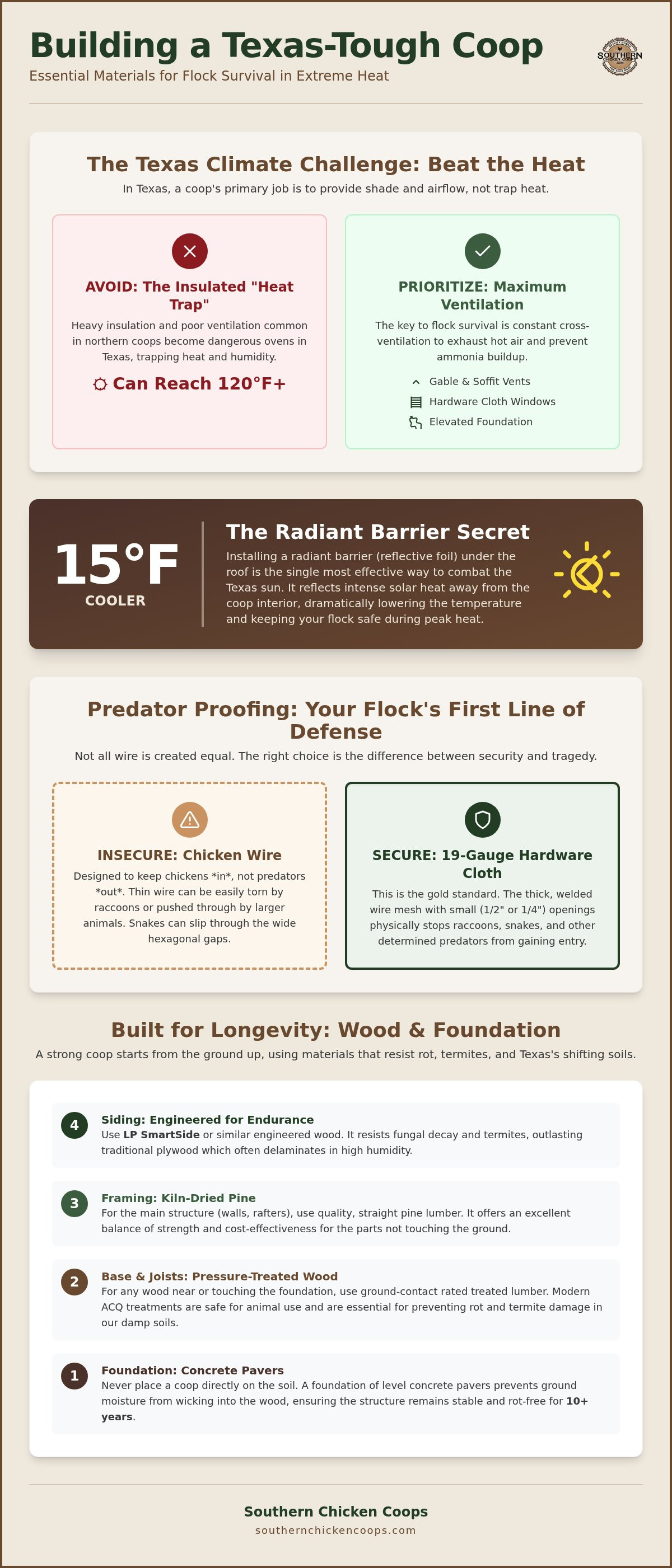
Living in Texas means we don't just deal with heat; we deal with a climate that wants to test every screw and board we put in the ground. If you've lived here through August, you know that 100 degrees outside can easily turn into 120 degrees inside a poorly designed structure. This is what we call the Heat Trap. When you're searching for the best materials for a chicken coop in Texas, your first priority must be managing this thermal load. Unlike coops in the North that need to hold heat in, our builds need to let it escape as quickly as possible.
We focus on reducing thermal mass in every build. This means we avoid heavy, dense materials that soak up sun all day and radiate heat long after the sun goes down. A coop that stays hot at night prevents your birds from recovering, which leads to heat stress and lower egg production. Understanding the general principles of poultry housing helps us see that in our region, the coop is primarily a shade structure and a predator shield, not a thermal blanket. By choosing materials that breathe, we also prevent the damp, stagnant air that leads to common Texas poultry ailments like respiratory infections and mite infestations.
Prioritizing Ventilation Over Insulation
In our McGregor workshop, we've learned that a tight coop is a dangerous coop. High humidity mixed with chicken droppings creates ammonia gases. Without constant airflow, these gases build up at the level where your birds sleep. We use materials that encourage maximum cross-ventilation, such as large openings covered with hardware cloth rather than solid siding. Every one of our handcrafted coops, like the signature 6x12 Polka model, features gable vents and soffit openings. These are essential because they allow rising hot air to escape through the roofline, pulling cooler air in from the bottom to keep the girls comfortable.
Durability in Central Texas Soils
Our Central Texas soil is famous for shifting. The heavy clay expands when it rains and shrinks during a drought, which can rack a flimsy frame in just a couple of years. We also deal with high humidity that can rot standard lumber in no time if it has direct contact with the earth. The best materials for a chicken coop in Texas include rot-resistant wood and elevated foundations. We always recommend placing your coop on a leveled lot with a foundation of concrete pavers. This prevents direct soil contact and keeps your structure level as the ground moves, ensuring your doors always swing true and your investment lasts for a decade or more.
Structural Integrity: Selecting the Right Wood for Texas Longevity
Choosing the best materials for a chicken coop in Texas starts with the bones of the structure. We've seen plenty of coops built with thin 1x2 slats that simply can't handle a spring thunderstorm in Central Texas. We believe in using heavy-duty lumber because your flock deserves a home that won't buckle when the wind starts howling across the prairie. While cedar is a beautiful, naturally rot-resistant option, it comes with a premium price tag that isn't always necessary for a sturdy build. For most folks in the McGregor area, high-quality pine is the practical choice, provided it's used in the right places and protected correctly. In our signature 6x12 Polka model, we select every board for its straightness and strength to ensure decades of service.
The Truth About Pressure-Treated Wood
Many chicken keepers worry about using treated wood, remembering the old arsenic-based methods from years ago. Modern ACQ (Alkaline Copper Quaternary) treatments are much safer for use around animals. We use these treated materials specifically for sills and floor joists where moisture is most likely to linger. Ground-contact rated lumber is essential for Texas homesteads because it withstands the constant moisture and fungal pressure found in our heavy clay soils. By using treated wood for the footprint and untreated, kiln-dried lumber for the upper framing, we balance safety with maximum durability.
Siding Materials: Aesthetics vs. Protection
When it comes to the walls, traditional plywood siding often delaminates after a few years of Texas humidity and sun. We prefer LP SmartSide because it's engineered to resist fungal decay and termites, which are constant neighbors here in the South. It provides a clean, professional look while offering the resilience needed to protect your birds from the elements. Selecting the right siding is a major part of finding the best materials for a chicken coop in Texas, especially when you consider how much heat a dark wall can absorb.
We always recommend finishing your siding with high-quality, light-colored exterior paint to reflect as much UV radiation as possible. Research on managing hot weather in coops shows that surface temperature plays a huge role in the comfort of your birds. A white or light grey finish can keep the interior significantly cooler than dark stains. If you're feeling overwhelmed by the choices, we'd love to help you design one of our custom chicken coops that already includes these high-performance materials as standard features.
Roofing and Siding: Deflecting the Intense Texas Sun
The roof is the most important line of defense against the relentless Texas heat. While asphalt shingles are common on houses, they're often a poor choice for a coop because they absorb and hold thermal energy. We've found that the best materials for a chicken coop in Texas always include a high-reflectivity metal surface. A dark roof can easily reach 160 degrees on a summer afternoon, essentially turning your flock's home into an oven. By choosing the right materials, we can keep the interior environment stable and safe for your birds.
Galvalume and Metal Roofing Benefits
Galvalume is our preferred choice because it combines the strength of steel with the corrosion resistance of aluminum. It's far superior to traditional shingles in high-wind regions where spring storms can peel back standard roofing in seconds. More importantly, the silver or white finish of a metal roof reflects the majority of solar radiation away from the structure. This choice alone can prevent the "heat trap" effect we discussed earlier. When we install these roofs, we use specific fasteners with neoprene washers to ensure the coop remains bone-dry during those sudden flash floods that Central Texas is known for.
Implementing Radiant Barriers
We consider radiant barriers to be the "secret weapon" for southern poultry keepers. By installing a foil-faced barrier directly under the roof panels, we can drop the interior temperature by up to 15 degrees. The science relies on a small air gap between the metal and the barrier, which stops the transfer of radiant heat. We've perfected this technique in our custom chicken coops Texas builds, ensuring your girls stay cool even when the mercury climbs past 100.
Beyond the material itself, the design of the roof makes a huge difference. We always build with a generous overhang to provide extra shade for the walls and windows. This keeps the sun from hitting the siding directly and helps direct heavy rain away from the foundation. Following Texas A&M housing guidelines ensures that your coop is sized and pitched correctly for our unique weather patterns. Selecting the best materials for a chicken coop in Texas is a balance of craftsmanship and common sense, and it starts right at the top.
Predator-Proofing: Hardware Cloth vs. Chicken Wire
Don't let the name fool you. Chicken wire is excellent for keeping chickens inside a specific area, but it's almost useless for keeping Texas predators out. A hungry coyote or a determined stray dog can tear through standard hexagonal poultry netting like it's wet paper. We've spent years observing the "Texas Trinity" of predators: raccoons, snakes, and coyotes. Each one requires a different defensive strategy. When you are sourcing the best materials for a chicken coop in Texas, your choice of mesh is the most important security decision you'll make. We believe in building a fortress that lets you sleep soundly at night, knowing your flock is truly safe.
The only material we trust for our builds is 19-gauge, 1/2-inch galvanized hardware cloth. This heavy-duty mesh is thick enough to resist the persistent chewing of a raccoon and the sheer strength of a coyote. We don't just staple it to the surface; we sandwich it between pieces of lumber or use screws with wide fender washers. Predators are clever, and they'll often try to pull the wire away from the frame rather than breaking the wire itself. Using these robust fastening techniques ensures the mesh stays exactly where it belongs, even under heavy pressure.
Stopping Snakes and Small Rodents
Texas is home to several species of snakes that would love nothing more than a fresh egg breakfast. Standard chicken wire has openings large enough for most snakes to glide right through. Choosing a 1/2 inch mesh is the gold standard for Texas snake protection because it's small enough to stop even juvenile egg-eaters from slipping through the gaps. We also recommend installing a "predator apron," which involves extending the hardware cloth 12 to 18 inches out from the base of the coop and burying it slightly. This prevents diggers like skunks and foxes from tunneling under the run walls.
Raccoon-Proof Latches and Hardware
Raccoons have incredible dexterity and can easily manipulate simple sliding bolts or hook-and-eye latches. We've seen them work at a latch for hours until they find a way in. To counter this, we use two-step locking mechanisms or spring-loaded carabiners that require "thumbs" to operate. It's also vital to use heavy-duty hinges that won't sag over time. If a door begins to hang crookedly, it creates a gap that a raccoon can use as a pry point. If you want a home for your birds that's already built with these security standards, we invite you to look at our custom chicken coops. We've already done the hard work of selecting the best materials for a chicken coop in Texas so you don't have to worry about a thing.
Interior Comfort: Bedding and Flooring for a Healthier Coop
Once you've secured the frame and the roof, the final step in creating a sanctuary for your birds happens inside the coop walls. Managing the internal environment is just as vital as the external build, especially when we're dealing with the dusty, dry spells of a Texas summer. The best materials for a chicken coop in Texas include interior finishes that prioritize respiratory health and ease of cleaning. We believe that a well-designed interior doesn't just make your life easier; it ensures your girls stay productive and stress-free. Our 6x12 chicken coop for sale is built with these health-first principles in mind, featuring nesting boxes positioned in the coolest, darkest corner of the structure to encourage consistent laying.
The Best Bedding for Texas Heat
While many folks in the North rely on the deep litter method to generate heat during the winter, we have to be careful that our bedding doesn't become a compost pile that adds extra warmth to an already hot coop. We've found that hemp bedding is a game-changer for our climate. It's incredibly absorbent and produces almost no dust, which is crucial for preventing respiratory issues when the air gets dry in McGregor. We always advise our neighbors to avoid cedar shavings. The aromatic oils that make cedar smell nice to humans can actually irritate a chicken's sensitive lungs. Some keepers prefer sand for its heat-wicking properties, though it requires more frequent scooping to keep it from becoming a "litter box" in our high humidity.
Easy-Clean Flooring Surfaces
If your coop has a wooden floor, protecting that wood from moisture and ammonia is the only way to make it last ten years or more. We often use a heavy-duty linoleum overlay or a specialized coating like "Blackjack 57" to create a waterproof barrier. This makes the weekly clean-out a breeze and prevents droppings from soaking into the grain of the wood. Proper moisture management is the secret to a coop that never smells, even on a humid July morning.
When you're preparing your lot for a delivered chicken coop Texas, remember that drainage is your best friend. We recommend a base of crushed granite or concrete pavers to keep the floor high and dry. By selecting the best materials for a chicken coop in Texas from the ground up, you're investing in a home that remains a joy to manage and a healthy place for your flock to thrive for many years to come.
Protecting Your Investment and Your Birds
Building for the Texas climate means respecting the power of the sun and the persistence of local predators. We've seen how reflective metal roofing and 19-gauge hardware cloth create a foundation of safety that lasts for decades. Choosing the best materials for a chicken coop in Texas isn't just about construction; it's an act of stewardship for the animals in your care. By prioritizing cross-ventilation over insulation and selecting rot-resistant lumber, you ensure your hens stay comfortable through every scorching August.
We know that sourcing these heavy, specialized materials and building from scratch is a massive undertaking. As local farmers who understand the unique challenges of our region, we're here to help. Our coops are handcrafted one at a time in McGregor, Texas, and delivered ready-to-use directly to your leveled lot. You don't have to navigate these choices alone. We invite you to Build Your Dream Coop with Southern Chicken Coops and enjoy the peace of mind that comes with master craftsmanship. Your flock is waiting for a home they can thrive in.
Frequently Asked Questions
Is pressure-treated wood safe for my chickens?
Yes, modern pressure-treated wood using ACQ is safe for chickens. We use it for the structural components that touch the ground to prevent rot. It's important to use ground-contact rated lumber for the foundation to ensure your coop lasts for years. While the treated wood is safe, we use untreated kiln-dried lumber for the upper framing and nesting areas where your birds spend the most time.
What is the best roofing material for a coop in Texas heat?
Galvalume or light-colored metal roofing is the absolute best choice for our climate. Unlike asphalt shingles that soak up solar energy, metal reflects the sun's rays away from your flock. This choice is a key part of finding the best materials for a chicken coop in Texas. When paired with a radiant barrier, it can keep your birds significantly cooler during those brutal triple-digit summer afternoons.
Can snakes get through chicken wire?
Yes, snakes can easily slip through the large holes in standard chicken wire. Most egg-eating snakes are surprisingly thin and can navigate hexagonal wire without trouble. To truly protect your flock, you need 1/2-inch hardware cloth. This smaller mesh size creates a physical barrier that stops snakes, mice, and even the "Texas Trinity" of larger predators from reaching your birds or their eggs.
Do I need to insulate my chicken coop for Texas winters?
You don't need thick insulation for our winters; in fact, it often does more harm than good. Trapping heat also traps moisture and ammonia, which leads to respiratory illness. A well-built coop with proper ventilation is enough for our occasional freezes. As long as your birds can stay dry and out of the direct wind, their natural feathers will keep them plenty warm without extra wall layers.
What gauge hardware cloth is best for predator proofing?
We recommend 19-gauge, 1/2-inch galvanized hardware cloth as the industry standard for security. This specific thickness is strong enough to resist the persistent chewing and pulling of raccoons or coyotes. It's one of the best materials for a chicken coop in Texas because it provides total peace of mind. We always secure our mesh with screws and wide washers rather than simple staples for maximum protection.
How do I prevent my coop floor from rotting in the Texas humidity?
Preventing rot starts with keeping your coop off the damp soil. We recommend placing your structure on a leveled bed of concrete pavers or crushed granite. Inside the coop, we use waterproof barriers like linoleum or Blackjack 57 coating on the floor. These materials prevent moisture from droppings from soaking into the wood, ensuring the floor stays solid and easy to clean even during our humid spring seasons.
Should I paint the inside of my chicken coop?
Painting the interior is a great idea for both cleanliness and light. A light-colored, low-VOC exterior paint makes the inside feel brighter and helps you spot mites or other pests more easily. It also creates a smooth surface that you can wipe down during your deep cleans. We focus on these small details in every build to ensure the interior environment is as healthy as possible for your girls.
Is metal or wood better for a chicken coop frame in Texas?
High-quality wood is generally superior to metal for coop frames in our region. Metal frames can conduct intense heat into the structure during the summer, making it harder to keep the interior cool. Wood provides better natural insulation and structural flexibility for our shifting clay soils. When we build one of our handcrafted coops, we use heavy-duty lumber to provide the strength of metal without the heat-transfer drawbacks.


