

A flock can support food security only when its daily needs are planned as carefully as its egg production. A practical starting point for basic emergency food security is 3 to 4 hens per household member, but long-term food security with backyard chickens also depends on dependable feed, clean water, protected shelter, and enough nesting space. Foraging and scraps can supplement a flock’s diet, but they can’t replace balanced feed.
It’s natural to focus first on how many hens you’ll keep and how many eggs they may provide. The less visible parts of the plan matter just as much: a well-sheltered coop helps protect birds from weather and predators, while thoughtful cold-weather care supports their comfort when temperatures drop. In this guide, we’ll cover alternative feed and sprouted grains, household and garden scraps, coop and nesting needs, and practical shelter considerations for colder weather. Together, these basics can help you build a more resilient backyard flock and plan more steadily for the food it provides.
Key Takeaways
- Use sprouted grains and foraging as supplements, not replacements for a flock’s balanced feed.
- Plan for cold weather with dry bedding and a sheltered coop that protects hens from wind, rain, and predators.
- Size the coop, run, roosts, and nesting areas around the number and breed of birds you keep.
- Offer household and garden scraps thoughtfully; they can add variety and help reduce feed use, but scraps alone don’t meet hens’ needs.
- Estimate egg production with the flock’s size and laying stage in mind, then shape your food plan around what the hens can realistically provide.
Alternative feed and sprouted grains
Backyard chickens can provide eggs at home, while store-bought eggs require less daily flock care. Chickens can provide eggs, and their needs for feed, space, and care are important to household planning.
City and county rules vary: some urban and suburban areas prohibit chickens or limit flock size and roosters. Local requirements determine whether you can keep hens, how many are allowed, and whether a rooster is permitted.
Startup and annual costs depend on the coop, fencing, flock size, feed, bedding, and ongoing upkeep. Feed and bedding are recurring expenses, while a coop and predator-resistant enclosure are part of setting up the flock. These factors determine your household’s actual costs.
Feed planning is central to the cost of home-produced eggs. Commercial layer feed contains 16-18% protein, and a laying chicken eats about one-third of a pound of feed per day. Home-produced eggs therefore depend partly on how much feed the flock consumes, while store egg prices can change: U.S. egg prices rose by over 137% during supply-chain disruptions and avian influenza outbreaks.
Egg production changes as hens age, and older birds can lay fewer eggs. If you buy mature hens for a backyard flock, look for birds about a year old or younger, since production can drop quickly in older hens. This helps set realistic expectations without assuming a fixed productive lifespan.
A resilient flock needs suitable housing, dependable feed, fresh water, and protection from weather and predators. Keep these daily needs in mind when choosing flock size, and treat sprouted grains as a supplement, not a complete ration.
Sprouting can turn dry seed into green fodder: 1 pound of dry seed, sprouted for 6 to 7 days, can produce 4 pounds of fodder. That added weight offers another feeding option, but it doesn’t remove the need for supplemental feed, even when chickens forage.
- Use sprouted grains as an addition to a balanced feeding plan, not as a replacement for layer feed.
- Plan feed quantities around the flock’s daily needs, then account for household budgets and changing egg prices.
- Consider forage a supplement; birds allowed to roam still need supplemental feed.
For long-term food security with backyard chickens, reliable routines matter as much as alternative feed. A steady supply of layer feed, with sprouted grains when prepared, makes feeding less dependent on scraps or foraging alone.
Coop shelter and cold weather
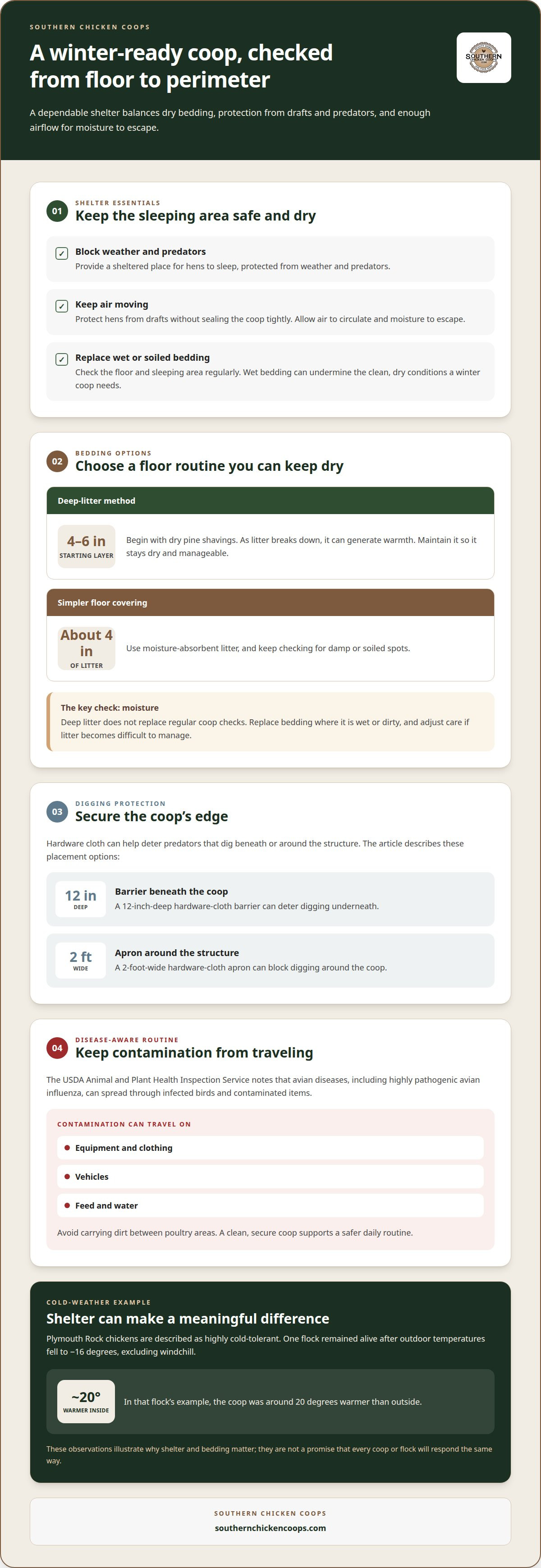
A secure coop matters in every season: hens need shelter from weather and predators while they sleep. In cold weather, dry bedding and protection from drafts help create a dependable resting place. The goal is not to seal the building tightly, but to provide shelter while allowing air to circulate and moisture to escape.
Health, predator, weather, and disease risks can overlap. Damp conditions affect coop comfort, while predators can threaten birds at night. According to the USDA Animal and Plant Health Inspection Service, avian diseases such as highly pathogenic avian influenza can spread through infected birds and contaminated equipment, clothing, vehicles, feed, or water. A clean, secure coop supports a safer daily routine.
Cold tolerance varies by bird, and a well-prepared coop can help hens cope with winter weather. Plymouth Rock chickens are described as highly cold-tolerant. One flock remained alive after outdoor temperatures fell to -16 degrees, excluding windchill, and its coop was around 20 degrees warmer than outside. Those observations illustrate why shelter and bedding matter, but they aren’t a promise that every coop or flock will respond the same way.
Deep-litter bedding can add warmth as litter breaks down. Begin with a 4-to-6-inch layer of dry pine shavings, then maintain the bedding so it stays dry and manageable. For a simpler floor covering, use about four inches of moisture-absorbent litter. Moisture is the key consideration: wet bedding can undermine the clean, dry conditions a winter coop needs.
- Keep the sleeping area dry. Replace wet or soiled bedding, and keep moisture from accumulating on the floor.
- Protect the coop from predators. A 12-inch-deep hardware-cloth barrier can deter digging beneath it, while a 2-foot-wide hardware-cloth apron can block digging around the structure.
- Keep disease risks in mind. Since contaminated equipment, clothing, vehicles, feed, or water can spread avian disease, avoid carrying dirt between poultry areas.
These details make shelter part of a practical winter plan, not simply a place to sleep. A sturdy custom chicken coop can be planned around the weather, predator pressure, and bedding needs of a backyard flock. In Texas, durable construction suited to local weather helps make the coop a more reliable foundation for keeping hens through changing seasons.
Lisa Steele says heat generated by the deep litter method helps keep her coop warmer than the outdoor temperature. Bedding can therefore contribute to a coop’s winter conditions, rather than serving only as a surface underfoot. It still needs the same attention to dryness and cleanliness as other litter. A warmer coop is no reason to ignore dampness or leave soiled material in place. Check the sleeping area regularly and replace bedding where it is wet or dirty.
When using this approach, keep air moving and moisture able to escape while protecting hens from drafts. Monitor the litter as conditions change, and adjust your care if it becomes wet or difficult to manage. Deep litter can be part of a winter routine, but it does not replace regular coop checks. A dry, well-kept sleeping area remains central to dependable shelter in cold weather.
Coop space and nesting requirements
Space planning begins with the number and breed of hens, then separates indoor shelter from outdoor run area. One recommendation calls for at least 4 square feet of interior floor space per heavy-breed chicken. Another gives 2.5 to 3.5 square feet of indoor space per bird. These are different recommendations, so don’t treat them as one combined measurement. Larger birds and flock comfort are reasons to plan generously.
The run has its own space needs. A recommendation of 10 square feet of exterior run space per chicken means four hens call for 40 square feet outdoors. That area gives birds room to move beyond the coop itself. Keeping indoor floor space and run space as separate calculations makes a layout easier to evaluate and avoids counting the same area twice.
Roosting bars also need to match flock size. Allow 8 to 10 inches of roosting-bar length per chicken. For four birds, that works out to 32 to 40 inches of total roost space. Arrange the bar so hens can settle without crowding, and keep the sleeping area distinct from nesting spaces. A well-planned interior gives birds separate places to rest and lay.
Nesting space should be quiet, sheltered, and easy for hens to reach. Place nest boxes away from busy paths through the coop, and keep the bedding clean and dry. A hen looking for a suitable laying spot may choose another sheltered corner, making eggs harder to find and the floor messier. Separating nests, roosts, and walkways makes daily egg collection simpler.
- Count the flock first. Multiply the chosen indoor allowance by the number of hens, then calculate run space separately.
- Account for breed. Heavy-breed chickens need at least 4 square feet of indoor floor space each under the heavier-breed recommendation.
- Measure the roost. Provide 8 to 10 inches of bar length per bird, and place it apart from nesting areas.
- Keep nests accessible. A calm, clean nesting area helps make egg gathering more orderly.
For example, a four-hen flock of heavy breeds needs at least 16 square feet of interior floor space under the 4-square-foot recommendation, plus 40 square feet of run space. The same flock needs 32 to 40 inches of roosting-bar length. These figures help establish the layout before construction, while separate nesting areas complete the birds’ daily-use space.
Lisa Steele shelters new chicks in a starter coop for about two weeks before introducing them to the flock. She places it beside the chicken run so the existing flock and new chicks can become familiar before physical contact. This gives both groups time to see one another while the chicks remain housed separately.
Feeding household and garden scraps
Kitchen and garden scraps can be useful additions to a flock’s routine. Vegetable trimmings or garden produce that would otherwise go unused can add variety and help reduce chicken-feed costs. But scraps alone don’t meet chickens’ protein requirements, so they should never replace balanced feed as the birds’ sole food.
Treat scraps as a supplement, not a ration. A dependable feeding plan still needs complete feed suited to the flock, with scraps offered alongside it. This distinction matters for food planning: household leftovers may vary from day to day, while hens need consistent nutrition. If the kitchen has few suitable scraps, the flock still needs its regular feed.
Garden access can also contribute to a flock’s routine. Chickens may forage among plants and insects, but foraging doesn’t make their diet complete. About 3% of bugs in a garden are considered harmful, so chickens eating insects shouldn’t be treated as a guaranteed form of pest control. Their access to the garden also needs to fit the household’s priorities for both birds and produce.
Pumpkins and cucumbers are sometimes believed to act as natural wormers. Lisa Steele says she hasn’t seen evidence proving that claim, so these foods shouldn’t be treated as a substitute for appropriate flock care. Scraps can add variety, but they aren’t a cure or a complete feeding strategy.
Chicken droppings and coop litter mixed with manure can be added to compost piles to support garden produce. This creates a useful link between coop and garden: scraps may supplement the chickens’ feed, while used litter and droppings can contribute to compost. Keep these roles clear, and don’t confuse composting with feeding scraps to birds.
Egg handling extends the value of a flock’s output. Gather eggs every day, then choose a storage approach that suits how long you need to keep them. Fresh, unwashed backyard eggs can be stored at room temperature for up to several weeks; another stated approach is safe storage for up to a month around 60°F to 70°F. Waterglassing can preserve backyard eggs for up to 18 months without electricity.
- Keep balanced feed central. Scraps and garden forage are additions, not the birds’ only food.
- Use garden contributions realistically. Insects and produce add variety, but don’t assume they replace feed or provide pest control.
- Connect the flock to the garden. Compost coop litter and droppings with manure to support garden produce.
- Collect and preserve eggs routinely. Daily gathering helps you manage fresh eggs and choose a preservation method.
For long-term food planning, scraps work best as part of a broader cycle: feed the hens consistently, use suitable leftovers thoughtfully, compost coop materials, and preserve eggs for later. This approach brings household and garden resources together without asking scraps to do more than they can.
How many eggs can backyard chickens produce per year over their laying lifespan?
Most chickens begin laying at 18-20 weeks of age, but production changes with age. In the first production year, a hen can lay about two eggs every three days, or up to 15 dozen eggs in a year. That gives a household a practical starting point for estimating fresh eggs, rather than assuming every hen lays daily.
Breed also shapes the estimate. Rhode Island Red hens can produce up to 250 to 300 large brown eggs per year. A flock of six laying hens can produce approximately 1,500 to 1,800 eggs per year, equivalent to 125 to 150 dozen. Those figures help households compare expected supply with how many eggs they use, share, or preserve.
Use annual flock totals as planning estimates, not a promise that every bird will produce the same amount. A six-hen flock at the cited range offers a useful household benchmark, while a Rhode Island Red’s breed-specific potential provides another reference point. For food planning, account for the eggs you’ll eat fresh and any surplus you may set aside. Collecting eggs daily, as discussed earlier, helps you track the flock’s actual contribution.
Age matters throughout a hen’s laying life. If you buy mature hens for a backyard flock, look for birds about a year old or younger, since egg production can drop quickly in older hens. Consider a bird’s age alongside its breed and laying stage when estimating future supply. This guidance does not establish a fixed productive lifespan, so don’t assume first-year output will remain unchanged in every later year.
Eggs also provide meaningful food value. One large egg contains approximately 6 grams of protein. For a household comparing flock output with its food needs, egg count and protein content describe two different parts of the picture: the count estimates how many eggs are available, while the protein figure indicates a nutritional contribution per egg.
- Start with age. Chickens typically begin laying at 18-20 weeks, so pullets won’t provide eggs immediately.
- Use breed as a guide. Rhode Island Reds can produce up to 250 to 300 large brown eggs per year.
- Estimate by flock. Six laying hens may produce approximately 1,500 to 1,800 eggs per year.
- Plan for changes over time. Production can drop quickly in older hens, so don’t assume first-year output continues unchanged.
For a flock sized around household needs, fit the coop and nesting space to the birds you plan to keep. Explore custom coop options for your flock as you plan housing that supports a steady egg supply.
Southern Chicken Coops
Southern Chicken Coops helps backyard flock owners plan dependable housing through custom chicken coops and coop delivery. If you’re turning egg-production goals into a practical setup, a coop suited to your flock and space can bring shelter, roosting, and nesting needs together. The handcrafted 6'x12' Polka model is designed for durability and functionality in the Texas climate, while semi-custom designs can be tailored to a household’s needs. A well-planned coop supports the daily care that makes a flock more resilient, from protecting hens to providing a consistent place to lay. When you’re ready to discuss housing for your flock, contact Southern Chicken Coops.
Make Your Flock Plan the Next Step
Building long-term food security with backyard chickens starts with a plan that fits your household, space, and the care you can sustain. Before expanding your flock or changing its setup, consider how the coop will support your daily routine through changing seasons. A thoughtful housing choice helps turn good intentions into a practical commitment to the birds.
Southern Chicken Coops offers custom chicken coops and coop delivery for households planning a backyard flock. If you’re ready to shape a coop around your needs, contact Southern Chicken Coops today. A clear conversation about your flock and setup is a steady next step toward creating a safe, lasting home for your hens. May your plans grow into a dependable part of family life.
Frequently Asked Questions
How much feed, water, and coop space does a small flock need?
For three laying hens, plan about 1 pound of feed and 3 pints (48 ounces) of water daily. A three-hen flock of heavy breeds needs at least 12 square feet of indoor coop floor space, plus 30 square feet of run space using the 10-square-foot-per-bird guideline. Keep fresh water available each day, and offer household scraps only as a supplement to the flock’s regular feed.
What permits, zoning rules, and flock limits apply to backyard chickens in my city or county?
City and county rules vary: some urban and suburban areas prohibit chickens or limit flock size and roosters. Check local requirements to find out whether hens are allowed, how many you can keep, and whether a rooster is permitted.
What are the startup and annual costs of keeping backyard chickens in the United States?
Startup costs include the coop and predator-resistant enclosures. Recurring costs include feed, bedding, and upkeep; total costs depend on the setup and flock size.


