

Have you ever looked at a budget pre-fab coop and wondered if it's the secret to beating grocery store prices, or just a fast way to lose your hard-earned money? We understand that hesitation. When you're standing in your backyard dreaming of fresh eggs, it's natural to ask if a chicken coop worth the investment or if it's just an expensive hobby. Between the current cost of feed, which sits around $20 to $35 per bag, and the unforgiving Texas sun, the math can get confusing quickly. We believe that true stewardship starts with being honest about the numbers and the protection your birds deserve.
We've seen too many neighbors fall into the "cheap coop trap," only to watch their investment rot or fall to predators within two seasons. In this 2026 guide, we'll help you discover the genuine financial and lifestyle ROI of backyard chickens. We'll show you how to calculate the real cost per year of a coop and why a handcrafted structure adds lasting property value. You'll gain the confidence to choose a home for your birds that stands up to the McGregor heat and keeps your investment secure for the long haul.
Key Takeaways
- Move past simple egg math to understand the true "cost per year" of maintaining a sustainable and healthy backyard flock.
- Identify the warning signs of the "cheap coop trap" that causes mass-produced models to warp and fail under the intense Central Texas sun.
- Learn why specific features like hardware cloth and advanced ventilation are non-negotiable for safeguarding your birds against local predators and extreme heat.
- Uncover the intangible rewards of homesteading, from harvesting "garden gold" fertilizer to providing meaningful stewardship lessons for your children.
- Decide if a professional, handcrafted chicken coop worth the investment for your property by weighing long-term durability against the frustration of temporary retail solutions.
The Financial Reality: Egg Math vs. Infrastructure Investment
We often hear folks in the Waco and McGregor areas ask the same question: "How long until these eggs pay for the coop?" It's a fair point to raise. When you're looking at your backyard and imagining a new flock, the numbers matter. However, we've found that looking at this strictly through the lens of grocery store prices is where most beginners trip up. To decide if a chicken coop worth the investment, you have to look past the first dozen eggs and consider the foundation of your entire homesteading journey.
Your infrastructure is the heartbeat of your success. While the birds themselves are a relatively small part of the startup cost, the home you provide for them dictates whether your hobby becomes a source of joy or a constant drain on your wallet. We see it as a balance between immediate expenses and long-term resilience. A well-built structure protects your birds from the elements and predators, ensuring your initial purchase of chicks actually turns into a productive laying flock.
Breaking Down the Startup Costs
Starting your journey usually begins with the birds. In 2026, you can expect to pay anywhere from $3 to $10 for common breeds like Rhode Island Reds, while rarer heritage breeds can reach $20 or more per chick. Then comes the brooder phase, where you'll need heat lamps, bedding, and starter feed. Commercial feed currently runs between $20 and $35 per 50-pound bag. These costs add up, but they're manageable.
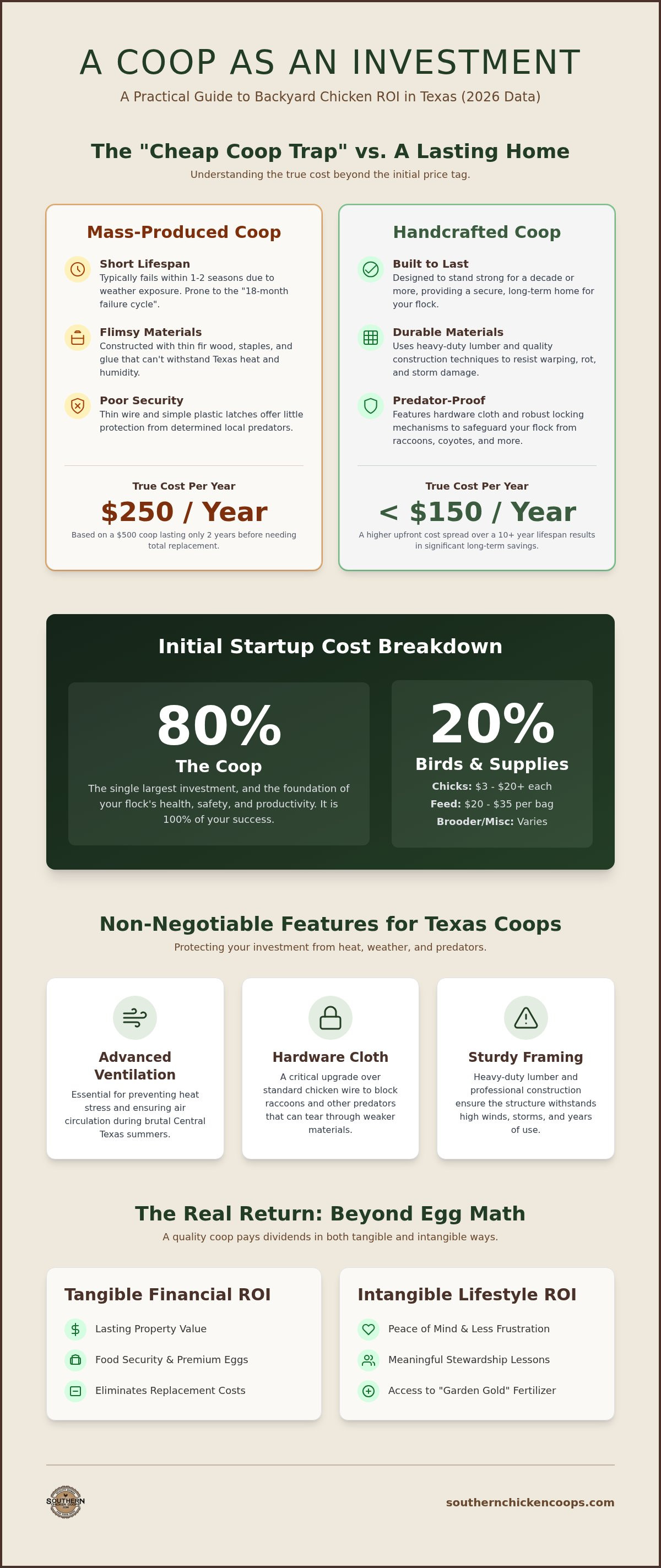
The real weight of your budget sits with the coop. It often accounts for about 80% of your initial startup capital. It's tempting to cut corners here, but your coop is 100% of your success. Without a sturdy home, your investment in birds and feed is at the mercy of the Texas weather. We build our signature 6x12 Polka model specifically because we know that a one-time investment in craftsmanship prevents the heartbreak of losing a flock to a flimsy structure that can't handle a summer storm.
The Egg Math: When Does it Actually Pay Off?
If you only calculate ROI by comparing the price of a carton of eggs to your feed bill, the "break-even" point might look miles away. But this math ignores the reality of modern poultry farming practices and the rising value of food security. When supply chains falter or inflation spikes, the value of those eggs in your backyard goes up instantly. Plus, you're getting organic, pasture-raised quality that would cost a premium at any local market.
Consider the "Cost Per Year" metric. A cheap, mass-produced coop might cost $500, but if it rots or warps in two years, you're spending $250 a year just for the roof over their heads. A handcrafted, durable structure might represent a higher upfront cost, but when it's still standing strong a decade later, your annual cost drops significantly. True return on investment for a Texas homestead is measured not by the first carton of eggs, but by the health and productivity of a flock housed in a structure built to last a decade or more. Choosing a quality chicken coop worth the investment means you're buying time and peace of mind, not just a wooden box.
The Hidden Cost of "Cheap": Why Mass-Produced Coops Fail in Texas
We've sat on many porches in Central Texas hearing the same story of the "Coop-in-a-Box" that looked great in the catalog but didn't survive its second summer. It's a frustrating cycle. You spend money on birds, feed, and a $400 retail coop, only to find the wood splitting and the door sagging before the hens even hit their peak laying years. This is the 18-month failure cycle we see far too often. It turns a hopeful homesteading dream into an expensive lesson in depreciation. When a structure falls apart that quickly, it's impossible to see a return on your money.
Then there's the predator tax. When a raccoon or coyote realizes that thin wire and plastic latches are all that stand between them and a meal, they won't hesitate. Losing a flock of six birds isn't just a loss of $60 to $120 in livestock; it's a loss of months of care and future egg production. To determine if a chicken coop worth the investment, you have to account for the cost of starting over every time a flimsy structure fails you. Professional craftsmanship acts as a hedge against these future repair bills and the heartbreak of a lost flock.
Mass-Produced vs. Handcrafted: A Durability Comparison
Most retail models use thin fir wood. It's light for shipping but terrible for longevity. In our McGregor workshop, we use heavy-duty lumber that's built for the long haul. We don't rely on staples or glue that melt in the heat. We use screws and solid framing to ensure the structure stays square year after year. If you're looking for a deeper dive into materials, our Handcrafted Chicken Coops: Central Texas Buying Guide 2026 covers why specific wood choices matter for our region.
Texas Weather: The Ultimate Investment Tester
Our climate is brutal. The cycle of high humidity followed by 100-degree heat causes inferior wood to warp and rot from the inside out. We've seen plastic roofs crack under the UV rays and thin metal panels turn coops into ovens. A McGregor-built coop uses roofing materials and ventilation designed for this specific environment. It's about building a home that protects your asset through every drought and thunderstorm. When you choose a structure that outlasts the birds, you're finally making a choice that secures your homestead's future. If you're ready to break the cycle of replacing cheap coops, we'd love to show you how our custom chicken coops are built to stand the test of time.
Beyond the Ledger: The Intangible ROI of a Quality Coop
We've spent time looking at the numbers and the durability of materials, but there is a side to homesteading that a spreadsheet just can't capture. It's the quiet satisfaction of stepping out onto your porch with a cup of coffee and watching your flock begin their day. This sense of stewardship and the rhythm it brings to a family is often what makes a chicken coop worth the investment in the first place. It's about more than just eggs; it's about the lifestyle you're building for your children and the health of the land you call home.
Many of our neighbors in McGregor and Waco find that their birds become an essential part of their garden's ecosystem. Instead of seeing chickens as a cost center, they start to see them as a tiny, feathered workforce. The mental health benefits are just as real. There is a reason folks call it "Chicken TV." Spending twenty minutes watching the social dynamics of a happy flock provides a level of relaxation and connection to nature that's hard to find anywhere else. It turns a backyard into a sanctuary.
Turning Waste into Wealth
One of the most immediate "hidden" returns on your investment is what we like to call Garden Gold. High-quality organic fertilizer can be expensive at the local nursery, but your chickens produce it every single day. By composting their manure and bedding, you're creating a nutrient-dense boost for your vegetables and flowers. You'll also notice a drop in your yard maintenance costs. Chickens are natural pest control experts, eagerly hunting down grasshoppers, ticks, and beetles that would otherwise require chemical treatments.
The physical design of your space matters for this process too. A 6x12 coop like the Polka model facilitates natural tilling for Texas soils as the birds scratch and turn the earth, effectively preparing your garden beds without the need for heavy machinery. This symbiotic relationship between your birds and your soil is a cornerstone of sustainable living.
Property Value and Aesthetic Harmony
We believe that a chicken coop should be an architectural asset, not something you try to hide behind the shed. A handcrafted structure with clean lines and quality finishes adds genuine curb appeal to your property. When it's built with the same care as a custom home, it signals to future buyers that the entire property has been well-maintained. We've seen that a permanent, high-quality outbuilding often stays with the home during a sale, adding more value than a temporary, rotting retail unit ever could.
Choosing a structure that complements your home's aesthetic is a key part of the long-term ROI. If you're curious about how our designs fit into a modern backyard, you can explore our guide on Custom Chicken Coops Texas: Handcrafted Housing. Investing in beauty and function ensures your homestead remains a place of pride for years to come.
Protecting Your Investment: Essential Features for Texas ROI
When we talk about whether a chicken coop worth the investment, we aren't just talking about the wood and the roof. We're talking about the lives of your birds. In Central Texas, the environment is your biggest competitor. If your coop can't handle a 105-degree August afternoon or a hungry raccoon, your investment disappears overnight. Protecting your capital means choosing features that address the specific risks of our region. We've spent years refining our designs in McGregor to ensure that every dollar you spend translates into a safe, productive environment for your flock.
Design choices like sizing also play a major role in your long-term returns. Overcrowding is a leading cause of stress, which leads to illness and a drop in egg production. Our signature 6x12 Polka footprint provides the necessary space to prevent these issues. When birds have room to move, they stay healthier. A healthy flock is a profitable flock. By investing in the right size from the start, you avoid the hidden costs of veterinary care or replacing birds lost to stress-related diseases.
The Ventilation Secret for Texas Summers
Heat stroke is the primary cause of flock loss in our state. Many mass-produced coops are designed for northern climates and lack the necessary airflow to keep hens cool. A "closed" or poorly ventilated coop becomes a dangerous oven in July and August. We focus on specific airflow patterns that prioritize cross-breezes at the roosting level. The Polka model optimizes this natural cooling, allowing your hens to continue laying even when the thermometer spikes. Proper ventilation ensures your hens aren't just surviving the summer; they're thriving through it.
Security: Keeping Your Capital Safe
Texas is home to some of the most determined predators in the country. Raccoons can open simple latches, and hawks are always watching from the treeline. We've seen many folks try to save money with standard chicken wire, but that's a mistake that often leads to a total loss of the flock. Chicken wire is designed to keep chickens in, not to keep predators out. It's easily torn by a coyote or squeezed through by a snake.
The only real standard for predator-proofing is heavy-duty hardware cloth. This mesh is strong enough to withstand teeth and claws, providing a true sanctuary for your birds. If you're looking for a structure that already includes these non-negotiable security features, you can explore our 6x12 Chicken Coop for Sale: Handcrafted Quality guide. We believe that peace of mind is a vital part of what makes a chicken coop worth the investment. To see how we build protection into every structure, we invite you to view our custom chicken coops and see the difference that master craftsmanship makes for your homestead's security.
Is a Southern Chicken Coop the Right Investment for You?
We've walked through the math, the materials, and the intangible joys of raising a flock. Now, the final question remains: is a custom structure the right path for your family? While some folks might suggest you spend your weekends struggling with a pile of lumber and a circular saw, we believe your time is better spent enjoying your land. Choosing a professional build means you skip the frustration of multiple lumber runs and the inevitable mistakes that come with DIY kits. We take that burden off your shoulders, delivering a finished home that's ready for your hens the moment it touches the ground.
Deciding that a chicken coop worth the investment is about more than just the wood; it's about the partnership you form with the people who build it. When you work with us, you're joining the Bird and Bee Farm family. We aren't just master artisans; we're your neighbors in McGregor who understand the specific challenges of our Texas climate. We're here to offer support and guidance long after the delivery truck leaves your driveway, ensuring your homesteading journey starts on a foundation of integrity and expert craftsmanship.
The Polka: A Signature McGregor Investment
Our signature 6x12 Polka model is our most recommended choice for a reason. Its walk-in design isn't just a luxury; it's a practical feature that makes daily chores a pleasure. When you can stand up straight to collect eggs or refresh the bedding, you're more likely to stay consistent with the care your flock needs. We also offer semi-custom options so the structure can fit your specific homestead goals perfectly. If you're ready to look at the specific figures for your project, our How Much Does a Custom Chicken Coop Cost in Texas? pricing guide provides a clear, honest breakdown of the numbers.
Professional Delivery to Your Texas Acreage
A building is only as good as the ground it sits on. To ensure your investment lasts for decades, we deliver our coops specifically to prepared lots. This ensures a level, rot-resistant foundation that keeps the structure square and the wood away from standing water. This methodical approach to delivery is how we guarantee that your chicken coop worth the investment over the long haul. There is a deep peace of mind that comes with a "move-in ready" home for your hens, knowing every screw was placed with care by someone who truly values the life of your birds. Explore our handcrafted coops and start your investment today.
Starting Your Journey with Confidence
Deciding to bring a flock home is a beautiful step toward a more grounded, sustainable lifestyle for your family. We've explored how a high-quality chicken coop worth the investment because it shields your birds from the elements and protects your peace of mind for decades. By prioritizing master craftsmanship over temporary retail solutions, you skip the cycle of rot and the heartbreak of predator loss that plagues so many beginners. True value isn't found in the lowest price tag, but in a structure that stands strong against the Texas sun year after year.
Every structure we build is handcrafted one at a time in McGregor, TX. We include predator-proof hardware cloth as a standard feature and use ventilation designs specifically engineered for Texas heat management. We believe that your birds deserve a home as sturdy and welcoming as your own. If you're ready to invest in a structure that reflects your values and protects your flock, we're here to guide you. View the Polka Model and Request a Delivery Quote today. We look forward to helping you build a legacy of stewardship on your own piece of Texas land.
Frequently Asked Questions
Is it cheaper to build a chicken coop or buy one in 2026?
Building a basic DIY coop can be cheaper in raw material costs, with basic builds starting around $250 for materials. However, when you factor in the value of your time and the durability of the lumber, buying a handcrafted build often makes a chicken coop worth the investment. Many retail models fail within 18 months, while a professional structure is built to serve your family for a decade or more.
How long does a high-quality handcrafted chicken coop last?
A handcrafted coop built with heavy-duty lumber and solid framing can easily last 10 to 15 years with minimal care. Unlike thin fir wood models that warp in the Texas humidity, our McGregor-built structures are designed as permanent property assets. This long lifespan significantly lowers your annual cost of ownership compared to replacing a cheap unit every few seasons.
Do backyard chickens really save you money on groceries?
Backyard chickens save you money primarily when you compare the quality of your home-raised eggs to premium organic store prices. While feed costs roughly $20 to $35 per 50-pound bag, the food security and the "garden gold" fertilizer you gain provide returns that go beyond the grocery receipt. It's about trading a recurring expense for a sustainable, high-quality resource for your kitchen.
Will a chicken coop increase my property value in Texas?
A handcrafted, architecturally sound coop can increase property value by serving as a permanent outbuilding rather than a temporary eyesore. In the Texas market, buyers often view a well-maintained homestead infrastructure as a desirable "move-in ready" feature. It signals that the property has been cared for with an eye toward quality and stewardship, making the entire chicken coop worth the investment during a sale.
What is the most important feature for a coop in the Texas heat?
Proper ventilation is the most critical feature for keeping your flock alive during a Central Texas summer. High-placed vents and windows that allow for cross-breezes at the roosting level are essential to prevent heat stroke. Without these specific airflow patterns, even the most expensive coop can become a dangerous environment when temperatures climb past 100 degrees.
How much maintenance does a Southern Chicken Coop require?
Our coops require very little maintenance because we use durable materials built to withstand the elements. You'll simply need to refresh bedding regularly and occasionally check the hardware cloth for any signs of predator tampering. Because we use screws and solid framing rather than staples, you won't spend your weekends fixing sagging doors or splitting wood.
Can I move my coop if I sell my house?
Yes, our coops are built with enough structural integrity to be moved if you decide to relocate. While they are heavy, permanent structures, they can be loaded onto a trailer for transport to your new acreage. This flexibility ensures that your investment stays with you even if your homesteading journey takes you to a different part of the state.
Is the 6x12 Polka model big enough for 12 chickens?
The 6x12 Polka model provides 72 square feet of space, which is ample for a flock of 12 chickens. We generally recommend at least 4 square feet per bird in the run to prevent stress and pecking issues. This footprint allows your hens to move freely and stay healthy, which is a key factor in keeping your egg production consistent year-round.


