

You have spent weeks raising your chicks from fuzzy yellow balls into the heart of your backyard, only to feel a sudden knot in your stomach when you hear a rustle in the brush after dark. We know that feeling well because we have lived it ourselves here in McGregor. The fear of a midnight visitor is often the heaviest burden a Texas chicken keeper carries, especially when you are trying to navigate the confusing world of DIY advice and fencing options. Effective chicken coop predator protection isn't just a list of features; it is a structural commitment to the safety of the animals under your care.
We believe that every flock deserves a home that is as beautiful as it is secure. In this guide, we will help you outsmart local wildlife and build a true fortress for your birds. You will learn how to identify specific threats in the Waco area, why certain materials like half-inch hardware cloth are worth the investment, and how to design a coop that gives you total peace of mind when you lock up for the night. Let's work together to ensure your homesteading journey starts with safety and ends with a thriving, protected flock.
Key Takeaways
- Identify the unique tactics used by Central Texas predators like raccoons and coyotes to ensure your defenses are tailored to local threats.
- Discover why 19-gauge hardware cloth is the essential standard for chicken coop predator protection, providing a level of safety that chicken wire simply cannot match.
- Master the L-shaped apron technique to prevent digging predators from entering the run without the need for deep trenching in our tough Texas soil.
- Implement the "Two-Step" rule for latches and doors to keep dexterous predators from reaching your flock at night.
- Learn how professional craftsmanship and heavy-duty materials create a structural fortress that outlasts the flimsy alternatives found in big-box stores.
Know Your Neighbors: Common Texas Predators and Their Tactics
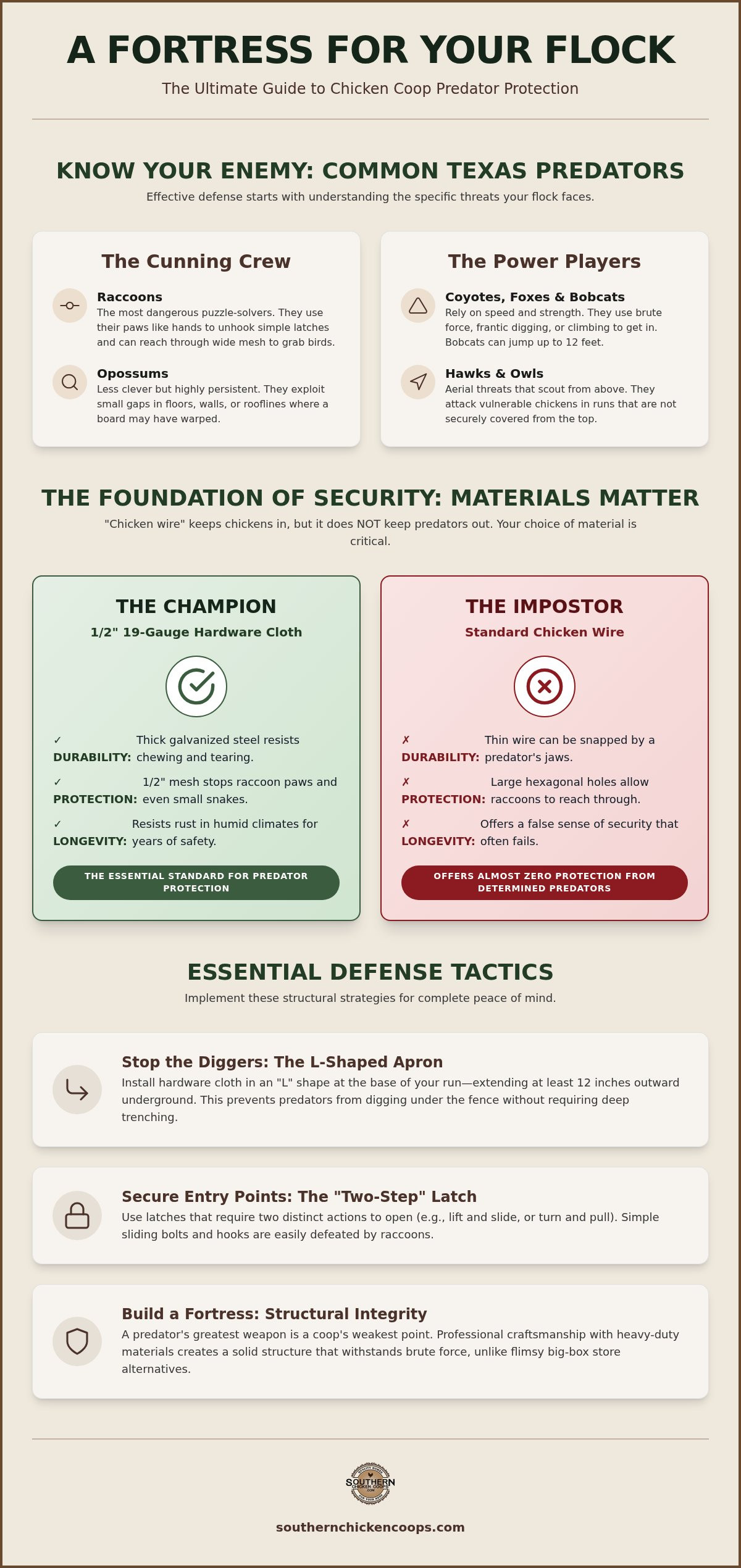
Living in Central Texas, specifically around McGregor and Waco, offers a beautiful landscape for homesteading, but it also means sharing the land with some very determined neighbors. These animals aren't trying to be villains; they are just looking for a meal. However, your flock depends on you to be their guardian. Effective chicken coop predator protection begins with understanding exactly who is watching your backyard from the tree line. Most common predators in our region fall into two categories: the clever opportunists and the high-power athletes.
Raccoons are arguably the most dangerous puzzle-solvers you will face. Unlike a dog that might just bark or dig, a raccoon uses its front paws like hands. They can feel around for weak spots, unhook simple latches, and even reach through flimsy wire to grab birds. They don't just want to get in; they want to solve the problem of your coop. Then you have the aerial threat. Hawks and owls scout from above during the day and at dusk, waiting for a moment when a hen wanders away from cover or a run is left open to the sky.
The Night Hunters: Raccoons and Opossums
Raccoons and opossums are the masters of the night shift. Raccoons are famous for manipulating simple sliding bolts, often surprising owners who thought a basic latch was enough. They have the patience to sit and fiddle with a door until it gives way. Opossums are less clever but just as persistent. They look for small gaps in the floor or along the roofline where a board might have warped. Because these animals are most active when you are tucked into bed, making a habit of a secure night-time lockup is the most critical routine for any Texas homesteader.
The Power Attack: Coyotes, Foxes, and Bobcats
While the smaller critters try to outsmart you, coyotes, foxes, and bobcats rely on speed and strength. Coyotes often travel in pairs or small groups and will use brute force or frantic digging to reach the flock. Bobcats are the master climbers of the Texas brush. They can clear a standard backyard fence with ease, and bobcats can jump up to 12 feet to reach a coop roof. Because we build our coops right here in McGregor, we understand these local pressures. We design our structures to withstand the weight and tenacity of these larger predators, ensuring that "Texas-sized" threats don't stand a chance against a well-crafted home.
Material Matters: Why Hardware Cloth is Your Best Friend
There is a common misconception that often leads to heartbreak for new homesteaders. The name "chicken wire" suggests it is the perfect defense for your flock, but in reality, it was only ever designed to keep chickens in a specific area. It is thin, flexible, and easily torn by a determined dog or a hungry coyote. For true chicken coop predator protection, you need a material that can stand up to the strength and teeth of Texas wildlife. This is where hardware cloth becomes the foundation of your coop's security.
When designing coops, we always insist on using 19-gauge galvanized steel. Hardware cloth is galvanized steel mesh with square openings. This material is rigid and incredibly difficult to cut without heavy-duty snips. We recommend the 1/2 inch mesh size as the absolute sweet spot. While 1/4 inch can sometimes clog with feathers or dust, and 1 inch allows a raccoon's arm to reach through, the 1/2 inch size keeps out everything from large bobcats down to small, sneaky snakes.
Hardware Cloth vs. Chicken Wire: A Quick Comparison
Investing in the right materials from day one saves you the emotional and financial cost of lost birds. While chicken wire is cheaper at the hardware store, it offers almost zero protection against a predator's power attack. Consider these differences:
- Durability: Chicken wire is made of thin wire that can be snapped by a predator's jaws. Hardware cloth uses thicker steel that resists chewing and tearing.
- Reach-Through Protection: The hexagonal holes in chicken wire are large enough for a raccoon to reach in. The 1/2 inch squares of hardware cloth prevent those dexterous paws from getting close.
- Longevity: Galvanized hardware cloth resists rust even in our humid Texas summers, ensuring your investment protects your birds for years.
Securing the Run and Windows
Protection doesn't stop at the coop walls. Every window, ventilation gap, and even the "roof" of your run must be covered with this heavy-duty mesh. We have seen many projects fail because the wire was simply stapled to the outside of the wood. A strong predator can eventually pull those staples out. In our McGregor workshop, we prefer "sandwiching" the wire between two pieces of solid lumber. This creates a mechanical bond that no animal can pull apart. If you are looking for a structure built with this level of care, you might find that our custom chicken coops provide the peace of mind you need to sleep soundly at night.
Stopping the Diggers: Underground Fencing and Aprons
Even if your coop walls are built like a vault, your flock isn't truly safe until you address the ground beneath their feet. Many predators, like coyotes and stray dogs, won't try to climb or chew through your hardware cloth. Instead, they will use their paws to excavate a tunnel directly under the bottom rail. This is why underground chicken coop predator protection is a non-negotiable part of a secure homestead. Identifying predators and their specific digging habits helps you realize that they almost always start their work right at the base of the fence. If they hit an immediate obstacle, they rarely have the foresight to back up and try again from a distance.
We often recommend the "L-shaped apron" as the smartest solution for our local environment. Instead of digging a deep, back-breaking trench, you lay a skirt of hardware cloth flat on the ground. This wire should extend at least 12 to 24 inches out from the perimeter of the coop and run. When a predator approaches the fence and starts to dig, they immediately hit the metal mesh. Their instinct tells them to dig harder in that exact spot, and they eventually give up in frustration. It is a simple, elegant way to use a predator's own behavior against them.
The Perimeter Apron Method
To install an apron correctly, you must fasten the hardware cloth directly to the coop's base frame. We prefer using heavy-duty galvanized staples or sandwiching the wire under a pressure-treated trim board for maximum strength. Once the wire is flat on the ground, you don't have to leave it looking like a construction site. You can easily cover the apron with a layer of mulch, decorative gravel, or even fresh sod. Over time, the grass roots will grow through the mesh, anchoring it even more firmly to the earth while keeping your backyard looking beautiful and well-maintained.
Trenching in Central Texas Soil
In many parts of the country, experts suggest burying your fencing 12 inches deep. However, anyone who has tried to sink a shovel into the rocky clay around McGregor or Waco knows that is easier said than done. Our "black land" clay turns into concrete in the summer and a sticky mess in the winter. This is exactly why the horizontal apron is our preferred method for chicken coop predator protection. It provides the same level of security without the need for a pickaxe. If you do choose a vertical burial, ensure the wire is integrated seamlessly with the overall coop structure so there are no gaps where the wall meets the ground. Finally, reinforcing the perimeter with heavy pavers or large stones adds an extra layer of weight that discourages even the most persistent diggers.
Securing Entry Points: Latches, Windows, and Doors
Managing the brutal Texas heat is a full-time job for any chicken keeper, but we can't sacrifice security for a breeze. In the Waco area, we deal with everything from clever raccoons to sneaky rat snakes. These creatures are masters of finding the one weak spot you overlooked. While we have already discussed the importance of heavy-duty wire, that protection fails if your latches and doors aren't up to the task. True chicken coop predator protection requires a "lockdown" mindset every single evening.
Raccoons are the primary reason we talk about the "Two-Step" rule. These animals have nimble paws that function much like human hands. If a latch only requires one motion, like sliding a simple bolt, a raccoon can eventually fiddle with it until it slides open. A two-step latch requires two distinct actions, such as pushing a spring-loaded pin while simultaneously sliding a bolt. This level of complexity is usually enough to frustrate even the most persistent raccoon. Automatic doors can also add a layer of safety by ensuring your birds are tucked away exactly at dusk, even if you are stuck in traffic or busy with other chores.
Choosing the Right Latches
When selecting hardware, we always steer our neighbors away from plastic components. The intense Texas sun makes plastic brittle over time, leading to snaps just when you need them to hold. Instead, look for heavy-duty galvanized or stainless steel. We often suggest adding a spring-loaded carabiner or even a small padlock to your main doors as a secondary defense. It is also vital to check the "give" in your door. If you can pull on the corner of a locked door and create a gap, a coyote can likely pry it open with its snout. A lock is only as strong as the wood it is screwed into. Flimsy frames can't hold a latch under pressure, which is why we focus on solid lumber and expert joinery in every build.
Windows and Ventilation Gaps
Ventilation is life for a chicken in a Texas summer, but every air hole is a potential entryway. You must cover every window and soffit gap with the same hardware cloth used on the run. This prevents predators from dropping in from the roofline or squeezing through the eaves. To keep out snakes and small rodents, we recommend that no gap larger than a quarter should exist in the coop. If you want a home for your birds that balances breezy ventilation with unyielding safety, our custom chicken coops are built to handle the unique challenges of the Texas climate while keeping your flock secure.
Why Structural Integrity is the Ultimate Predator Defense
Many folks start their journey with those "easy assembly" kits found at big-box stores. While they look cute in a catalog, they are often made of thin, lightweight wood and held together with flimsy staples. A determined coyote or even a large neighborhood dog can make quick work of these structures. You can add all the hardware cloth in the world, but if the frame itself is weak, the whole system fails. Real chicken coop predator protection starts with a frame that is built to last, not just shipped in a flat box. You shouldn't have to spend your weekends "fixing" a brand-new coop just to make it safe.
Handcrafted in McGregor vs. Mass-Produced
We build our coops one at a time in our McGregor workshop. Because we live here, we know the Texas wind and the tenacity of our local wildlife. We use heavy lumber and expert joinery techniques that ensure the structure remains rigid for years. The sheer weight of a quality coop is a deterrent in itself. A mass-produced kit might weigh very little, making it easy for a large predator to shift or tip it to find a gap. Our coops are substantial, anchoring your flock's safety to the ground. For Bill and Tina, this isn't just a business; it is a calling rooted in the stewardship of your animals.
- Texas-Sized Durability: We use materials that won't warp or crack under the intense summer sun.
- Solid Foundation: Heavy-duty frames prevent predators from lifting or moving the structure.
- Expert Joinery: Precise construction means there are no accidental gaps for predators to exploit.
The Polka: A 6x12 Fortress for Your Hens
Our signature Polka model is a 6x12 masterpiece of durability. We designed it to be the ultimate foundation for your backyard homestead, balancing a beautiful aesthetic with unyielding security. Every corner, door, and ventilation point is engineered to keep predators out while keeping your hens comfortable in the heat. When you choose a coop like this, you aren't just buying a product; you are investing in peace of mind. See how the Polka protects your flock by exploring the specific details of its handcrafted construction.
To get the most out of your new fortress, preparing your lot is essential. We focus on local delivery to prepared lots because a level coop is a secure coop. If the ground is uneven, it can create small gaps at the base where a snake or rodent might slip through. By ensuring your site is ready before our delivery truck arrives, you maximize the effectiveness of the structure's built-in defenses. We take great pride in helping you set up a home that looks beautiful and keeps your birds safe from day one. It is our way of serving the community and honoring the lifestyle we all love.
Secure Your Texas Flock for Generations
Your journey as a chicken keeper should be filled with the joy of fresh eggs and the quiet company of your birds, not the constant worry of what might happen after the sun goes down. By understanding the tactics of local bobcats and raccoons, and by investing in high-quality materials like 19-gauge hardware cloth, you are doing more than just building a fence. You are practicing true stewardship. Effective chicken coop predator protection is a combination of smart habits, like the "two-step" latch rule, and a structure that won't give way when the weather or the wildlife gets tough.
We take great pride in our work because we know exactly what is at stake for your family. As local farmers who are family-owned and operated right here in McGregor, we build every coop to handle the unique heat and environmental challenges of our home state. We want to help you create a safe haven that stands the test of time. You can request a quote for a handcrafted, predator-proof coop today and take the first step toward total peace of mind. We look forward to helping you protect your flock and celebrate the beauty of the homestead lifestyle.
Frequently Asked Questions
Is chicken wire really useless against predators?
Chicken wire is not a reliable defense against hungry predators. Its primary purpose is to keep chickens inside a specific area, but the thin wire is easily torn by a determined dog or coyote. Raccoons can also reach through the large hexagonal holes to grab birds. For real safety, you should always use 19-gauge hardware cloth, which provides the strength needed to resist teeth and claws.
How deep do I need to bury wire to stop a coyote?
A depth of 12 inches is the traditional recommendation, but our rocky Texas soil often makes trenching nearly impossible. Instead of fighting the clay around McGregor, we suggest a horizontal apron that extends 12 to 24 inches out from the base of the coop. This stops coyotes from digging right at the fence line. It is a much more practical solution for our local environment and just as effective at stopping intruders.
What is the best latch to keep raccoons out of my chicken coop?
The best latch is one that requires two distinct motions to open, often called the "two-step" rule. Raccoons are clever enough to slide a simple bolt, but they struggle with spring-loaded carabiners or latches that require a thumb-press. Using a secondary defense like a padlock ensures your chicken coop predator protection remains intact even when a "masked bandit" spends all night trying to solve the puzzle of your door.
Can snakes get into a chicken coop through hardware cloth?
Snakes cannot pass through 1/2 inch hardware cloth, which is why we use it on all our windows and ventilation points. Most adult rat snakes found in Central Texas are far too large for these small square openings. However, you must be diligent about checking for other entry points. If a gap is large enough for a quarter to pass through, a small snake or a rodent can likely squeeze inside.
Do motion-sensor lights actually scare away predators?
Motion-sensor lights offer a temporary deterrent, but they aren't a foolproof solution on their own. Clever predators like foxes and raccoons eventually habituate to the light once they realize it doesn't pose a physical threat. Think of these lights as a secondary warning system for you rather than a primary shield for your birds. Your coop's physical structure and heavy-duty materials remain the most important lines of defense.
Should I have a floor in my chicken coop for predator protection?
Having a solid floor is one of the best ways to ensure complete chicken coop predator protection. A solid wood floor or a heavy wire lining prevents predators from tunneling up into the coop while your birds are sleeping on their roosts. It also makes your daily cleaning routine much simpler, which helps maintain a healthy environment for your flock throughout the changing Texas seasons.
How do I protect my chickens from hawks in an open run?
Overhead protection is the only certain way to stop a hawk or owl from diving into your run. We suggest covering the entire top of your run with hardware cloth or heavy-duty poultry netting. Providing "hidey holes," such as small huts or dense bushes inside the run, also gives your hens a place to quickly duck and cover when they spot a predatory shadow passing overhead.
What should I do if a predator has already attacked my flock?
If an attack happens, your first priority is to move the survivors to a secure, temporary location. You must then identify the exact entry point the predator used and reinforce it with stronger materials immediately. Predators are creatures of habit and will almost certainly return to a successful hunting ground the very next night. Take a deep breath, secure the perimeter, and focus on rebuilding your flock's home into a true fortress.


